I am Christopher Michael Blake, the great grandson of Herbert George Stolworthy, who for many years lived and worked in the railway village. His daughter, Dora Alice Stolworthy, was my paternal grandmother and I was very close to her. She was much loved by all who knew her.
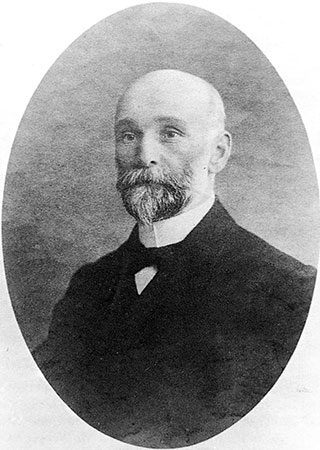
I was very pleased to see the website contains several mentions of the Stolworthy family and two wonderful photographs, namely: one studio photograph of Herbert George Stolworthy in late middle age (I have the original photo), probably taken about 1918 and also one of the wedding reception at 1 Grove Road in 1908 for the marriage of Constance Amelia Stolworthy to Stanley Webber. My cousin (a granddaughter of the married couple) has the original photo. My grandmother could name all the people in the photograph but unfortunately I can’t, although I can name quite a few. Please let me know if you would like me to provide names. The wedding party sub-divides into several groups: the married couple and their closest relations in MC & Briston, then close relatives from Great Yarmouth, a possible railway colleague from MC who was married into the Webber family and two local clergymen. The Stolworthys were regular churchgoers.
Herbert George Stolworthy died on 25 March 1919. My grandmother, Dora Alice Stolworthy, nursed him during his final illness. She told me he was showing signs of recovering from the Spanish flu and she went to Norwich for the day but on her return to MC she was met by her sisters, Muriel and Winifred, at Melton station who informed her that Herbert George had died. She was so upset that she could not attend the funeral at St Peter’s, Melton park. You might find it helpful to know that the Stolworthys always attended St Peter’s church where Herbert George was a member of the choir for over 30 years and my grandmother, Dora Alice Stolworthy, sometimes played the church organ. She would recall seeing the Astley, Lord Hastings, family in their private pew. Herbert George is buried in St Peter’s churchyard. His gravestone takes the form of very large concrete slab, lying flat, which I suspect was provided by the M&GN. Herbert George was closely involved in the experimentation and production of the M&GN concrete products, working closely with Mr. Marriott. He also worked on the railway viaduct over Breydon water. He was also much engaged in the works and signalling installations at MC and elsewhere on the rail network. On his working trips to inspect the railway infrastructure he would sometimes take his younger children with him. The MC website mentions a number of addresses where the Stolworthys lived. They started at 17 Melton St, probably in 1885, following the family move from Great Yarmouth, then to 10 Station Road in the 1901 Census, then 1 Grove Road, however, there was another address, which the MC website mentions as 50 Briston Road! Some time ago I realised that part of MC village is actually in the parish of Briston. If you come out of Grove Road and turn right onto what is now the Fakenham Road and continue onwards you pass the local store on the left and then the sign for Briston as you cross the parish border and then going forwards a little way there are on the left three cottage-like terraced houses with bay windows . The Valuation Office survey of 1912, undertaken to value land & property for the purpose of assessing Estate duty, confirms that Herbert George Stolworthy owned the middle house. It was a private house, not owned by the railway and was valued at £265 in 1912. This house is now numbered as 154 Fakenham Road and I believe it is there that Herbert George died in 1919. Further proof of Stolworthy residence there is provided by the fan light window above the front door having the etching ‘Stanley House’. I believe this is a reference to Herbert Georges’s youngest son, Stanley Arthur Stolworthy, my great uncle. I see that the MC website mentions a residence named ‘Bereba’. My father told me that when his uncle Percy Stolworthy returned from Australia the Stolworthys named their house after where Percy had lived in Australia. That must be ‘Bereba’ but I do not know which property it was! The MC website is correct in stating that Herbert George Stolworthy’s younger brother, John Arthur Stolworthy, born 1865 in Great Yarmouth, also worked on the railway. I can add that he started at MC as he is mentioned there in 1885 in a newspaper article but eventually settled at Sutton Bridge where he became the clerk to the railway works and lived in the Old Station House. He died in Sutton Bridge in 1947.
My grandmother, Dora Alice Stolworthy, was a nurse at Kelling Heath children's sanatorium, near Holt, in the years before World War One. She used to cycle or take the train to Holt. In 1916 she transferred to the military hospital in Thorpe St Andrew on the eastern outskirts of Norwich. It was here that she met her future husband, my grandfather, Reginald William Blake, who was being treated for his war wounds. My grandmother always said that MC was very quiet for her and she yearned for a more lively environment. This is why she liked going to Great Yarmouth for the bright lights. The reason that she is not included in the 1901 Census as living at 10 Station Road, MC, with her family is that she was staying with her maternal grandmother in Great Yarmouth and acting as a sort of young companion. My grandmother’s convivial personality meant she was ideal for such a role. She had very many relatives in Great Yarmouth, on both sides of her parents.
The M&GN website shows annual lists of male heads of households living in Melton Street for the purposes of elections.
The Stolworthys lived at 17 Melton Street for about 15 years and Herbert George Stolworthy was the head of household during these years.
You might find it useful to have some background on the wider Stolworthy family. Herbert George Stolworthy and his wife Amelia (née Fish) both came from longstanding Great Yarmouth families. Amelia’s were fish merchants during the town’s herring boom. Herbert George came from a family which had been the leading millwrights in the town for several generations in the 18th & 19th century. They built and maintained mills both in the town and in the hinterland and also undertook a variety of other construction work, such as hanging church bells and work on the Nelson monument in Great Yarmouth. The most famous windmill they built was the Berney Arms Mill standing by the river Yare where it enters Breydon Water. This was constructed in 1865 by Edmund Stolworthy, who was a first cousin of George Stolworthy, Herbert George’s father. George Stolworthy, was for many years the millwright at Lacon’s Brewery in Great Yarmouth. During my own research on the Stolworthys I have noticed they had links to the Lacon family over several generation. I believe the Lacon family were great patrons of Norfolk railways. However, by the time Herbert George Stolworthy came to working age windmills were fast becoming a thing of the past and members of the family had to find other employment and that is probably what brought Herbert George to MC. Following his death in March 1919 Herbert George Stolworthy’s Obituary appeared in the Yarmouth Independent providing a short resume of his life and listing the many colleagues and representatives of the M&GN which attended his funeral at St Peter’s, Melton Park. I have a photo of the Obituary and I also have a short letter written by William Marriott providing a reference for Herbert George Stolworthy’s eldest son, Herbert Fish Stolworthy. The two eldest children were baptised in Great Yarmouth while the younger five children were all christened in St Peter’s, Melton Park, including my grandmother, Dora Alice Stolworthy, on 7 September 1890.
Following the death of Herbert George Stolworthy in March 1919 there was no reason for most of Stolworthys to stay in MC and they departed later in 1919, going mainly at first to Wandsworth in London. The exceptions were Constance Amelia who lived in Briston with her husband, Stanley Webber, and their growing family and also, initially, her brother Percival George Stolworthy, who married Alice Sadler, a farmer’s daughter from Briston, in which village they lived for a while in a property called Dial Cottage. Stanley Arthur Stolworthy joined the Palestine Police force. Herbert Fish Stolworthy continued working on railways and in about 1922 he was in West Africa installing railway infrastructure when he contracted malaria which resulted in his left arm being permanently paralysed. This did not stop him raising a family and he went to live in Caister-on-Sea where he died in 1941.
Herbert George Stolworthy was only 59 when he died of Spanish Flu in March 1919. This prevented his planned retirement to Sheringham where he had, several years earlier, purchased a largish house in Alexandra Road not far from the railway station. Several years ago I was standing in Alexandra Road looking at the houses and chatting with a resident. I said the houses had the look of houses I had seen in MC and he replied that the houses were built with the express purpose of being sold to M&GN employees as retirement homes.
Very many years ago my father asked my grandfather what Herbert George Stolworthy was like. He replied succinctly, ‘A dear old gentleman’.
Chris Blake - 10th April 2026 |