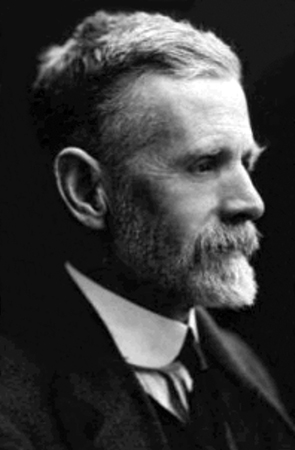
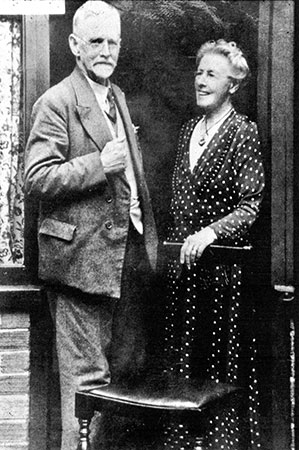
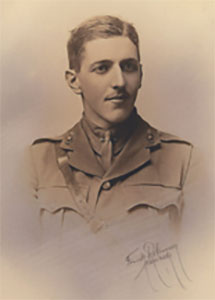
William Marriott was born in 1857, the son of the Professor of English at Basle University and his German-Swiss wife. He was orphaned at the age of 11 and only then came to live in England, with an aunt, at Bideford. At that time, he could speak German, French and Italian, from living in Switzerland. His aunt got him into an apprenticeship at Ransomes & Rapier in Ipswich and he worked for them as a draughtsman for a short time after his time was out, In 1881 he was offered a six weeks job by Mr Jarvis, of Wilkinson & Jarvis, on a railway his company were building from Yarmouth to North Walsham. Wilkinson & Jarvis were also constructing and had constructed the Lynn & Fakenham Railway. All the lines built by W&I were built as cheaply as possibles, (William Marriott)
Wilkinson was the son of a very famous physician, Dr. Garth Wilkinson, who was a ‘Swedenborgian' in religion, William Marriott, in his book, '40 years on a Norfolk Railway' wrote that Mr. Wilkinson, son of the doctor, ‘was possessed of superabundant energy and had an absolute belief in his schemes. He had tremendous driving power.’ Mr. Jarvis was the partner with practical civil engineering experience . He was a Devon man, who had served his time on the South Devon Railway and then in India and the Argentine. Jarvis, according to Mr. Marriott, was ‘a charming gentlemen' and in 1879 he and Wilkinson were occupied in getting the Act of Parliament to close the gap between North Walsham to Melton and from Fakenham to Norwich.
Mr. Marriott was also a man of strict religion - a member of the 'Plymouth Brethren', They were a ‘Low Church', Nonconformist group that emphasised biblical prophecy and the Second Coming of Christ. Mr. Marriott had strong religious and philosophical ideas he also knew, from events in established towns elsewhere, that drunkenness led to all sort of disarray and misery. He was concerned that as hundreds of men, women and families came to work at Melton they should come to an orderly, peaceful place and have a happy life thereby. Mr. Marriott was aware of the need for Leadership. He was therefore an advocate of teetotalism. The oldest residents I met said that the very first thing Mr. Marriott did at Melton, even before he began building the station and factory, was to buy two old cottages and convert them into a place of worship. To inculcate a sense of personal discipline he introduced, not Baden Powell's Boy Scouts but when the Railway Institute was built by the Midland and the Great Northern Railway companies, the building became the meeting place for the Church Lads Brigade and was the Drill Hall - there was a large sign over the door proclaiming its purpose. Today this building stands on a bank, on the west side of the main road, a few yards beyond Burgh Beck Road.
Marriott was said, by elderly locals to me in 1983, to be a member of the Plymouth Brethren'' religious sect. They held their meetings in a house in the 'private' estate called ‘Avondale', adjacent to Burgh Beck Road and opposite Grove Road in the railway estate. The front and back room of this house was knocked into one. The Brethren's religious beliefs were so extreme that it is hard to believe Mr. Marriott held to them. The sect believed in the literal truth of the Bible: believing that the world was created by God exactly 4004 years before the birth of Christ and that creation took 7 days.
Marriott's strongest certain beliefs were that no-one should consume any alcohol, that everyone ought to go to church or chapel on Sundays and his admiration for the existing class structure. ln his memoirs '40 Years on a Norfolk Railway' one can read his rather grovelling attitude towards people with titles - Mr. Upcher, of Sheringham Park was ‘A Patriarch amongst his People'. Mr. Marriott
saw his role as 'Patriarch’ of Melton Constable. He certainly gave Leadership to the people of Melton Constable to create a stable society. He established the childrens' Sunday School at Melton and also a ‘Young Mens' Bible Class' which he taught himself. Every year the children of the Sunday School went to Marriot's house, Brinton Grange, for their treats. Their mothers came out from Melton to make the sandwiches and Marriott supervised them to ensure the butter was spread thick. Marriott was supremely keen on Sunday worship basing his enthusiasm on the Second Commandment of God in the Bible: 'to keep holy the Sabbath Day and do no work' Marriott did not allow this ‘Commandment of God' to stand in the way of running trains on Sundays until the start of 1912. On 16th December 1911 the National Insurance Act became law - to protect working people against loss of income related to sickness or unemployment' The Act required employees to contribute four pence a week from their wages and employers 3d per worker in their employ. In the New Year, Mr. Marriott stopped running trains on Sundays except for excursions coming in from outside the M&GN. Sundays were then a wageless day for a lot of railwaymen.
Whilst it was the certainly case that many men and women, approved of Marriot's ideas, many others did not. The man who introduced me to Melton and M&GN history, Pearcy Youngman, was a 3rd generation M&GN employee, starting his service in 1923. Percy had a cynical attitude towards Mr. Marriot. 'He was an old busybody', Percy reckoned. If anyone working on the railway at Melton was seen - or reported on by one of his bible punchers - going into or coming out of the Hastings Arms, that individual was summoned to Marriott's office next day for a telling-off. I was a guard on the trains for years and I know there was a tot of hypocrisy going on - his bible punchers did their drinking in Yarmouth or Lynn'. There's nothing in the Ten Commandments against drinking beer.’ Later on, after hearing that from Percy, I was Visiting Bertie Willard, retired signal & telegraph maintenance man for Belton to Norwich and Cromer lines. Mrs. Willard was there too. l told them what Percy had said and Mrs. Willard snapped, ‘Youngman would say that!’
When my mother got into complications when she was in labour with me, Mr. Marriott saved both our lives, The mid-wife attending to mother said that Mother was in difficulties and should be attended by experts at the Norfolk & Norwich hospital. Mother's eldest daughter was told to run fast to Mr. Marriott to tell him that Mother was in trouble and needed to be admitted to the N&N, Meanwhile, they had to scrape around to find something to carry mother to the station - and the only way onto the platform was down that staircase. Anyhow, when they got her onto the platform there was an engine and one coach waiting. Mr. Marriott had wired all the signalmen down to City station and told them to put all trains out of the way and give mum's train a clear, express, run to Norwich.
When the village was new and entirely lacking in a social life, Mr. Marriot took the lead and obtained the wooden shed, which had been Holt station, and Yarmouth station before that, and set it up as hall with a library and for simple entertainments which the railwaymen and their families put on for themselves. In his memoirs Marriott states that there was ‘an art class for the lads’. In Marriotts account of life in Melton there is no mention of him doing anything for girls, he was far too conservative for that. He was able to establish a School of Art at Melton thanks to the Norfolk County Council Education Committee person, Mr. Barwell, bending the rules a bit on the matter of unqualified teachers. These classes were still running in the 1920’s. Marriott does not say the classes were open to women and I have never heard of a female attending them - although they might have.
Females were however useful and admirable as preachers. Mr. Marriot believed that, ‘Education without religion makes men clever devils' that is to say, not subservient and he brought in Miss Hammond of Fakenham, whom he described as ‘one of a band of noble women for whom Norfolk is famous' to help keep a proper sense of order in the village. There was never a shortage of Godly people willing to come to Melton and preach the status quo at the workers. Mr. Charlton, Vicar of Snettisham, inaugurated Melton Sunday school indoctrination for the children. The Sunday Schools were taught by Mr. Fisher, and Mr. George Clarke. The latter was M&GN salaried staff, the former was a magistrate living in Melton. This is probably the same Mr. Fisher who ran Melton chemists shop and was known as ‘Chemical Jo’. It was said that, whatever your ailment, Chemical Jo, would concoct a remedy out of the contents of all his bottles which would cure you. Mr. Fisher's magisterial photograph appeared in the Eastern Daily Press in September 1919. ‘Chemical Jo' had a scowling face as long and grim as a tombstone, enough to make any poor poacher quake in his boots. Through the years, it was the higher management of Melton Works who taught the children of the workers' what to believe. Most prominent for a lifetime of such dedication was one of Mr. Marriot's Chief Clerks, Arthur Newman.
There could hardly have been a committee concerned with life in Melton Constable on which Newman did not sit. Besides him there was Mr. Wilkes, a parson, Mr. George Mumford, Mr. Tench, and Mr. Clarke ‘the police court missionary’, who regularly came to Melton, along with those ‘well known non-conformists’, Dr. John Roche, Messrs Vince, Palmer, Moulton, Frank Adies, while the Evangelisation Society and the Railway Mission sent its helpers from Norwich and London. Even Divinity students were invited to practice their lecturing on the railway workers of Melton. The result of all this work was, according to the very self-satisfied report of Mr. Marriot, that ‘the Gospel of Christ showed its power and changed the lives of men.’ How Marriot knew this, is not explained but powerful egos enjoy making gentler people feel guilty and thus subservient by claiming that ‘God’ is on their side.
The E&MR had 'no money' so Mr. Marriott persuaded a contractor to put up Melton Street in return for the rents. Later the company bought them back, The financial state of the E&MR grew worse and frequently the men were unable to take home wages to their families.
The men put up with this because they were loyal: their lives had been changed by the Gospel of Christ and they were ready to put up with all troubles meekly. The village shops would give credit and they did not want to lose their fine houses and the chance of better times. It is very important to know that Melton Constable's railway workers' houses were the most modern in Norfolk, warm, dry, and clean. They did in 1900, and for over fifty years after stand out like a light house in a storm from the surrounding villages where working people lived in vile conditions: mud floors, damp walls, insanitary and overcrowded. This is not an exaggeration. The Eastern Daily Press for 15 August 1912, page 6, reported a lecture and lantern slide show in St. Andrew’s Hall, Norwich, on the subject of rural housing in Norfolk. It was stated by the lecturer, supported by photographs, that in Erpingham RDC area, headquarters in Sheringham, there were ‘cottages with mud floors, wet walls and walls cracked open so that daylight shows through and planks have to be nailed over to keep the worst of the draught out.’ The Rector of Edgefield said that in the 50 years he had been there, 35 houses had disappeared ‘they have simply ceased to exist' but the population of Edgefield was the same as 50 years before. The condition of houses in the next RDC westwards, Walsingham, was no different: no sanitation, no running water, leaking roofs.
Mr. Marriott caused the building of the village school which faced Colville Road and the Railway Institute and the recreational facilities, bordering on Grove Road: tennis courts, bowling green and ornamental gardens and glass houses.
Marriott was a total abstainer from alcohol. He very much discouraged the consumption of beer by his men and any railway worker seen coming out of the Hastings would be ‘on the carpet’ for a dressing down by Marriott the following day. A man who experienced it, told me that 'You did not let Marriott see you coming out of the Hastings'. A career was best advanced by being good at your job and being a total abstainer and a regular attender church or chapel, Marriott's obsession undoubtedly ‘led to a lot of hypocrisy in Melton because Marriott's ‘bible punchers’ did their drinking in Yarmouth and King's Lynn',
The Hastings Arms must have been a thorn in Marriott's flesh, Lord Hastings had it built, right by the station, as a hotel for commercial and other travellers. Marriott had a Temperance establishment - selling tea and coffee - within the Railway Institute, close to the Hastings.
The publican of the Hasting's Arms from 1896 to 1916 was Thomas Chesney. In 1916, Lord Hastings dismissed him and he went with his wife Annie and their children to a house on Gordon Road. He was very depressed and became ill. His wife Annie, did her best to keep the family together and in August 1919 she found a pub looking for a publican in Cambridge. Her husband would not go with her to look at it so she went alone on the 13th. On the morning of 14th Thomas Chesney's daughter was unable to rouse her father by knocking on his bedroom door and found the door locked. She went next door for help. The room was broken into and Thomas was found on the floor. He had cut his throat with an open razor.
The Railway Institute was built for further education, in particular of the apprentices but non-railway people could attend lessons for 6d per lesson. Arthur Newman ran the committee that administered the Institute and thus he was responsible for facilitating the many social functions which took place there - dances, plays, musical concerts, whist drives and chess tournaments. The Institute also had a bath-house, a wooden anneal, men and women in separate parts, of course, for 2d each. Bath time was Friday afternoons. There was a Labour Exchange in Melton in the early years of the 1911 National Insurance Act. No-one now remembers it but it was definitely there. Its Manager was Arthur Newman and his daughter (or wife) Margaret was his clerk, A nice little earner, along with his job as Registrar of Births, Marriages and Deaths. It seems very likely, given Newman's involvement, that this Labour Exchange was a one day a week affair and it was probably set up in a room, within the Railway Institute.
During September 1919 one Robert Digby was coming to the Labour Exchange each week, signing on as unemployed and getting his dole - 7/-. Newman found out that Digby was employed by Lord Hastings as a farm labourer and Digby was hauled up before Holt magistrates. Digby said His Lordship did not pay much in wages and he thought it would be all right to supplement what he earned by drawing the Dole, The Magistrate, Major-General Sir John Ramsey - who was not
short of the odd seven shillings - sentenced the wretched Digby to one month hard labour. During the Second World War the Institute was again used as a government office when it houses a medical care clinic for the children of the district and anti-polio and other innoculations were given within its walls by the District nurse.
An especial favourite of Marriott's was the ‘Church Boy's Brigade’, This was a uniformed, marching club for boys with a silver band and a bugle band. It was very Low Church protestant, militaristic and even jingo-istic - under the disguise of ‘the Church Militant'. lt seems likely that membership of and training in this uniformed, marching, camping organisation encouraged its members to volunteer for war when the occasion arose. Marriott encouraged all the railway boy workers and his apprentices to join the ‘Boys' Brigade’ and mourned for them when they were killed. The Boys' Brigade and the Sunday School at the Railway Mission lasted at least until 1957.
At the end of their apprenticeship each young man went for an interview with patriot and the final part of this meeting was for Marriot to give the young man a bible. One young man was presented with Marriott's personal Bible because Marriott had run out of ‘issue’ bibles, This bible is now with Sybil Kirk at 26 Kitchener Road, Melton.
Mr. Marriott detested trade unions because he was the absolute ruler of his railway - and because trade unions, in the opinion of a ‘Godly’ person such as himself, were engaged in attempting to subvert the Laws of Economics which are the Laws of Nature - and therefore the Laws of God. This was a commonly held view at the time, when God is on your side, it clearly follows that anyone who disagrees with you is ‘un-Godly’ and not to be trusted.
A man who was a Melton Works apprentice in 1915, tells the story on the ‘M&GN’ video, of how he wanted to volunteer for the armed forces. For this he properly needed Marriott to release him from his agreement. Several apprentices had been given permission but he was becoming worried about losing too many workers to the war. This young man knocked on Marriotts door, Marriott told him to come in and as soon as he saw the young man standing there on the mat, he called out to him. ‘I know what you've come for! Go away, go back to your work, l won't let you go.’ So the young man went to Norwich and volunteered anyhow, When the war was over he returned to his place at Melton works. Marriott told him that, because of the law on such matters, he would have to let him in and pay him for the statutory year but at the end of that time he would be sacked. And he was, disobeying William Marriott was more important to Marriott than the fact that the young man had served his country. |
On a Sunday morning a hundred children walked through the streets to the Railway Institute Sunday School, starting at 10 am. At 11 a couple of hundred adults walked to the Institute to join the children for the Anglican church service and as many again went to the Railway Mission and other chapels. In the afternoon the children walked again through the streets for Sunday school. But no shop opened and no trader's cart passed through, There would have been a blanketing, gentle, silence. This would have been broken - or accentuated - by the noise of an excursion train up at the junction, but, from March 1912 there were no scheduled Sunday trains on the Joint. People walked to their allotment gardens and spent half a day there. There was a very peaceful, serene feeling to an English Sunday 50 years ago, I remember it well.
The atmosphere in Melton, in Marriott's day, was probably oppressive for non-church/chapel goers or even for those who did go to church but also wanted to go for a drink in the evenings at the ‘Hastings’. There was a ‘looking down the nose’, at such people by the Godly, especially the women, a feeling that they were 'not on the Lord's side'. The usual petty jealousies of a village had plenty of additional material on which to feed at Melton Constable. There was a ‘feeling’ between some of those who lived in the ‘private’ houses on the east side of the main street and some of those in the railway houses. There was even rivalry between women as to who got their Monday morning washing onto the line first - the woman who was habitually last was considered to be lacking in moral fibre by her neighbours - and they were not above letting each other know! But these same people had to work with each other and the differences of attitude in religion could not get in the way of work although friendship tended to be with your own kind, of course. Doubtless there were some sarcastic comments between one camp and the other but everyone likes peace and quiet, friendship and an orderly existence, especially when they were working three shifts round the clock as railwaymen, when two men worked together on an engine. These was a very powerful forces to unite the community.
These factors and the lack of outside distractions in a pre-electrical era obliged the people of Melton Constable to make their own amusements. The wives did things like making clothes and weaving rag carpets and the men painted pictures or did marquetry - when they were not working on their allotments. Most of the railway factory workers had made some of their own tools and brought their skills to their hobbies in the evenings. People developed themselves in these ways and gained a satisfaction with themselves which is probably not attainable by passively watching television or buying ready made pleasures.
Ambulance classes were started with lessons at the Institute and competitions held there and elsewhere around the railway. Marriott wrote that this was of great advantage to the Company. ‘400 men are now volunteers who can assist in first aid, a valuable asset to the company.’ And one which had cost the company nothing since the men did all the work out of the kindness of their hearts.
Church and chapel-goers used the Institute for their evening and Sunday activities. Children played street games: dancing, ball games, hopscotch, chasing ‘tag’ around the streets. Some went with their parents to the allotments, rambled off across the field footpaths and played with the little brooks they found. A child used his or her imagination to pass the time as enjoyably as possible.
There was a choral society in Melton Constable which took in a large number of people and within this broad group there were small groups who got together in ‘concert parties’ and gave entertainments at the Institute and around the villages. The railway company provided lovely flower gardens, landscaped, with steps down from one level to the other, a bowling green, recreation ground and tennis court. There was always a football team, a cricket team and once there was a quoits team. The members of this, seen in photographs, look deadly serious, in a group outside the ‘White Horse’ or ‘Crawfish’ pubs, clutching their metal quoits. This would have been the one team or activity which did not receive Mr. Marriott's blessing, since every game had to be played at a pub, and so would have been made up exclusively of rather independent-minded men.
The school on the main street at the north end of the village was built as a joint venture by the M&GN Jt. Committee and Lord Hastings. It was opened in 1897. The Headmaster was Mr. Alfred Hamer and his wife Mary Alice. The Headmaster and his wife lived for a time in a railway house until they went into their own on the other side of the road. The salary was £84 a year, so Mary Alice worked for nothing. There were 85 children on the first day. By 1904 there were 291 children and was by then under the authority of Norfolk County Council.
The original building was too small and was enlarged three times in its life. Mr. Hamer retired from the headmastership in 1928 and was succeeded by Mr. Thorn. ln 1933 Swanton Novers school was closed and the children transferred to Melton, ln 1936 the Senior children went sent to the ‘Higher Standard’ school which was actually in Briston and the original school became known as ‘Melton Constable Junior School.’
Melton Constable railway works was shut in 1936 and the workers sent to Stratford or Doncaster and their children with them. ln a street of 24 houses there was only one child left. For many years there were 100 children at the school, coming in from the surrounding villages as well as Melton. During the war there, 50 evacuee children swelled the ranks of the school. ln January 1949 there were 134 children at the junior school. Council housing at Swanton Novers and Melton brought in people from Norwich and the villages and in 1954 there were 182 children at the junior school. In 1957 extra classrooms were built on the north side and two old classroom were knocked into one room for dining and activities.
After Marriott's departure in 1924 his regime was continued for many years by Arthur Newman and of course by the villagers. The closure of Melton Works in 1936 dispersed the sanctimoniously inclined headquarters staff and life in Melton could loosen-up a little. The Hasting's Arms was no longer under any watchful eye and some memorable evenings of music and conversation ensued. During the Second World War, Vera Allison played the piano many an evening for the drinkers, locals and military personnel, and cheered the place up enormously with music, song and good company. The feelings of ‘them and us’ did persist, there were men in the headquarters at Austin Street, in Lynn, who rather fancied their chances in the religious supremacy stakes and they kept up something of the old sanctimoniousness. When Anglia TV made their film tribute to the M&GN in 1971 they had an ex-Austin Street headquarters man fo their technical adviser and presenter. He remembered the old feud between those that were hallowed and those that were not - and he belonged to the former camp. During the course of filming a fine record was made of the Lenwade signalman working his box. These sequences would have been the best part of the whole video - if they had been included - but they were not. That signalman had never been one of ‘Marriott’s - or Newman's - bible punchers’ and he was not allowed to be seen as part of the M&GN although he had spent 50 years on it and his father and grandfather before him. |