Frank Morgan
Born 8th October 1912
Lived at 22 Melton Street, Melton Constable |
Part 1
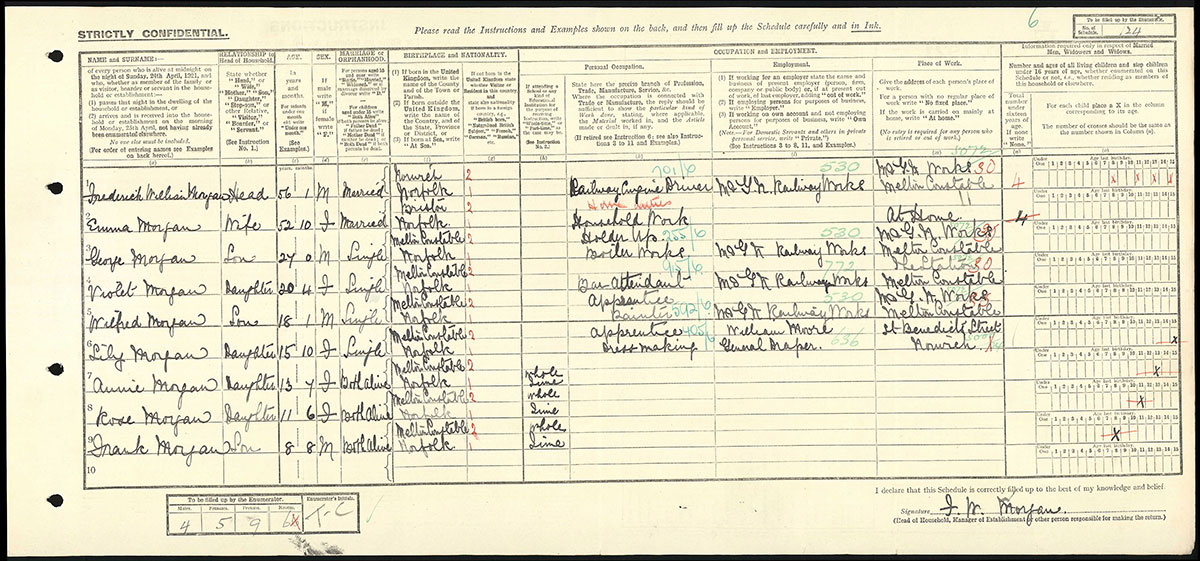
Hello to you all. My name is Frank Morgan and many of you know me because I have lived here practically all of my life and now I'm in my 94th year. The people who produced the new magazine suggested that I tell you about myself in a series of articles, and I remembered that years back when I used to pop into the Hastings arms for a pint, my old mates used to say, “Cor! Frank, with your memory, you ought to write a book”. Well, of course I never did. Never thought I would, I was always too busy with one thing and another. But things is different now and my circumstances have changed. So with a little bit of help I can now begin. I hope you will find it interesting. I was born on the 8th of October 1912 into one of the many railway families who lived and worked for the M&GN at Melton Constable. My father originally came from Norwich and took lodgings in Briston before getting married and renting a house from the railway. He was an engine driver and we lived at 22 Melton_Street, just down the hill from the Railway_Institute which is now the Melton Country Club. There were 11 of us children, 5 girls and 6 boys, and there would have been even more, but two brothers died in early infancy.
We were very crowded to say the least as there were only three bedrooms and I can clearly remember sleeping 5 to a bed, 3 at the top and 2 at the bottom. Must have looked like an open tin of sardines. Mother spent most of her time washing clothes and cooking our food and we were fortunate in having gas downstairs in our house which was supplied by the railway gas_works. Mother had one round gas ring on a flexible pipe on which she could boil up water and cook the potatoes. There were two cast iron cooking ranges, one in the scullery and the other in the back room, which was our kitchen, and both were used most of the time. I remember we had a very large table with a handle at the end which was wound to extend the table. You could then fit in extra leaves.
Not all the streets had gas supply, in fact it was mostly those closest to the gas works and I seem to remember that not all the houses had it laid on even when it was available. The cost of the gas was added to your weekly rent. There were a few gas street lights and we were very lucky to have one right outside our house. When it got dark, the gas man who made the gas at the works would come round with his pole and turn on the taps and light the lamps. We always try to make sure we got to bed before 10:00 PM because he used to come round then and turn them all off. Which would mean you had to go up the stairs to bed by candlelight.
Part 2 |
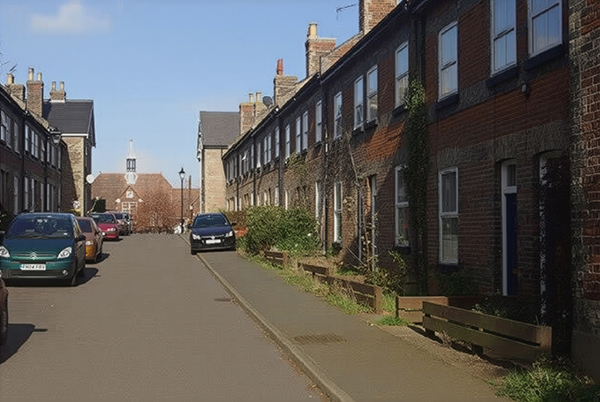 Melton Street no. 22 far left of picture
 |
This is the house I was born and raised in number 22 Melton_Street. It holds many memories for me. Many happy and some sad. Looking back, I think the first event I can clearly recall from my infancy was looking out from our backyard and seeing this almighty great airship passing over, it was in fact a German Navy Zeppelin on one of the many bombing raids made on our country. It was an enormous thing, over 500 feet long, with several engines droning away. And it had a crew of around 15 men and could carry a couple of tons of bombs. (Editor's Note: The first raids occurred in January 1915, and Frank would have been three years old).
As soon as I was big enough to be running around, I made pals with a boy called Ted Walpole who lived in the next row, Astley_Terrace, and we were pals from the time we could walk, you might say. And he was to remain my closest pal throughout his life. He was always very special to me and we never went anywhere without each other. We did everything together and got into all sorts of scrapes. We kept pals right up until he passed away. I can't remember what year it was, but he was retired and that was a very sad time for me.
When I was 5, I started school and although at first it wasn't too bad, I soon realized that there was a lot more fun to be had outside of going there every day. Mrs. Dunthorne was my teacher, she looked after the babies, and the schoolmaster was Mr. Alfred Hamer. He was a very learned man and a well respected character, affectionately known as “Boss”, although you never let him hear you call him that. His wife was in charge of the infant side of the school. I got the cane many times for mucking around and talking in class. You got one stroke on the hand each time and sometimes two hits if you had been rude or something. I was really a bit of a duffer because I didn't pay attention and couldn't wait for the bell to let us out of school.
I was very keen on agricultural work and I made-up my mind that I was going to work on the local farm. I loved being among the cattle and horses and I thought that was the job for me. But being the youngest member of the household of 13, my father being a staunch railway man, he had other ideas. He promptly told me that all the rest of the family had worked on the railway and that was where I was going. So that was that his word was law. I joined the Church last brigade when I was about 10 and we used to meet in the long Flint faced hall down the hill from Eke’s garage on the same side as the Chinese food place. This building served many purposes over the years and I can remember going dancing there ages ago. It has recently been changed into a residential dwelling, but in my youth it had a large sign over the door which read Drill Hall. I actually fired a .22 rifle in the indoor range in that building.
When I got to 11 years of age I then had to attend the secondary school which was the Astley, still in use today. I remember we did gardening and woodwork which I enjoyed, the latter being a clue to my working career. At the time I just looked forward to leaving. Does anyone who did gardening actually remember seeing anything worth produced? And if it was, where did it go?
Part 3
As I think you will have gathered, school was not my favorite place, and I remember one afternoon when I was 12, racing home up this hill, grabbing a snack, a drink of water, a bit of short cake and I was away over to Burgh Hall Farm, one of my favorite haunts. On spotting me, the old farmer shouts, “Hi boy, do you want to go for a ride?” Of course I did, and so off we go in his pony and cart to Brecks Farm at Thornage. The old farmer was William Dunham and he was manager of both farms. On arrival he says “jump down boy and undo that gate”. This released 12 bullocks from the yard and he says “right ho boy, take him home” and with that a “gee-hup” he turned the pony and rode off in his cart.
There was I all by myself and feeling a might nervous, left to drive these bullocks home along the lane to Melton. Well I should thank every blessed field in meadow gate along the way was open and these awkward animals just had to try to run through every one of them. As you can imagine, I had a very difficult three mile journey driving these lively and cantankerous creatures home.
This was late autumn, and by the time I got to Burgh Hall Farm it had become quite dark, but fortunately I had not lost any of the herd. On arrival a very relieved old farmer cried out “Come on, boy, where the ‘H’have you been?” He was pleased to see me, however, and gave me a sixpence. And when I got home, my mother gave me a good hiding to go with it.
At about this time I left the Church Lads Brigade, which I believe later disbanded, and joined the Boy Scout movement. Under the tutorage of Mr. Claude Roper we learned first aid, which I became very interested in and we formed a team of 6, reaching quite a high standard. We used to visit neighboring villages to give demonstrations. He also led the railway team to many competition victories. He lived in Gordon Rd. and was a clerk on the railway. As far as I know he had no medical qualifications, but if any one had an accident he was usually the first one on the scene. I remember one occasion when I was a bit older calling him out at nearly midnight one Saturday to deal with a girl who flopped out at a dance in the Railway Institute. He got dressed, dealt with the situation and made arrangements to get the young lady taken home to Gunthorpe. Truly a very public spirited and wonderful man.
Eventually, when I was nearly 14, the day arrived when I and five other lads took the entrance examination to become apprentices for the M&GN Railway company. This was normally only open to sons of railway employees, although I recall one year that due to a shortage of boys wishing to become Boilermakers they took on 2 lads whose fathers were not railway men, namely Reg Bunkell and Arthur Manthorpe. Reg known as “Primo” is still with us but like me is not enjoying the best of health. He served his seven years and was always looked upon as a grafter, but I don't think he followed his apprenticeship in the trade. If I remember rightly all his later jobs involved hard work which was no problem to the likes of him. He is often now to be seen sitting in his front garden in Church St. Briston with Margaret, his wife, and they do like to pass the time of day with any one passing by.
The six of us lads had been told to report to the Railway Works mess room where we were to take the exam, and it was just like an ordinary afternoon at school, a little writing, some reading and maths. Then the examiner stood, a kettle on his table in front of us and we had to sketch the best we could. After all this, if you gain 70% in each subject you were through. Shortly after this I was informed I had been successful and the M&GM were pleased to offer me an apprenticeship, but not just yet. Next I will tell you about the start of my working life.
Part 4
I left school at the end of the summer term in July and heard from the railway company that I was going to be offered an apprenticeship, but I couldn't start until I reached the age of 14, which was in October. Obviously, I needed to earn a little money in the meantime and so I took a job delivering newspapers. At the time there was only two suppliers of daily newspapers in the area, one being WH Smith and Sons on the railway station platform and Scoots Woods, who lived in Melton and worked from his house in Ferndale Villas on the Main Sreett. Surprisingly, there was no newsagent in Briston at this time. I started working for Scoots and used to collect the papers from his house at about 6:30 each morning and cycle around Briston and also delivered as far as Thurning all of this for the princely sum of five shillings a week and I had to use my own bike. There was 1 customer who lived in a big house in Reepham Rd. who I was told would always wait for me at his gate but one particular morning he wasn't there. I was flummoxed by this and put the paper back in my bag and when I finished the round I told Scoots what had happened and he said “why didn't you deliver it properly and put it through his letterbox?”. In truth I had been a bit daft and it just hadn't occurred to me, he made me cycle all the way back in the pouring rain with it.
The day eventually came and I had just reached 14 years of age when I received a letter from the railway company advising me that I shall report to the time office at the works to start my apprenticeship. After giving my details and signing on, I had to read a large framed notice measuring about 3 foot feet square fixed to the office wall. This contained all the rules and regulations. A clerk stood beside me all the time to ensure I read it thoroughly, which took some time as it was in very small print. I then had to sign a paper to the effect that I had read it all and understood everything. There were so many rules that I don't know how they expected any one to remember them all. Normally you would then be introduced to the job you were about to undertake. I had already advised them that I wanted to serve my time in the carriage shop as a coach builder, but there were no vacancies in that trade, so they offered me a spell in the mess room for the time being until position arose.
This consisted of keeping the mess room clean, going around with the Can Pole, collecting up the men's tea cans from designated areas in the workshops and taking them back to the mess room. I usually had to collect 50 or more cans from the various places and that was quite a long job. Sometimes for a bit of a prank, the men would hang things on my Can Pole beside behind my back and you'd be surprised what I found on a number of occasions. There was a rubbish tip right outside the mess room windows not the best place really I suppose, but it was handy for getting rid of any unwanted objects.
The men always sat in the same places and after a few days you got to remember them all. If a man has something to cook or heat up, he would leave it by his dinner basket on one of the mess table room tables and I had to write his name on a bit of paper and stick it on his dish and put the food in the oven so that all was ready when the men knocked off for dinner. At 12:15 PM all pies and heat ups were placed in position along with the tea cans. Afterwards everywhere had to be cleaned up again and all the tables scrubbed and things left clean and tidy for the next day.
The tea cans were the men's own property and they would bring them to work each morning with just a spoonful or so of tea or coffee in the bottom. These cans were slightly conical in shape, with a shallow lip from which they drank and a wire handle which looped across the top. Most of the cans bore the owner's name, either engraved or punched into the metal, and in some instances with just the label. My job also was to fill them with boiling water ready for the dinner break, as that was the only time the men were allowed a drop of tea, there being no other tea breaks in those days. It was quite usual to find these beverages were drunk without milk and almost certainly without sugar.
Part 5
The start of each working day was heralded by the works buzzer, which was in fact a low pitched, very powerful steam whistle fixed near the top of the boiler house chimney. It sounded rather more like a ship's siren than a train whistle and was so loud that with a favourable breeze it could be heard in Holt. It blew first each day at 7:45 AM, then at 8:00, which was the time to start the working day. It then sounded at 12:30 PM, which was lunch time, and again at 1:25 PM and 1:30. This was done to warn those who had who run home for lunch that it was time to get back. It also let rip at 5:00, which was the end of the eight hour day. So Melton, Briston and surrounding areas for miles around were treated daily to six blasts on the whistle. It seems hard to imagine. All this noise going on every day, but that was how it was.
After my spell in the mess room, which was supervised by my uncle George Wiggett Morgan, I was informed that a vacancy had arisen in the coach building shop. I was placed under the supervision of a man called Billy Daniels, whose job it was to show me what to do and how to do it. In 1926 when I started my apprenticeship they no longer built carriages at Melton, so the work consisted of repairing the existing stock, much of which came from other regions such as the London Midland and Scottish and the London and North Eastern Railways. As time went by, the work I was given became more interesting and I took a pride in what I produced at this point. At this point as the task sgot bigger, so did the expenses. We had to provide all our own tools, pay for our keep, buy our clothes and if we were lucky, spend a few coppers on a bit of pleasure. All this out of 10 shillings a week. Needless to say our parents were obliged to help us out. Seems little changes.
Billy Daniels was a hard taskmaster. He expected you to do everything right and Woe betide you if you were caught skylarking about. Although these men were harder on us lads, it set you up right and prepared us well for the work in the outside world. It was the custom for the youngest lad in the coach building shop to go and assist the Loco carpenter when he was extra busy, and of course I had a spell at that. He was a nice old gentleman and a bit more patient and sympathetic than the man I was with in the carriage shop. And so on one occasion I stayed with him an extra half day. And I should have gone back to my proper job. Someone informed my full time mate and he promptly reported me to the charged hand and insisted I be punished. So the charge hand gave me a piece of Deal timber about two feet long and 9 by 3 inches and told me to sharpen my plane and reduce the wood to shavings. This of course was a bit ridiculous and after about two hours he came round to see how I was getting on and said “I think you've had enough of that, you can go back to your job and I hope you've learned your lesson”. That sort of thing made you think twice about how you behaved.
The loco carpenter's job was to replace the wooden insulation on the locomotive boilers after removing the steel outer casing the insulating materials of wood and asbestos would be revealed. After a couple of years or so the timber would have deteriorated due to the heat and moisture and need complete replacement. The carpenter would take very long pieces of wood to the sawmill shop and using a special fixture would make dozens of shallow cuts across the strips, which thus enabled him to bend them into a circle and fit them around the boiler at regular intervals with the use of special metal clips. He would then by using these hoops attached boards to cover the boiler and under which would be stuffed the asbestos fibre. He was allowed about a day and 1/2 for each engine and no one knew about the risks from asbestos.
Part 6
|
|
I began to enjoy my work as I became more skilled and soon began obtaining all the necessary tools which I kept in an unlocked drawer under my bench. You had No Fear of things being stolen as everyone respected each other. This could not be said later on when I went to work at Kings Cross. I suppose the fact that particularly everyone lived in and around Melton helped to create a sort of team spirit at the works and we were quite a happy bunch, although there were the odd one or two who were right miseries.
If you walked up the hill past the Hasting Arms public house, then turned left for the road to “Hindle”, you would shortly come to the bridge upon which stood the station entrance, with the end of the platform and the railroads passing directly underneath. A further 30 or 40 yards along, you can still see the concrete steps and metal handrail leading down into the old works yard. At the foot of the steps on the left was the ‘time office’ where we all had to clock on and off. Directly at the bottom of the steps on the right stood the watchman's hut. The railway company employed three men whose job it was to patrol the works and keep an eye on things, and one was named Hooky Pegg. They worked a sort of three shift system. Beyond the time office and to the left was the mess room where I started my railway career and over to the right were the main assembly and engineering shops, most of which are still standing. We walked across several rail tracks to get to our workplace, but these were only sidings into the shops, so not really dangerous.
If your travels in Melton chance to take you down Ashley Terrace, you will see the imposing end structure of the carriage and wagon shops with their large entrances obviously designed to allow the passage of rolling stock. There are still some parts of the hinge pivot mechanisms to be seen in the brickwork as massive doors were used to keep out the cold wind and dust.
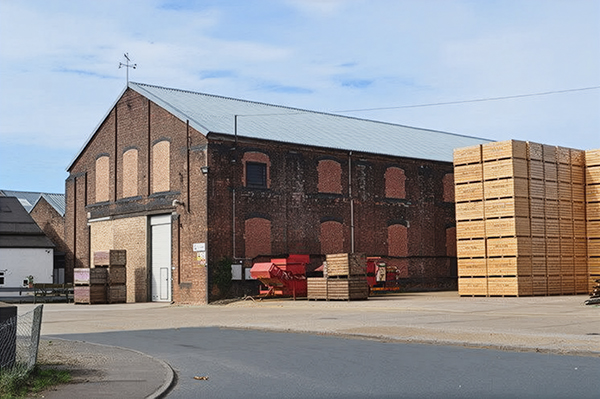
It is difficult to remember the total number of different workshops, but there must have been about a dozen and a half. Apart from the large fitting and machine shop where many of the locos had been built and were now maintained, there was also the blacksmiths, the boiler house with its tall chimney, the carriage and wagon shop all clustered close together and which all the buildings in use today.
The boiler house was a very important facility because the steam produced by the boilers (I can't remember whether there were four or six, but they needed two stokers) was used to drive the massive engine which provided mechanical power for the machine shop via an impressive overhead shaft system with leather endless belts supplying the Rotary motion to every lathe and workshop machine.
The workshops had radiators for heating purposes during the winter, and there were also other pieces of equipment around the place that needed steam power as well so you can imagine, these pipes run around the entire works. One should bear in mind that there was no electrical power in those days, or electric lighting and the whole works had to be lit by various types of oil lamp.
In the corner of our carriage shop was a small room which contained a device called “The Bosh”. I think that was how it was spelt. This consisted of a large metal tank about 7 feet square and two feet deep, which was filled with a caustic soda and water mixture. Upon opening the valve, steam would heat the water to a very high temperature and into this would be placed any filthy or greasy metal components which would soon come out gleaming bright and clean. This was indeed a very powerful and effective cleaning process. One of our carpenters, finding his oil stone was badly glazed and in need of a good clean, placed it in the “Bosh”. On retrieving it some considerable time later, we fell about laughing as his stone appeared to be now made from spiders webs. This caustic process is still used these days to strip old paint from pine doors. |
Part 7
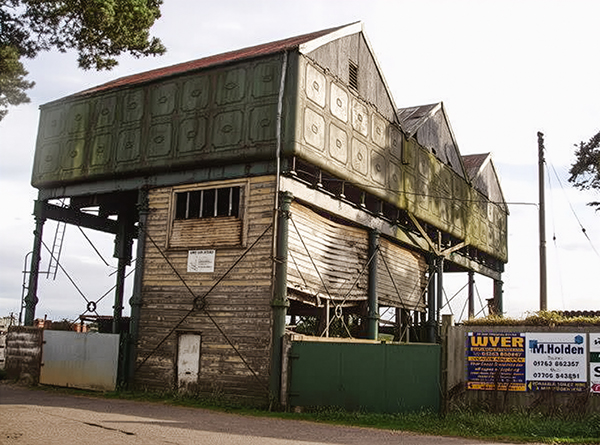
Everyone living in this area must have noticed these massive water tanks standing in the southwest corner of the old site. They were erected in the very early days of the railway and provided water to the works and the railway men's houses. The water was drawn from a bore hole just beyond the very back of the yard and pumped up into the tanks.
|
|
Damaged by enemy action during the Second World War, when a bomb dropped very close in the adjoining field, puncturing several panels they have long since ceased to be used and are now in a very sorry state. I was once requested to climb to the top of the structure and measure the panel size and also the M&GN lettering which can be seen on each section. I never found out why this was needed but the view from the top was magnificent. At the foot of the tanks was the start of a very handy narrow gauge railway track, the rails being only about 15 inches apart. Upon this system we could push 4 wheeled wooden trolleys which were used to move parts and materials from one department or store to another. This small railroad made its way completely around the works and finished almost back where it started, except that the rising ground here was too steep and you could never have pushed the trolleys up the incline. This was a shame really, as it would have saved a lot of time and effort if the full circuit could have been completed.
There were 13 small turntables at various points around the works and these enabled us to branch off in various directions as required. The turntables were round metal platforms with two slots across the top to accommodate the trolley wheels and each was firmly set in the ground. You pushed your trolley onto it and then swung the whole lot round to line up with a different track and then off you went in a new direction. It must be difficult for many of you to appreciate what it was actually like to be employed at the depot. The first thing that would strike you would be the tremendous noise in some of the workshops with the hammering, the machining of metal into shapes and the riveting of boiler plates: the constant rhythmaic. Clatter of the overhead revolving power shafts and the flipping and clicking of the leather drive belts in the machine shop.
The smell of the workshops would also have impacted on your senses, with a mixture of coolants used in machining and metal treatment, together with smoke, steam and soot from the locos. I was quite fortunate, working mostly with wood in the carriage shop and only occasionally would a loco enter our department and then only to bring or take out a carriage or two. To be employed in some of the workshops could be and was for some very dirty and tiring work.
This was recognized by the company in that they provided hot baths at the Railway Institute for wherefore the payment of 3 or 4 pennies and you took your own soup. a man could have a decent bath after work and arrived home clean. The alternative would be to take the tin bath from its hook on the outside wall by the back door and bathe in front of the fire with a couple of pans of hot water from the stove or copper. You couldn't use much water because if you did, the bath would be too heavy to lift as you took it out to empty down the outside drain.
Part 8
I started work in 1926, the year of the general strike, and I remember it well because just after Christmas, one of the older apprentices, Archie Hutchins by name, got all of us lads together and organized a series of marches around the neighboring villages. After we met up each time and assembled into a column he would set off at a brisk pace, pace leading us to our first destination. The idea was to visit 2 villages most times and by the end of it all we must have marched miles and miles. On arriving he would bellow down his megaphone to draw people out into the streets and we would then sing carols while he collected as much money as he could. The proceeds of our efforts were sent to the desperate miner families, for although the strike occurred in May, the battle between the miners and some pit owners went on for several months, certainly until Christmas. Some of the pits closed and many locked out men in some forms of reprisal action.
My job was proceeding well, however, and I was getting along famously, becoming more confident with tackling the various jobs as I learned my trade. I started a small notebook which I still have today, in which I wrote down every carriage number that I worked on, also the engine boilers that I assisted the local Carpenter to reinsulate. In the back of this little book there is a list of the tools I was purchasing together with their prices and it may interest you to know that my first hammer cost me two shillings and most of my wood chisels appear to have been 1/3d.
Part 9
I can remember back to 1917 - 1918 when I was about 5 years old and my father was Sexton at Saint Mary's Burgh Parva. As soon as I was able to sit still for a while I was taken to church on Sunday mornings and again in the evenings. I suppose I passed the test and it was a regular thing after that. My seat was next to father and woe betide me if I got off it. He would sit and watch all the goings on in the church and ensure that everything was satisfactory such as the lamps getting too high or low as at the time the only lighting was paraffin oil lamps and of course, after a while this all became a way of life.
My parents were in no way religious in the current understanding of the word, but all their spare time appeared to be spent at the church. When I was seven years old, my mother, who was already a member of the choir, along with another brother and sister, informed me that I was to take my place as a chorister. At that time we had 29 voices. How's that for a village choir? Also around this time, a man by the name of Harry Beales came to work as a clerk at The M&GM. A marvellous musician he trained us up to a very high pitch and we performed Stainers Crucifixion and similar demanding pieces. We flourished under his tutelage for several years, but alas, he passed away and the quality of our singing sadly declined. My brother Wilfred took over as choirmaster but he couldn't reach the standards that Harry had attained.
One of Harry's dying wishes was that the shadow of the tower would fall on his grave. My father took the matter up with the church council who declined his wish and so he had to take his place in the line which was in the extreme northeast corner at that time, however rules are rules The Saxton’s duties were very diverse and included keeping the church and graveyard clean and tidy, performing various maintenance tasks inside and out, and above all came the job of organizing funerals and actually digging the graves. The usual procedure when a bereavement occurred was that a relative of the deceased would knock at our house 22 Melton St. and inform my father who would then make all the necessary arrangements. It was quite usual for a funeral to take place about two days after the persons demise so if someone passed away Monday their funeral would take place on Wednesday. Father would of course inform the vicar of when he was required to perform the service and at what time. All very different to what goes on now.
Time marches on and when Father retired my brother became Sexton and this he did until he finished his apprenticeship and had to move away to find work. Next in line was me. I took the job on without really looking at what it consisted of and I had some rather nasty situations to deal with on several occasions and the old gentleman that was vicar at the time, when I asked him for advice he promptly told me that I was in charge of everything at the church and I would have to find the answers.
One of my problems occurred when I had two funerals at the same time. I had given them the choice of two o'clock 2:30 or 3:00 PM. The Church of England was happy with the 2:30, but the Plymouth Brethren also insisted on 2:30. So I had to stick my neck out and insist they came at 2:00 PM or wait until three. In the end they came at 2:00 but would not give me the disposal certificate. This was highly illegal, so I had no option but to lock the gate until they decided to give it me. It was that or take the corpse away. In the end, common sense prevailed and I was left to get on with the job.
Part 10
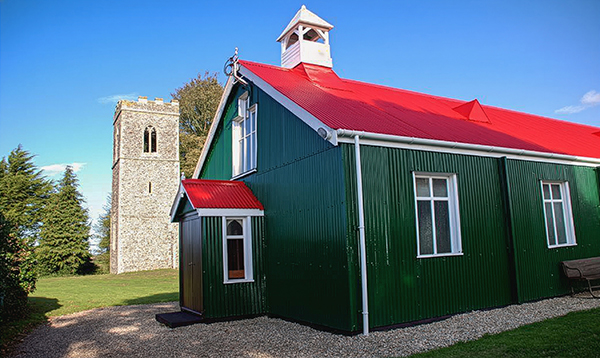
This recent photo shows one of the original places of worship in Melton, the Church of Saint Mary at Burgh Parva, the locally well known “Tin Church”, a replacement for the original Flint building which fell down. This was the church to which my family and I were strongly attached and it was always very well packed for both the morning and evening services. |
|
The Railway Mission held their services in the Railway Institute and again were very well supported. Further down the hill at number 63 just up from the fish and chip shop, the Plymouth Brethren held their services in the front room of what was then called Avondale House and always had the usual 12 in attendance. In Briston there was the C of E All Saints Church which was again very well supported and a choir of about 16 with a very good organist who was also the local school teacher. The Salvation Army had a very strong following and the Citadel was in Church Lane which is behind the Old Post Office car park. On some old maps of Briston it is marked as the Barracks. I have seen that place so packed that as us youngsters had to sit on top of the cupboards.
Then there was a Methodist Chapel in Hall Street again always well filled and the Lecture hall on the junction of Church Street and the Lanes which is now the Congregational Church. How times have changed. We could all now worship in one place and still have room to spare, shame on us. In Melton on alternate Sundays, The Salvation Army would set off at 10:30 AM. Assembling in Burgh Beck Rd at first the numbers were very few. Usually Vic Dewing was first and he would take off his hat and offer a short prayer. Gradually the rest of the band arrived. Then they would March off into Kitchener Road and by now the band was nearly complete. Next on to Gordon Rd then across to Melton St. and down to Colville Rd where at the end of the service the big drum was laid on its face and all members gave their subscriptions and when the collectors had finished their job all was placed onto the drum and counted. The alternate Sundays would cover all of the Briston area.
I suppose I was about 16 when I started attending the various dances in our area. One of the regular places we went to on a Saturday night was the Railway Institute where we danced to music supplied by the Melton “Tar-pots.” This group consisted of piano, drums and violin, with maybe another instrument thrown in, sometimes a trumpet. On alternative Saturdays the lads went to the Church Hall in Holt and also occasionally there would be a dance in the Drill Hall. I actually preferred the Drill Hall dance floor to that of the Institute because the floorboards run the length of the ballroom, whereas in the Institute they went from side to side and it was difficult sliding your feet across the joins.
Part 11
The highlight of each weekend, of course, was going to a local dance. Us lads really looked forward to it with great excitement and would usually spend quite a time getting ready. These dances were always well supported and we would look keenly to see if any of our favorite girls had turned up - they usually did. I remember one particular girl who made straight over to me one night and asked to dance, and for the rest of the evening more or less insisted that she had every dance with me. At the end of the evening I said, “I suppose you want me to walk you home?” “Yes please”, she replied, and after getting her coat we walked to the door and upon reaching the pavement, I was surprised when she turned left and started walking up the hill towards the Hastings Arms. “Where do you live then?” I asked. “Oh, I live in Gunthorpe”, she replied. This really was bad news, much too far to go in the pitch dark. When we eventually reached her home, she said she seemed to have lost her dancing shoes and would I be good enough to find them on my way back. I never did because I didn't go home the same way because I knew some shortcuts across the fields.
As I mentioned last time, us lads used to go to Holt quite regularly, but transport was always a problem. However, an enterprising fellow from Melton by the name of Dick Eke, who had a small motor car and made a living by repairing bicycles and the occasional vehicle, always offer transport in his car upon a payment of a shilling for the return journey. The one proviso being that he would pick us up in Holt at midnight but he wouldn't wait if we were late appearing. There were so many of us lads in his car, sometimes 7 or 8 on occasions, that we couldn't shut the doors and legs and arms were poking out everywhere. Goodness knows what would have happened if he had needed to pull up in an emergency. By the way, I only had to walk home once.
At the Railway Institute dances they had an MC and a most strange gruff and almost rude fellow he was. After announcing “the next dance will be a foxtrot”, he would step from the stage onto the nearest chair and make his way from chair to chair around the hall, which was his way of getting everybody up on their feet to dance. Quite effective it was too, but I doubt he would get far doing that today.
Then I met Kate. We had made a sort of casual eye contact for a few weeks and one night I plucked up courage and went across to her and asked most politely, “May I have this dance”. It was as if something had told me that she was going to be very special to me. We danced together for the rest of the evening and then I said, “Can I see you home?” Just before we parted, she murmured, “There's another dance in a couple of weeks, would you like to take me?” I walked home afterwards with my head in a whirl and that's how it all started and we remained dancing through life together for 70 years.
I recall that on our second or third date, she looked at me very seriously in the eye and said that she had heard and knew quite a lot about me and that if we were to continue seeing each other I would have to change my ways. I suppose I was a bit of a scallywag, but I wasn't afraid of a bit of hard work and I never gave her any cause for concern except when I was working down in London and I missed her so much that I was thinking of packing it up and coming back home to Norfolk, but that can come in a later tale.
Unfortunately I wasn't very popular with Kate's father in those early days and soon felt the sharp edge of his tongue. When we were going out for the evening I usually met her by the lamp post near to where she lived and one night her father appeared and bellowed up the hill, “if you want to take my daughter out you will knock at our door properly and not pick her up in the street”. It wasn't too long before she joined our choir at Saint Mary's Church and we really spent all our available time together talking and going for walks in the countryside. I was still serving my apprenticeship which was by now approaching its end. And I was worried about obtaining work locally, there were certainly no opportunities in my type of trade. It would mean moving away from home and leaving all and everyone that I loved. Some hard decisions were going to have to be made.
Part 12
Apprentices were always encouraged to attend evening classes at the Railway Institute and I chose to go to the technical drawing lessons under the tutelage of Mr. John Henry Price Lloyd. As I worked in the carriage shop, I naturally chose to draw something that I was very familiar with. The illustration is a small section of a quite large drawing showing about 2/3 of the vehicles length plus an end elevation and planned view and was completed on the 24th of November 1932. It depicts a coach originally belonging to the London Midland and Scottish Railway, several of which were purchased by our M&GN Company having ceased production of units to their own design some years previously.
I meticulously measured and noted the dimensions for every part of this carriage and was thus able to produce an accurate drawing during our classes held on Thursday evenings. It is drawn in pencil and the eagle eyed among you will no doubt spot the small dots in the window corners which were caused by the needle point of my compass. As I look at the drawing again, I am reminded that the coach trimmers use this section of our workshop, it being necessary for reupholstering to be done from time to time. Using one of many various templates as a pattern they would cut the cloth in readiness and with the necessary tools and bundles of horsehair they would upholster a compartment in surprisingly short time. Having ripped out the damaged or soiled fabric, they then removed the horsehair padding was which was duly passed to Teddy Eke, labourer to the coach trimmers. He had an old coach body set down on the ground outside where he cleaned all the horsehair for reuse. It was all cranked through a machine by hand and was recycled in almost perfect condition. A thankless job really as the dust created by the operation was terrific.
On one occasion I was informed that Mr Nash, the works manager, required my presence in the boardroom. Good Lord, I thought, I must be in some sort of trouble. Nobody from the works was ever required to go there. Tidying myself up a bit, and after combing my hair, I meekly presented myself, tapping gingerly on the door. “Come in”, rang out the voice, but my fears were unfounded, as Mr. Nash preceded to explain that he wanted me to strip the polished surface from the boardroom table as it was showing signs of wear and tear.
It was with some relief that I returned to my workbench. Stripping the table involved many hours of careful scraping and sanding and I was duly able to inform the paint shop men that it was ready for re-polishing.
Before I close, I must mention one other section that stood quite close to our workshop. This was the small department where they repaired the horse drawn delivery carts. It should be remembered that most materials were delivered by horse and cart in those days and even in the 30s horses were still used extensively by tradesmen and farmers.
Part 13
When you were getting near to the end of your apprenticeship, the foreman would give you permission to make your own tool chest. For this of course you would select the best of the timber and make a real grand job of it, bearing in mind it had got to last you a lifetime and probably be moved about all over the place of course, depending where you got a job. Having literally made my chest, it was then handed to the paint shop who carefully gave it several coats of varnish and real smart it looked in the end.
My apprenticeship had now finished and several of us were looking for suitable jobs and believe you me, there weren't many about. The chief clerk sent me a note to say they wanted some young men for the summer season to work as cleaners and firemen in the loco shed and four of us went to Yarmouth for four months. It was great as we had an early turn job and we would finish at 1o’cock so we had all the afternoon and evening off and it was like a summer holiday although we had to start at 4:00 in the morning.
We had to find ourselves lodgings but I was lucky as I was able to stay with an uncle in Yarmouth. Some of the other lads were less fortunate. (Such was Frank's meticulous nature that he logged down all his firing duties while working at Yarmouth). Back again at Melton, the lads who were nearing the end of their time would dash into the reading Room at the Railway Institute to scan the newspaper adverts for jobs vacancies after work. Having scribbled down any useful addresses, it was off home to write a few letters of application. I sent off three such letters and was surprised to receive three job offers. One was with an Aircraft Company in Cambridgeshire, another with a coach firm in Yarmouth and the third was with ‘Carter Patterson’ a haulage Company who mainly performed delivery work for the railways and this job was in London where I had an older brother working at Kings Cross depot. I chose the latter.
Part 14
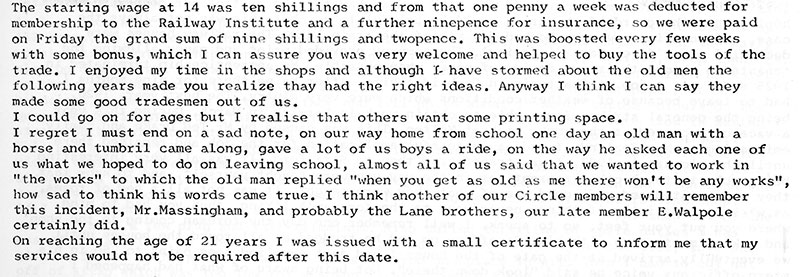
It came as a shock on my 21st birthday when Mr. Oliver Monks, the foreman, handed me a small envelope containing a letter stating that as of a certain date my services would be no longer required. They were giving me a month's notice, which was hard to accept after having worked there for seven years. This was the normal practice for all apprentices, but somehow you hoped you would be lucky and be offered a position.
On the set date I went to Mr. Nash's office. He was the general manager of the railway at Melton to collect whatever I was entitled to and show him my letter of introduction that I had received from my new employer. He said “you are a lucky chap to get that job2 and he says 2go off. into the world and don't let the grass grow over your boots”. With those words of wisdom, he then gave me a free ticket to travel down to London, and also a docket to cover the costs of transporting my heavy tool chest, which I sent in advance.
It was a sad time for everyone as not only was I leaving my family and friends but I had to part with from my dear Kate. After making sure they were satisfied that I would write as soon as I got settled, I boarded the train and started my journey to London. Fortunately, as I mentioned, my brother worked in King’s Cross as coach builder and he got me a few addresses offering board and lodgings which was my number one priority. I took lodgings near Camden Square and quite close to the Carter Patterson works where I was due to start on the Monday.
You can imagine my surprise when I arrived at the job on Monday morning to find my beautiful tool chest standing in the workshop on its end so that my tools were jumbled up and all down at one end. I then realized the importance of the advice given to me back at Melton about making sure I made a good, strong tool chest.
I was again very surprised when after only three weeks, the foreman walked around one Friday morning to tell most of us of us that our jobs finished lunch time that day. Luckily for me, my brother found that a vacancy had occurred at his carriage works and so a short time later I commenced at King's Cross but on a three month probation. This meant that I could be dismissed at a minutes notice if for any reason they were not happy with me or are I upset someone and I can assure you that for three months I was very closely watched.
Everything progressed well however, and at the end of the three months the Governor came and informed me that I was now on the permanent staff. He also inquired if I was in touch with any of the lads where I learned my trade. I told him I was and that a lad named Alec Holbrook would be finishing his apprenticeship in a fortnight's time, “Right?” He said “Get in touch with him tonight and tell him there's a job here for him and if he works like you do, he will go straight on the staff and will not have to do a probation period”. He then added, “I'll take him on your word, but if he lets me down, I'll sack the pair of you”. Such were things in those days. Alec became the workshop foreman some years later.
Part 15
I was settling in quite nicely to my new life in London. My lodgings were comfortable and very convenient for my work. Although I told people I worked at Kings Cross, the carriage sheds were actually just up the line at Highgate, a stones throw from the terminus. The workshops were very large and the facilities first class and apart from one annoying thing, I was getting on rather well.
Of course I miss Norfolk terribly and quite regularly on a Saturday I would buy a ticket and travel up to Melton, mainly to see Kate and of course my family and friends. This could work out a bit expensive because apart from the fare, everyone expected me to buy the drinks because I had a good job down in London. I remember often returning to London with a heavy heart and found myself regretting being so far away from home.
I kept myself to myself while at work as it appeared that my Norfolk accent was a matter of amusement to several of my workmates. They would call me ‘country bumpkin’ and other less polite things. From time to time jobs were advertised on the board which would earn you a few coppers a week more or even a bit of a promotion. I always applied and usually was successful, which only seemed to add to the grief with my workmates and things got quite heated sometimes.
There was one particular individual who made no secret of his dislike for me. He was a pallet truck driver and a big man at that, what I suppose you would call a bully. One day he was being really aggressive towards me and began goading me quite offensively. Of course, everybody was watching and listening, waiting to see what would happen. I tried to politely tell him to leave me alone and go away, but he would have none of it. I walked away from my bench to calm things down, but upon returning found him still waiting with a most unpleasant leer on his face. “Come on bumpkin, what ye’r going to do about it, eh?” he snarled at the same time hurrying forward. Then without thinking, I slung a right hook which connected very satisfyingly on his jaw. He crashed to the floor and didn't move, and I couldn't believe what I had just done.
Right, that's it I thought, might as well start packing up my tools as I knew that it was, still is, a sacking offence to be caught fighting on the shop floor. However, some of the lads dragged him into the corner and propped him up and not a single word was ever heard, although news of what happened went right around the sheds. Subsequently this bully of a man could not have been nicer to me and would always hop off his truck to give me a hand or have a quick chat.
Sundays were my leisure time and I'd like nothing more than to travel around the city taking in the sights and touring the famous landmarks. One of my favourites was Horse Guards Parade and on this Sunday I made a special effort to look my best because I had just bought a brand new Bowler hat. Off I set, feeling rather proud and all togged up like a four-penny ninepin. My lodgings were in Camden Square and the tram stop was called Brecknock, just a few yards down the road. There was I so self confident and here comes the tram. I would travel to Trafalgar Square and walk the short distance down Whitehall. The tram stopped and bracing myself I elegantly mounted the platform and turned bristly to step up into the compartment, whereupon my bowler collided with the roof, forcing the brim down almost over my ears. I can still hear the barely controlled chortling that run around the cab as I struggled to remove hat.
Part 16
As I mentioned last month, my job was proving very satisfying and I had no complaints with that part of my life, but I was really feeling lonely and found myself constantly thinking of home. Worst of all, I was missing Kate dreadfully and she was always in my thoughts. Although I had only been away for a few weeks, it was rapidly becoming apparent that I couldn't handle the separation. I got so depressed that I knew I had to do something drastic soon.
I had come up to Melton again one weekend and Kate and I went for a lovely long walk through the countryside. She could tell that something was on my mind, I suppose, because she suddenly asked what was wrong. Taking both her hands in mind, I explained that I couldn't carry on like this and then without thinking, I blurted “When I get back to work, I'm going to hand in my notice. I'll come back here and try and find some kind of work or other, but at least I will see you every day”. Kate looked dumbstruck “You can't do that”, she said “People will blame me for you losing your job, and I wouldn't like that at all”. We stood looking at each other for what seemed an age. And then she murmured - “I'll speak to my mother and explains things to her and if she's happy about it, you and I can get married and I will move down to live with you in London”. It turned out that her mother said that she could see the pair of us got on well together and bring well suited and as long as we were sure she would speak to Kate's father and everything would be all right.
And so it came about that shortly afterwards, Kate and I married in All Saints Church, Briston at 10:00 in the morning and we caught the 12:30 train to London later the same day. We remained married for two weeks short of 70 years.
Although I had what was regarded as a decent job, times were very hard in the 30s and it was a struggle to make ends meet. It's a laugh really because you still hear the same tales of woe even today. But I do think that it was tougher then. We had no National Health Service and benefits were unheard of. The main thing though was that we were happy and of a course together.
I had a bit of luck at work not long afterwards when I was asked if I would look after the Royal Train. This was the one that was used by King George V and Queen Mary. It was kept in our shed most of the time and only put into service if the royal couple were embarking on a visit somewhere. There were two carriages, one for the King and the other for Queen Mary, but if they were going somewhere together, they would share the Queen's carriage.
My duties involved me going to the office every Monday morning to collect the keys and then consisted of me checking for any damage and that all doors and windows are operated correctly and didn't squeak, creak or rattle. I also ensured all fittings were functional and kept an eye open for any other problems like dampness, dust and spider webs etc. Also, I lifted the druggets, which are the covers over the seat backs, and finally I wound the carriage clocks. This was always a nervous moment because you had to gently unscrew the brass bazel that held the glass in place on the clock face in order to insert the key and on one occasion I nearly dropped it all which would have been a real disaster.
In all the time I performed this job I never found the clocks had lost or gained time, and in any event I was under strict orders that if they were wrong I was not to try adjusting them. This was the job of a specialist, they said.
Some years ago I was amazed to see one of these carriages on show at the Bressingham Steam Museum. I'm given to understand that the other is at the York Railway Museum. It makes me smile when I remember that both of them used to stand just outside my workshop door and I saw them every day.
Part 17
There was talk of war and tension began to build, but as we afterwards found out, much of the news was suppressed in order to keep our spirits up. Times were hard and my weekly wage was barely enough, what with the rent and food and everything else. I was fortunate enough to get an occasional bit of overtime and that would sometimes mean I received one of those very rare large white £5 notes in my pay packet. This always caused a problem because when you went to buy something, the shopkeepers often wouldn't accept them. I think they thought these fivers were either forged or not legal tender. Luckily I found a Jewish shopkeeper in Stamford Hill who was only too pleased to accept my currency. And as it happened, we very soon struck up a bit of a business relationship.
He so practically everything in his shop, from tobacco to toys, nick-knacks and newspapers. One day I spotted some lead soldiers in his window, and don't ask me where I got it from because I can't remember, but amongst my tools was a mold for casting lead soldiers. I then began salvaging old lead pipes from various places as it was quite unusual in the old houses to find the drain pipes from sinks and such were made of lead. I also collected the worn out plates from the lead acid batteries fitted to the railway carriages. These were then all melted down in an old iron saucepan and I got quite good at pouring the molten lead into my mold and with care, splitting it open to reveal the shiny figure of an infantryman in just a few seconds I was able to produce quite a few of an evening once I got going, although the pong was rather strong and acrid, also it was very easy to burn your fingers.
The shopkeeper was always pleased to buy them from me however and I must have made a few battalions by the time it all ended. I often wonder what became of these figures and what they ended up looking like because they were left unpainted and it was up to the buyer to complete them as he wished. I never kept a record of how much I earned from this hobby, but it was very useful addition to our finances.
Meanwhile Adolf Hitler was mustering his forces and despite talk of appeasement and the flying visits of Neville Chamberlain we moved inexorably towards World War 2. I remember well the broadcast from the Prime Minister on the morning of Sunday the 3rd of September 1939 telling us that no undertaking had been obtained from Hitler to withdraw his forces from Poland, and accordingly we were now at war with Germany. It was called the Phony war at first because nothing appeared to happen apart from many men joining up and the appearance of sandbags at various places. Thousands were called up to serve their country, and our workforce were suddenly and dramatically depleted. I remember well the effect it had on our ability to perform the work, and the intense pressure applied to us to do our very best but it became impossible to cope.
One Monday morning when I arrived at work, I found a young woman standing by my workshop door. I passed her feeling very puzzled as we rarely saw women around the works. I got on with my job but had to go out to get a length of wood and found this young woman still standing there. She stared hard at me and then asked if I knew a man called Frank Morgan. My first reaction was to deny any knowledge of him but she added that I matched the description she had been given.
I asked “Why do you want him” and was staggered by her reply - “I have been sent to assist in his workshop”. “well you’d better come in”, I replied, “I'm Frank Morgan”. After hanging her coat up, I proceeded to ask her what knowledge she had at working with wood and I must say her experience seemed minimal. She had assisted her father on a few jobs and knew that chisel and plane blades must be kept sharp, but I feared her appearance could prove more of a hindrance than help. As it turned out she did become useful at some tasks, although I had to be constantly thinking ahead as to what I could give her to do. She also advised “I won't do anything heavy or have you chasing me about - because I’m pregnant.
Part 18
The phony war had ended as Hitler's Air Force began attacking our airfields and defenses. His intention was to remove our ability to defend ourselves, thus ensuring success for the forthcoming planned German invasion. Fortunately, our RAF proved more invincible than the Luftwaffe anticipated and after suffering heavy losses, they decided to bomb our cities, the intention being to break Britain's morale to the point where our government would have no option but to sue for peace. They reckoned without the indomitable spirit of the British people and Winston Churchill, our leader.
The Blitz of London commenced on September the 7th, 1940 and from 4:00 PM until 6 PM, 348 bombers escorted by 617 fighters bombed key points in the city. Two hours later a second wave arrived and the bombs rained down until 4:30 AM the following morning. For 57 days, London was bombed either by day or night.
On December the 29th, a concerted incendiary attack was made on Saint Paul's Cathedral, followed by a heavy bombing raid and only by chance and a change in the weather was the magnificent church saved. Obviously living in London was proving extremely dangerous and we didn't know the extent of the numbers killed and the wounded as the authorities suppressed the figures in order to prevent public morale from being shattered.
With the sky glowing pink and red every night, thousands sought refuge in the shelters and underground stations. Kate and I then moved to a property in Harringay, which was on the outskirts of the heaviest bombing but we couldn't escape the danger. At this time I had cultivated a rather smart mustache in the style of the famous film starring actor Robert Coleman, a real heart throb of his day. I was carefully shaving one morning when there was a whistling sound and an almighty crump as a high explosive bomb fell 3 doors away. As I picked myself up, with plaster and dust still falling everywhere, my first thought was for my Kate. Dashing into the living room, I was relieved to find her standing there looking very shocked. And then she suddenly started laughing, “What are you laughing at?” I asked. “Look at yourself in the mirror”, she replied. To my dismay, I found that I had shaved 1/2 of my wonderful moustache completely off with the jolt of the bomb. I must admit that I did look a bit odd, with only half of my pride and joy remaining on my upper lip.
At this time, Kate was advised by the Ministry of Employment that she must take up a job. This was fairly normal for women without children and indicates the extent of the emergency. Many worked in factories producing aircraft and munitions, in fact, thousands found themselves working for the first time in jobs normally performed by men.
The first place they sent her was to a soap factory but she but as she suffered from a form of dermatitis she was considered unsuitable. After one or two other abortive job interviews, she was finally taken on as a track side assistant with the railway. She found this quite interesting and once she settled quite enjoyed the work. In my mind, however, was the wish to get her back to Norfolk and comparative safety.
Part 19
The photo accompanying this part of the story {not present} is of my wife Kate and I and was taken in the back garden of her father's public house, now known as the John H Stracey. I thought the world of her and it was a very hard decision when I told her I thought it too dangerous for her to continue living in London and that she should move back to Briston.
This was eventually arranged, but not without a lot of fuss and bother. I remember when I first tried to come up to Melton to see her and my family one weekend. In those wartime days, you had to have a permit to travel to certain areas and all around the coast was classified as restricted due to the intense military activity and installations. I duly filled in an application form only to have it returned from the Ministry of Defence with ‘Application Denied’ stamped across it. I still have the form after all these years. After several unsuccessful attempts, I decided on other tactics and strolling up to the railway ticket office I asked for a weekend return to Melton Constable. To my delight and amazement, I was handed a ticket without even a question. I would have been in trouble, of course, if I'd been stopped by a copper, because anyone found in a restricted area without a permit would have been immediately arrested.
Strange things were going on all around, though and I smile as I remember the so-called ‘Hush Hush’ train that was always stabled at Bounds Green Carriage shop. It was called “Rapier” and was guarded by a soldier named Albert Spain, who was always on duty with the train. Pre-war he was a sleeping car attendant. The reason I smiled is that everybody seemed to know about the train so there was very little hush in fact.
At one point when things were getting very dangerous, a lot of the lads were saying that they would be safer off in the Army at least you would have a weapon in your hands. All we could do was crouch down in an air raid shelter and keep our fingers crossed. One Saturday morning I said to my mate.” I'm going to try to enroll this afternoon”. “Right” He replied “I'll come with you”. We set out, heading for the recruitment office at White Hart Lane not far from the Spurs ground. We filled in some forms and the recruiting Sergeant took a quick look at them and yelled “Get out of here, you are both in reserve occupations”.
Part 20
So we continued with our work in spite of the bombing, which would soon turn into another sort of hazard as the Germans launched their V1 attack. The problem with the V1’s was that they were very unpredictable with the targeting as they were small pilotless aircraft which relied on gyroscopic compasses for direction control and a carefully measured fuel load, calculated to provide just sufficient flight time to reach London. When the fuel run out, down came the ‘doodlebug’, and as it carried about a ton of high explosive, it could do quite a lot of damage. They had a particular engine sound which we could all recognize, listening with baited breath as it hopefully passed over. Once it was directly above, it was considered that you were safe as even if it stopped right then, it would glide on for about 10 seconds before exploding on impact. If however its motor stopped as it came towards you that was when it was time to crouch even lower and pray. It was not unknown for the engines to occasionally restart, and it was rumored that this was done on purpose to scare us even more.
The rumor mongers were having a field day during the war and the tales were invariably based on fiction. In fact, “Don't spread rumors” posters were often to be seen. There were tales about bullets that could go around corners, that the Germans were putting poison germs on their bombs, and the children were always being told not to pick up anything strange they might find laying around.
Once again my electrician friend and I tried enlisting with the army at the local office but again we got short shift over this blessed reserved occupation status. Looking back at it all, I suppose it made sense. After all, we had to have people looking after the home front.
At last, the daily bombing raids were getting quite rare which encouraged us all as we realized that Hitler wasn't having it all his own way but one day I was sent out of the depot to do some carriage repairs just outside London and on completing the job, while travelling back by train I was subjected to an aerial bombardment and machine gun strafing. Well of course, you were really in a sport speeding along in a carriage with all hell going on around you, and you can take it from me that a wooden railway carriage is no protection against bullets. It's not as if you could jump off even. Luckily, I arrived back safely, and as soon as I could, I told my boss that I didn't want any more jobs like that one.
Part 21
At last it became evident that the fortunes of war were swinging in favour of our brave lads and the Allies. The news continued to be favourable from the many campaign fronts, both on land, sea and the air. We began to feel that the end was insight and so my thoughts turned to what I would do when the hostilities were over. I was never at home in London with its noise and bustle and continually wished to be able to return to dear old Norfolk.
Eventually came the news that the war was ending, and not before time as far as I was concerned. Perhaps we could look forward to a prosperous peace which is what kept us going during those years of shortages. Little did we know how long it would be before things returned to something like normal. Our entire industry had been converted to the war effort and suddenly there was no call for tanks, aircraft, guns and munitions. It took a considerable time to change back to peacetime production and in the meantime we were short of everything.
One weekend when I was digging my father's allotment, I got chatting to a chap who was in charge of a workshop at the Melton Works, and he said he could offer me a job. This of course sounded wonderful, but I was a bit disappointed to learn that the only thing produced by this department was the weatherproof covers for goods wagons. They were quite large tarpaulin type sheets with several short ropes attached around the edges which they were secured in place on the top edge of the wagon. I found the work very boring as it did not put my skills to any good use. However, at least I was back home.
I then worked for a while on the track maintenance team, which was quite a change and pleasant as long as the weather stayed dry. It was obvious though that this wasn't my cup of tea either and so I continued to look for something that would suit me. Then one day I heard that a carriage repairman was retiring at Norwich, so I applied and got the job. They always say that patience is a virtue.
It wasn't long though before I was obliged to move my activities to Yarmouth. It became part of the LNER plan to service and maintain all the Norwich to London trains at the Vauxhall Yard at Yarmouth and together with a very good mate and some blooming hard work, we got all the stock up to a very high standard which in the long run made it easier for us. I came up with a plan so that we could work on each set of stock in turn, because there was normally always a spare set in hand, barring the unexpected.
This scheme worked out well and after the initial hard slog, the job became much easier. Occasionally I was required to dash off with my toolbox to perform a repair somewhere around the region. This was rather pleasant as I was able to meet old friends and you could never be sure what the job would entail until you arrived and examined the problem. I wonder now how I managed to sprint about with my toolbox which I still possess, it is extremely heavy, believe me.
Part 22
From time to time we were we were required to attend a medical conducted by the Railways Doctor. This was normally not a problem because most of us kept quite fit and well and the examination was a formality and quite brief. However, for some time I was getting increasingly concerned about my eyesight, for although I wore spectacles, I was finding it more and more difficult to see to do my job.
Came the day when I went before the doctor, and although he assured me that there was not much wrong with my general health, my eyesight was a really big problem. He asked me if I had any money put away, to which I replied in the negative, and then he said that was a pity because he was going to have to pension me off. You can imagine my dismay. There I was in my late 50s and out of work, but fortunately I kept my chin up and thought of things I could still do.
(Note: Unfortunately at this juncture the information about Frank's life story becomes rather vague as he was taken ill and subsequently passed away. What followers was obtained from casual remarks previously made whilst being interviewed.)
Frank had lived for several years at 29 Station Road, Hopton on Sea, Great Yarmouth, where he became very friendly with the local vicar, a friendship that was to last throughout his life. He often helped with the repairs in the church and mended the churchyard gates at least twice. The vicar was dismayed with the small size of the congregation and after holding morning prayers would frequently cancel the evening service and then drive to another church, taking Frank with him.
It seems that at one point Frank and his wife returned back home to look after his elderly mother at 22 Melton Street his father having passed away. Also that Frank owned a property in the village which he rented out and eventually occupied himself. In his notebook, the one he seems to have carried around throughout his life and in which are listed all the tools he bought as an apprentice and all the carriages he worked on at that time are four and a half pages of materials which he purchased for a major restoration project. Each page is headed “House at Melton” and all the prices are meticulously noted although no dates are given.
He certainly spared no effort listing 2 fireplaces, door timber for partitioning, window glass and several sliding door tracks, also wallpaper and tiles plus carpet, wiring and switches. Frank mentioned that he regularly repaired furniture and made small items for local people and also had a sideline which was the production of garden ornaments such as windmills and wishing wells. Possibly due to his previous connection with the church and having been Sexton at Saint Mary's for a while, Frank was approached by a gentleman undertaker who inquired if he would be prepared to help him out from time to time with local funerals. Frank thought carefully and said he would be prepared to assist.
Part 23
Frank was called upon to assist the undertaker from time to time, but one day, to his amazement, upon meeting his friend and employer, he was handed the keys to the premises and told “it's all yours for a couple of weeks, I'm off on holiday”. Although rather taken aback, Frank wasn't unduly concerned at the prospect of being in charges as he had by then acquired considerable experience. However, it was quite a shock when he was first called upon to perform his function as an undertaker, for the deceased was his own brother-in-law. The premises used at the time were situated in Reepham Rd. on the right hand side as you leave Briston, about 300 yards from the junction with Craymere Road. It was quite small and seems to have consisted of a single story brick building with a wooden shed attached.
At this point information about Frank draws to a close, although it should be noted that on one occasion whilst being interviewed Frank inquired about the date and upon being given it he became quite emotional and explained that it was 2 years to the day since his dear wife Kate had passed away. He went on to say that she died just 10 days short of their 70th wedding anniversary. And so Frank's story is concluded. A story with so much more that could have been told. It was indeed a pleasure and a privilege to have met the man and to have been able to record some of his life.
John Wing
Frank Morgan 1912 - 2007.
It was with great sadness we learned that Frank had passed away on Saturday the 14th of April. Born in Melton Constable, he was the youngest of a family of 11 and followed the family tradition of working for the railway by gaining an apprenticeship with the M&GN. With an acute desire for correctness and pride in his workmanship, Frank enjoyed a lifelong career as a Carriage Repair Specialist in various Depots in this region. He married Kate, a local girl whose parents were licensees of the public house now known as the John H Stacey. They remained together for 70 years before his much loved Kate passed away in 2004. There is one son David now living in Norwich.
Frank's phenomenal memory combined with a happy smile made him the most pleasant of gentlemen to reminisce with, and many happy hours were spent as he related his life story for this magazine. Such was his enthusiasm for the project that he frequently provided written notes for inclusion in future episodes. Even apologizing for not being able to write more when I visited him in Kelling Hospital a week before he died. Such was the man that I felt privileged and honoured to be able to call my friend. He will be sorely missed by all who knew him.
John Wing
Note - Taken from the Briston & District News 2007.
The photos in this document are not those that were used in 2007. Likeness to the original where possible has been used.
|
|