Melton Constable History

Home

Railway History

Railway Traffic

Melton Constable traffic

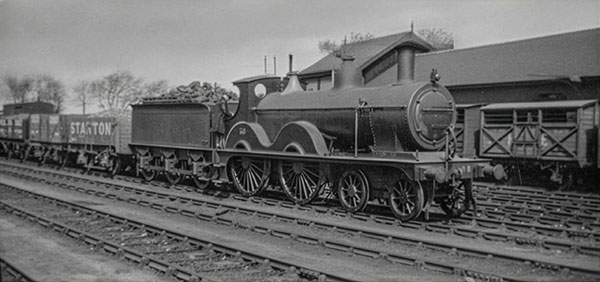
From 1889, the East & Midland Railway (E&MR) usually only worked its own trains east of Lynn, letting the Midland Railway and the Great Northern (GNR) Railway to operate services west of Lynn. The Midland & Great Northern Joint Railway (M&GN) was formed in 1893. Jointly managed by the Midland and GNR, the M&GN took control of both the E&MR's locomotive stock and complete rail network. The E&MR had sufficient locomotives to only operate the eastern section, so the M&GN found it needed new locomotives to operate the entire network. This was solved with the delivery of the M&GN Class C locomotives, designed by S. W. Johnson of the Midland. These were inside-cylinder 4-4-0s that were almost identical to the Midland's existing "1808" Class. The most significant changes were the slightly deeper frames, and the slightly larger (by ½ inch) diameter cylinders.
An initial batch of twenty six engines were built in 1894 by Sharp, Stewart & Co. These were followed by seven more Sharp, Stewart engines in 1896, and seven Beyer, Peacock & Co. engines in 1899. It is unusual that such a small railway purchased forty locomotives of the same design within a space of only five years. In fact, the M&GN never built any more passenger locomotives, and the Class C engines took the bulk of the M&GN's passenger traffic until 1937. They would be the last of S. W. Johnson's 4-4-0s to remain in service in essentially original condition.
The original boilers were of the Midland Class B type. The Class B boilers had many variations, but the original Class C locomotives were built with the 244 1.625in tube variant. The Midland supplied a number of different variants as spares, but records suggest that all of the un-rebuilt Class C engines were fitted with the 196 1.75in tube variant when they entered LNER ownership in 1936. This boiler was interchangeable with the boiler fitted to the J40 0-6-0 locomotives. The LNER initially classified the un-rebuilt engines as Class C/1, but reclassified them as D52 in July 1942. Eventually all of these engines received extended smokeboxes and Melton Constable chimneys.
Two of the Class C locomotives followed contemporary Midland Railway practice and were rebuilt with S. W. Johnson Class H large diameter round-topped boilers in 1908. Between 1909 and 1916, eight were rebuilt with the Midland "G7" boiler. The G7 boiler was actually the Belpaire version of the Deeley Class H boiler. The two 1908 rebuilds were similarly rebuilt in 1924-5. The Class C locomotives kept their original Midland frames during these rebuilds - unlike similar rebuilds on the Midland Railway which received deeper frames. The rebuilds also retained their Ramsbottom safety valves. The M&GN gave the large Belpaire boiler rebuilds the classification of "Class C Rebuild". On taking control in October 1936, the LNER initially classed these engines as Class C/3, but then reclassified them as D54 in July 1942.
Seven of the original locomotives were rebuilt with Fowler small Belpaire boilers in 1929-31. Given the Midland designation of "G6", these boilers had a similar tube arrangement as the Class B boilers, but they were fabricated from two rings instead of three. Unlike the large Belpaire rebuilds, these locomotives continued to be classed as simply "Class C". On taking control in October 1936, the LNER initially classed these engines as Class C/2, but then reclassified them as D53 in July 1942. Unlike the large Belpaire (D54) locomotives, the small Belpaire rebuilds included Ross pop safety valves instead of Ramsbottom safety valves. The Ross pop valves were reported to frighten nearby horses when they suddenly blew-off, so the Ramsbottom valves were re-fitted before 1937. Possibly due to a boiler swap, at least one D53 was withdrawn with Ross valves re-fitted.
The M&GN's territory included large areas of agriculture but a sparse population. Hence the Class C duties were typically of the mixed-traffic variety. As well as the passenger traffic for which they were designed, they were also used on fast perishable produce trains and fish trains.
After the rebuilds, the ten D54s were usually reserved for the express passenger services due to their larger grate area. The D52s and D53s were used for most other duties, and often combined fast passenger and fast freight in opposite directions of the same round trip.
Passenger duties were typically the through trains from the Midlands to Yarmouth and Lowestoft; and the Peterborough to Cromer expresses. The Peterborough to Cromer expresses were a part of the GNR's competition with the Great Eastern Railway (GER). These two railways became a part of the LNER with Grouping (1923), and these services dropped in importance. This contrasted with the through traffic from the Midlands. The summer Saturday seaside traffic from the Midlands grew significantly, and was an important revenue earner for the M&GN during the 1930s. Double heading of these heavy trains was common, although single-handed D52s and D53s were often recorded hauling twelve or even fifteen bogie trains. Coal consumption was heavy, but the D52s and D53s managed to handle these extremely heavy loads with success. The inevitable signal delays due to so much traffic running on a single track line helped, as the delays allowed them to 'catch their breath' as it were, and build up sufficient boiler pressure.
When it took control in 1936, the LNER found that many of the M&GN's locomotives were worn out. Thirteen D52s, one D53, and three D54s were quickly withdrawn in a space of twelve months. Withdrawals of the D52s continued steadily until 1943 when the last was withdrawn. Five of the D54s survived until 1943, when all were withdrawn within a space of eight months. The D53s survived longer with their relatively new boilers. Withdrawal of the six remaining engines started in 1941, and was completed in January 1945.
LNER


The 4-4-0T tank engine Fakenham hauled the first E&M train from Kings Lynn to Gt Yarmouth on 5th April 1883.
A typical daily journey of a Hudswell Clarke 4-4-0 tank engine in 1885, was to haul a passenger train from Norwich to Kings Lynn on a return journey twice for a total of 220 miles.


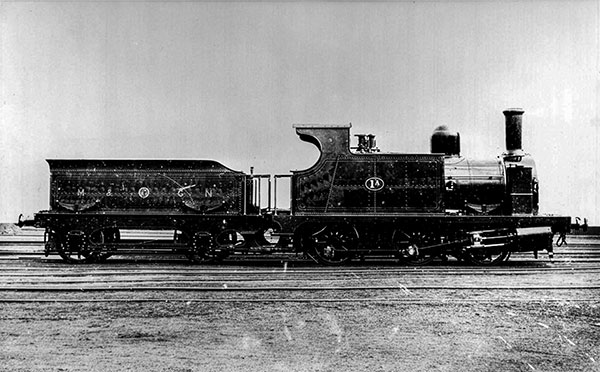
M&GN Marriott 1A
M&GN 1A Marriott built in August 1898 at Melton Works

Melton Built Shunting Engines

M&GN Shunting Class 0-6-0T
Marriott 3ft 7in. Engines
Engines taken over on 1st October 1936 (Built 1897 - 1905) 015/6, 093-9.
Total 9
These engines were designed and built by the M&GNJR at Melton Constable, but the influence of Midland Railway practice was apparent in many features of the design. The boiler drawing was made at Derby in 1896, and many other details were similar to those on contemporary Derby designs, notably the cab, tanks, boiler mountings and smokebox door, but the chimney was similar to the standard Melton Constable "3rd pattern", tapering in towards the base.
The nine engines were built at Melton Constable between 1897 and 1905, seven being numbered in the duplicate list. In 1907 the engines with "A" numbers were renumbered 93 - 99 in order of their original numbers.
When built, most if not all of the engines carried "Rebuilt Melton Constable" plates, and Nos. 93 - 98 were reputed to have been rebuilt from 0-6-0Ts inherited by the Eastern & Midlands Railway from the Lynn & Fakenham Railway, and which had started life with the Cornwall Minerals Railway.
Eight of these ex-CMR engines (built by Sharp, Stewart & Co in 1874) had been acquired by the L&FR in 1880-1, of which four, (Nos. 3, 13, 14 and 18) were rebuilt to 2-4-0 tender engines in the early 1890s, whilst the 1936 M&GNJR stock register shews the nine J.93s (L&NER classification) as new in 1897 - 1905, and Mr G B Clarke, who was Mr Marriott's Chief Draughtsman at Melton Constable when the 0-6-0Ts were built, once stated emphatically that they were new engines.
Nos. 93 - 98 should correctly be considered as replacements of the ex-CMR engines, whilst No. 99 (old No. 17A) replaced a Black Hawthorn 0-6-0ST, and Nos. 15 and 16 took the numbers of the two Fox Walker 0-6-0STs built in 1877.
The wheels from the Cornwall Minerals engines are believed to have been used on some of the J.93s, and at various times Nos. 16, 95, 96, 98 were noted with wheels of the same design as those on ex-CMR engines. These wheels had ten spokes and built-up balance weights, whereas the new wheels, where fitted, had twelve spokes and cast-in crescent-shaped weights. No. 98 had received the new pattern wheels by April 1933, and No. 096 was fitted with twelve-spoked wheels some time after July 1936, but No. 095 retained the old pattern ten-spoked wheels until withdrawn in 1947 as No. 8485. The fourth engine, No. 016, finished its days in 1949 as No. 8489 with ten-spoked leading and trailing wheels, but the driving axle had a ten-spoked wheel on the left hand side and twelve-spoked wheel (with crescent shaped balance weight) on the right! All photographs so far examined of Nos. 015, 093, 094, 097, 099 show twelve-spoked wheels.
Locos of the L&NER - M&GN Circle


The Bridge c.1906 13th March 1939
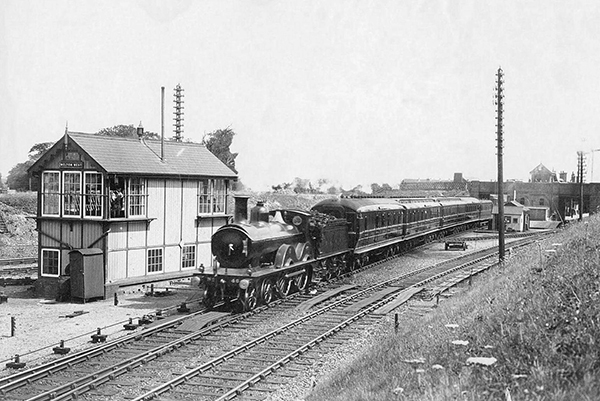
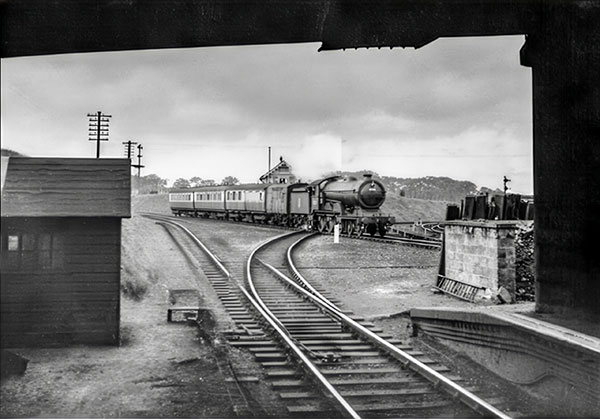
Melton West with a 4-4-0 leaving towards Thursford - c.1906
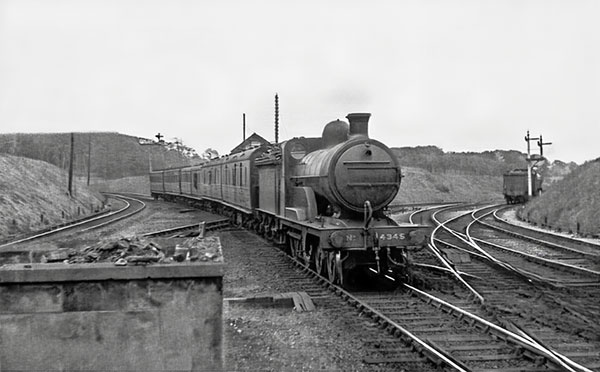
M&GN Class C 4-4-0 loco no. 43 coming in from Holt - 13th March 1939

Above left photo
Cromer - Kings Cross, Corridor Express leaving Melton Constable, having just passed under the original bridge, drawn by M&GN Class C 4-4-0 no. 46 built by Sharp Stewart in 1896.


All the flat-bottom rail running lines were replaced by chaired bullhead rail in 1896. The Cromer line was doubled to Briningham Single Line Junction, opened on 17th June 1900, still using the original signal box, which now had a frame of thirty two levers. The Yarmouth line was doubled to Corpusty, opened on 20th May 1901 and the Lynn line doubled to Fakenham, opened on 25th June 1901. Two new M&GN type 1a signal boxes were opened at the same time to control the new arrangements.
Nigel Digby


c.1935 c.1890
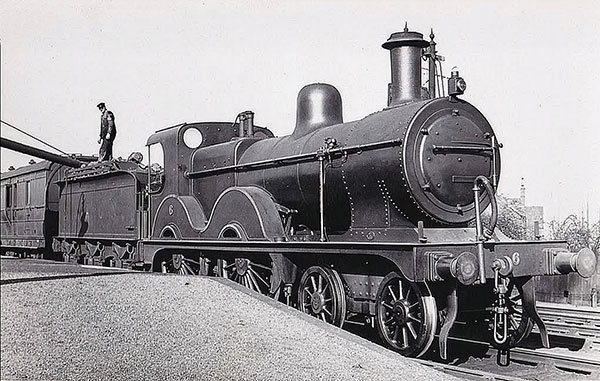
M&GN Class C 4-4-0 no. 4 outside Melton East signal box - c.1935
M&GN Class C 4-4-0 no. 5 with staff posing outside the engine shed - c.1890

In 1903 up to 86 trains a day were coming into Melton Constable station.


During 1907, an automatic tablet delivering apparatus was installed on the Down line to Norwich near the junction, about 108 yards from the signal box. However, it was not to be used except for the few trains which ran through without stopping. In the Up direction there was a non-automatic tablet receiving post by the signal box steps but this was altered in 1908 to hold a net into which the tablet was now thrown.
Nigel Digby


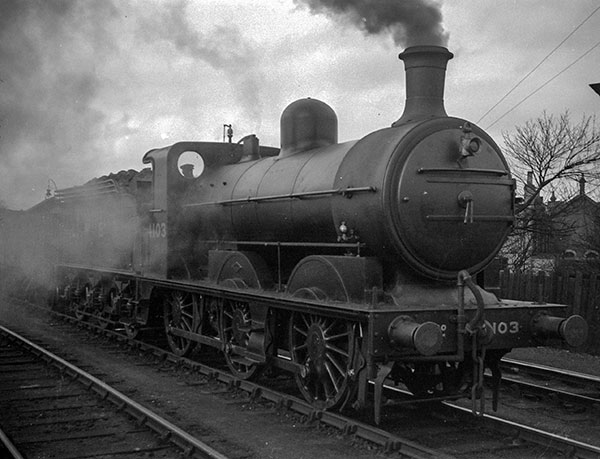
c.1935 LNER J4 no. 03
M&GN Class C 4-4-0 no. 6 taking on water - c.1935
LNER J4 no. 03 beside Astley Terrace

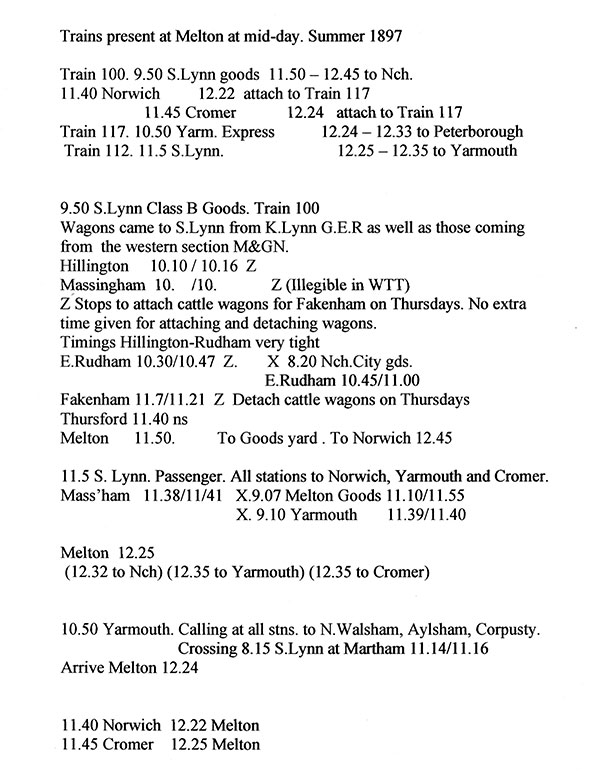
  Trains Summer 1898
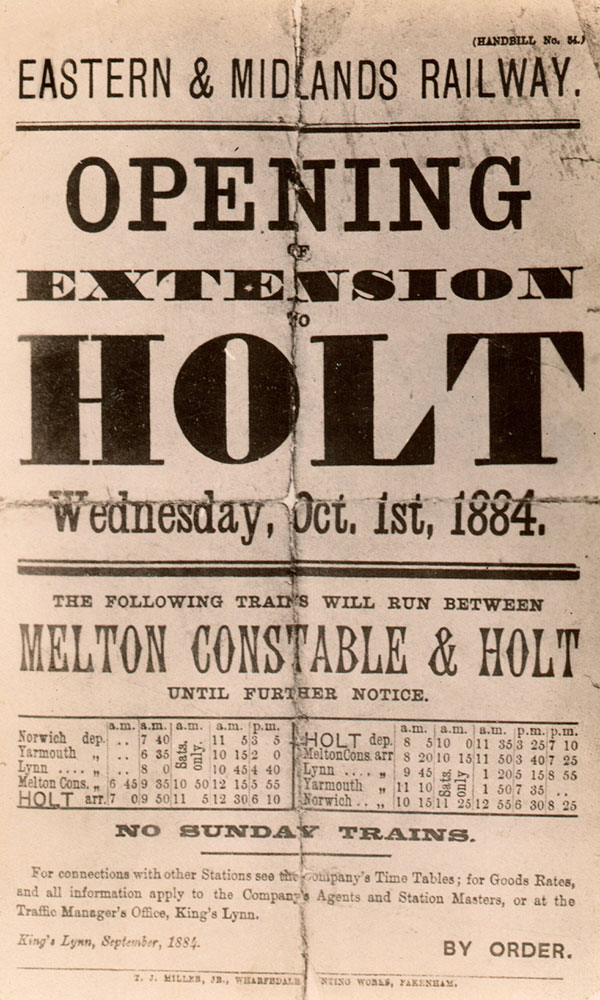
Holt Extension opening 1st October 1884


26th June 1929 D2 4-4-0 20th June 1938
26th June 1929
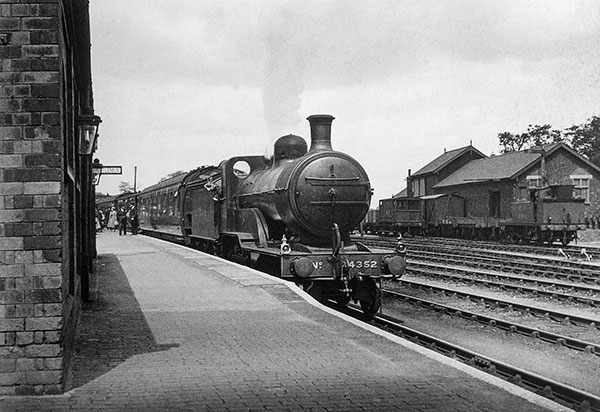
D2 4-4-0 n. 4352 en route to Gt. Yarmouth - 20th June 1938

Above left photo
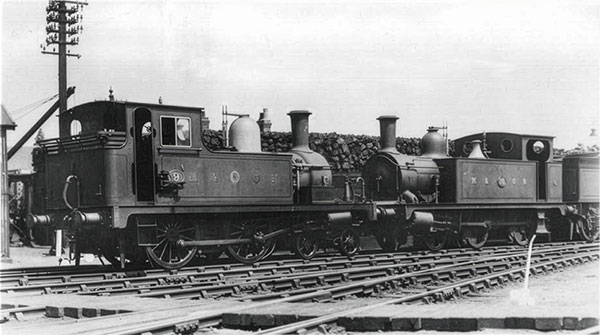
M&GN 4-4-0 tank no. 9 was a small, side-tank locomotive built by Hudswell, Clarke & Co. for the M&GN. It was one of seven similar engines built between 1878 and 1881 and was primarily used for working branch passenger trains, including those to Mundesley on the N&SJ line. While most of its class were withdrawn by the 1930s, No. 9, along with No. 20, survived into the 1930s.
Above right photo
The LNER continued to use several GNR class D2 4-4-0s . No. 4352 is seen waiting to leave for Gt Yarmouth on 20th June 1938. M&GN 0-6-0T no. 099 is engaged with shunting wagons beside the Goods Shed.


The Norfolk & Suffolk Joint Line (N&SJ) was jointly owned by the M&GN and the Great Eastern Railway (GER).  N&SJ trains ran from Runton East Junction to Cromer (Beach). Different companies' trains used different sections - N&SJ trains went to Mundesley to Cromer Beach, while GER trains would go to Sheringham. An unusual landmark was the Cromer Tunnel, which was part of the line and ran under the throat of GER's Cromer High Station. The N&SJ opened in 1902 and closed in 1952.


Mobile Crane 1937 Weed killer train c.1920
Melton West - 20th June 1938
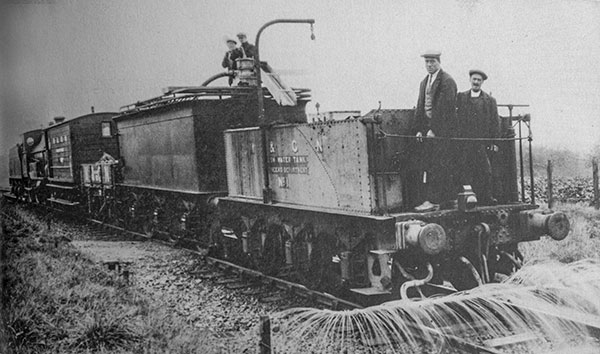
Weedkiller train based at Melton Constable - c.1920

Above left photo
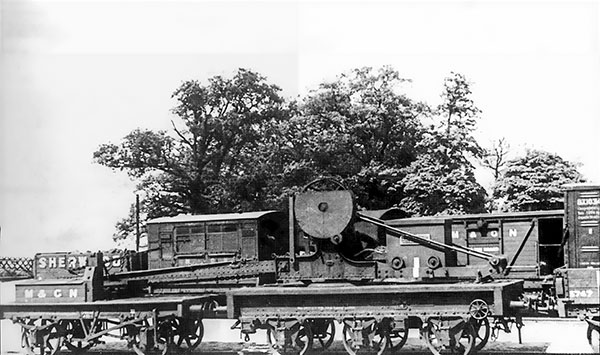
M&GN's mobile crane no. 491 built in 1904, was attached to a six wheeled wagon with a four wheeled wagon holding the jib.
Above right photo
Melton Constable's weedkiller rain that was often pulled by outside cylinder Beyer Peacock locos.


Effect of the General Strike of 1926
In the ten months to the end of October 1926, train mileage across the Joint decreased by 16% compared to 1925, while traffic revenue decreased by 13%. Receipts up to the end of April - immediately before the strike - showed an increase of £16,894 compared to the year before. By the end of July, however, receipts showed a decrease of £26,728. The ongoing curtailment of both passenger and freight traffic meant that by the end of October receipts showed a decrease of £67,224.
M&GN Circle


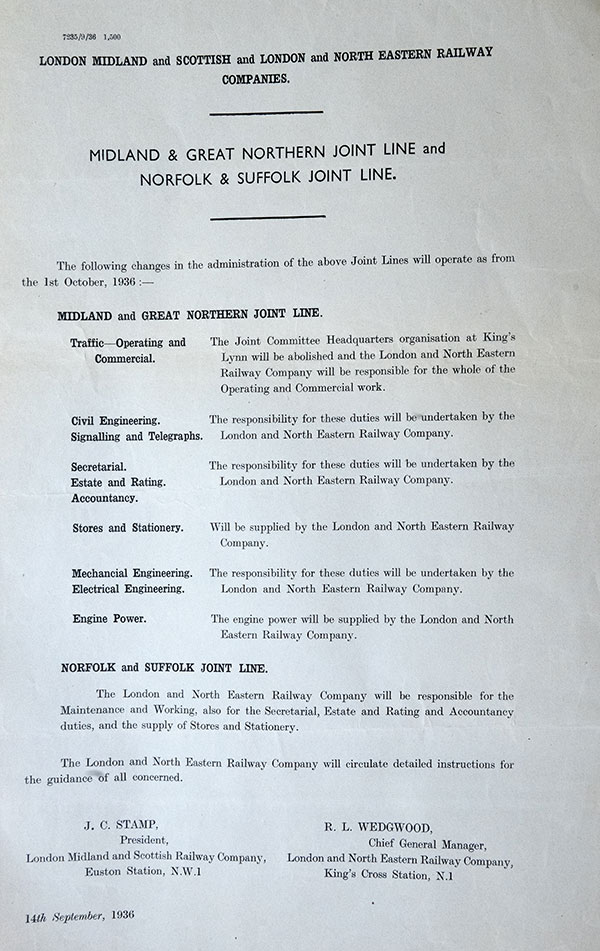
LNER takeover 1936

Melton West 20th June 1938 Cromer Crab train 1st July 1936
Melton West - 20th June 1938
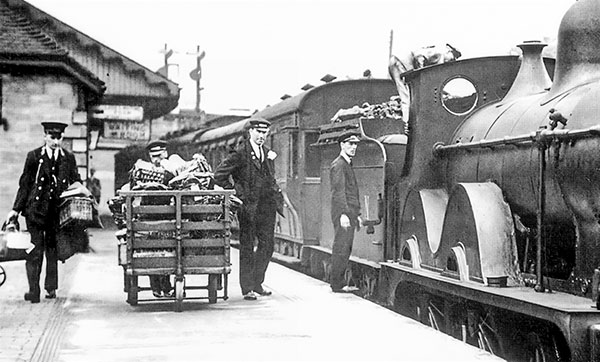
Cromer crabs unloaded from a train at Melton Constable - 1st July 1936

Above right photo
The guard on the left, Jack Childs, has finished his shift and is going home, wicker lunch basket in hand. George Cork is pushing a barrow of crabs. The smart gentleman with the buttonhole is Mr. Frary. Leslie Cousins is standing beside the engine and bending over on the tender is Fred Eke.


The Hush-Hush Train

Several weeks ago there was a film on television called "The Eagle Has Landed" adapted from the novel of the same name which dealt with a German plot to kidnap Winston Churchill when he was on a visit to North Norfolk.
On 5th June, 1941 my father received a letter from the Loco Superintendent to say that he and his fireman were to come on duty at a special time that night to prepare his engine and would be riding with an Inspector and Fitter. Two more men came on at the same time. My father had No.8887 which was a "Claud", and the other men had No.51 which was an old M&GN engine. They prepared the engines and then went to Peterborough North and waited for the train to come in from King's Cross. The movement of the train was kept a great secret because it was a Royal Train.
I did not know anything about this until a few weeks ago when the fireman who worked with my father visited me and asked if I knew about this trip. I looked throughout my father's records and found that they left Peterborough, everything being done very secretly. Then the fireman got off the engine to go and get the tail lamp, which was his job at Peterborough Station, he was told to go back and get on the engine. He said that when the tail lamps did eventually come, two soldiers brought them. Their tail lamp was put in the cab because they were double headed.
They were told that they had to have air-raid sheets and these were tied down either side of the cab. The fireman wanted to know how he was to change tablets and was told "Leave 'em - that'll be all right!", but of course after they started away they cut the strings and had the flaps open so they could get a little air on the footplate.
They worked the train to South Lynn where another four men took over to Melton Constable. Running into Melton they went right away to the carriage sidings where the train was guarded by soldiers all night long. At daybreak next morning the train was taken over by some Melton men who took it out all the way round the Cromer coast and we heard afterwards that they were inspecting the defences of the Norfolk coast.
The Royal Train was for the Prime Minister, Winston Churchill and his staff.
Apparently they dropped the tablet at Hillington and the fireman had to go back after it and nearly got shot! There was no argument about it - they meant it! The Inspector got off the engine to walk back for some reason and one of the soldiers who was guarding the train said "Get back on there or you'll get one through you!"
In the film the Germans were supposed to have landed on some marshes near Weybourne but apparently there is no evidence and no graves can be found of those who were supposedly killed in the ensuing fight - but Winston Churchill was staying in the area at that time."
Tom Stokes

A note from Ralph Kimber provides some additional information. He confirms it was a British High Command visit to Eastern Command. The Melton men used were A Walpole and E Mallett (drivers): H Sewell and H Olley(?) (firemen). He believes the VIPs in addition to Winston Churchill were Lord Gort, General Alexander, and General Horrocks. The train was put up Wyngate Sidings at Melton.
M&GN Circle


August 1955 28th February 1959
August 1955
28th February 1959

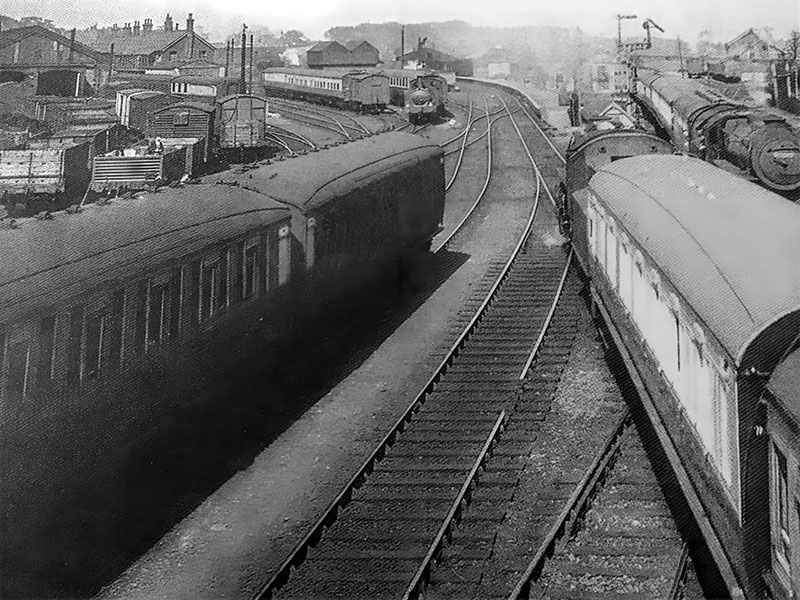
Traffic was of course heavy at Melton Constable, with trains approaching from four directions; but because of the combining or dividing of many trains, activity tended to be concentrated into short spaces of time, with long periods between where nothing much happened. However, the activity usually concerned passengers and goods passing through Melton Constable - the station itself was not a large generator of traffic, although there was a great deal of cattle handled. The busiest time of year was the summer season, when special trains from the Midlands would be coming in every few minutes and the staff in the refreshment room would be busy serving tea and sandwiches.
A lad would also meet the trains with a tray of chocolates and sandwiches. Melton Constable was also one of the few M&GN stations which had a W. H. Smith bookstall.
Nigel Digby


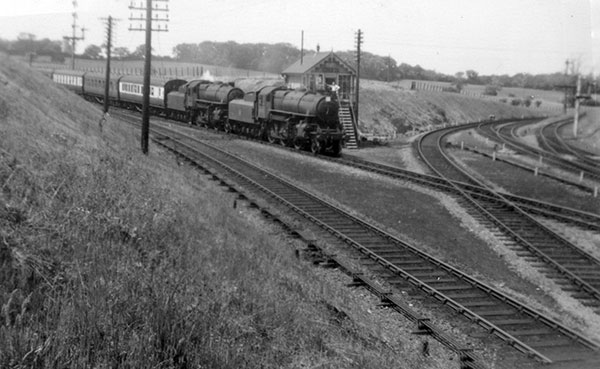
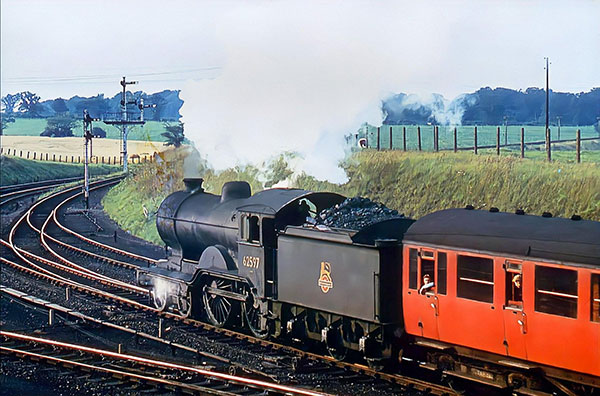
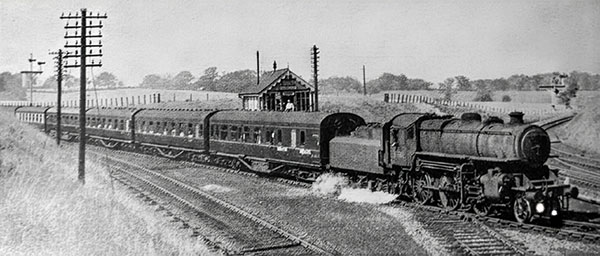
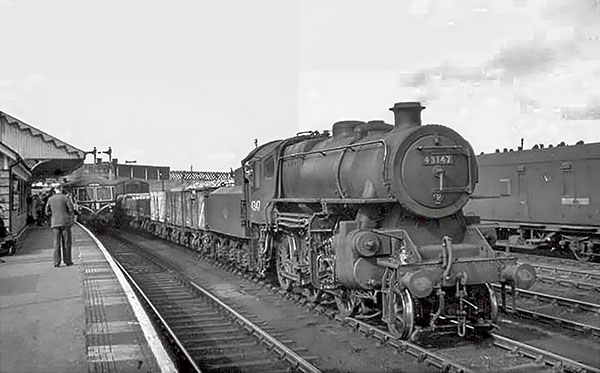
4MT doubler header LNER D16/3
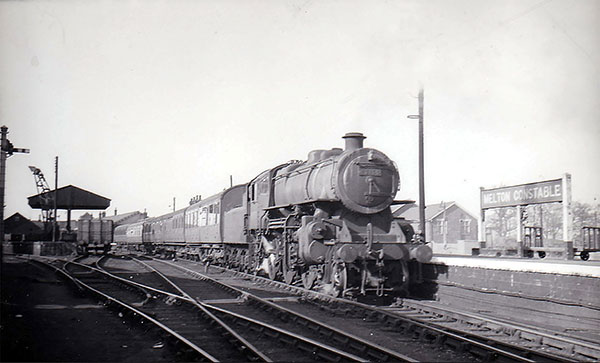
An unusual sight at Melton West of two 4MTs double heading
Ex LNER D16/3 4-4-0 62597 heading towards Holt

The combining of several trains into one at Melton Constable was a fascinating process, accomlished with military precision within the space of a few minutes. The prime example was the express to Birmingham, referred to by M&GN men as the Leicester and sometimes the Midland. Its assembly depended upon the period under consideration.
Before the First World War it was the policy for Norwich engines to run through to Leicester, which they had done since 1903.The Norwich portion arrived at the Up platform at the same time as the Cromer portion was arriving at the Down platform. The Norwich engine would draw its portion out onto the Cromer line and set back onto the Cromer carriages on the Down platform. Three minutes later the Yarmouth portion would arrive at the Up platform. The Cromer engine would draw forward onto the Yarmouth line and set back into the Up platform for the ex-Yarmouth portion, to place it onto the combined Norwich and Cromer portions on the Down platform, before the Norwich engine left Melton Constable with all three portions, wrong road from the Down Platform and taking the crossover by Melton West onto the Up line.
In the 1920s and '30s, it became the rule for either a Yarmouth or a Melton engine to take the train to Leicester and the method changed accordingly. It also became the custom to attach the express portion to local sets, which had not occurred before. The Norwich portion arrived at the Up platform with a local set plus two LM&SR coaches for Leicester. The Cromer portion arrived at the Down platform, again with a local set plus LM&SR coaches at the rear. The ex-Norwich train then drew out onto the Cromer line before setting back onto the ex-Cromer train on the Down platform. The LM&SR coaches were coupled together and the ex-Norwich local set detached. The Yarmouth portion then arrived at the Up platform, all three to five LM&SR coaches being for Leicester. The ex-Cromer drew its local set plus the Leicester coaches forward on the Yarmouth line and set back onto the coaches on the Up platform, combining all the Leicester coaches together. The Yarmouth engine would then take the train to Leicester, departing thirteen minutes after the first portion had arrived at Melton. The Norwich and Cromer engines and their local sets would then proceed on their next duties. If a relief engine was required , the Yarmouth engine would take the crossover onto the Up loop and then proceed to the loco area, while a Melton engine, which had been waiting by West box, would set back onto the carriages in the Up platform.
Finally, in the British Railways period, the method was different again. The coupling of the express portions to local sets had been discontinued. The Yarmouth portion arrived first on the Up platform and stopped as close to the starting signals as possible. The Norwich portion arrived next, again on the Up platform, the engine being released via the crossover onto the Up loop and then into the loco area. The Cromer portion would arrive at the down platform, and the engine would draw the train forward onto the Yarmouth line before setting back onto the coaches on the Up platform. All three portions would be coupled together and the Cromer engine detached, before the combined train departed.
Nigel Digby


B12 c.1956 c.1957
A B12 4-6-0 at Melton West heading for Kings Lynn
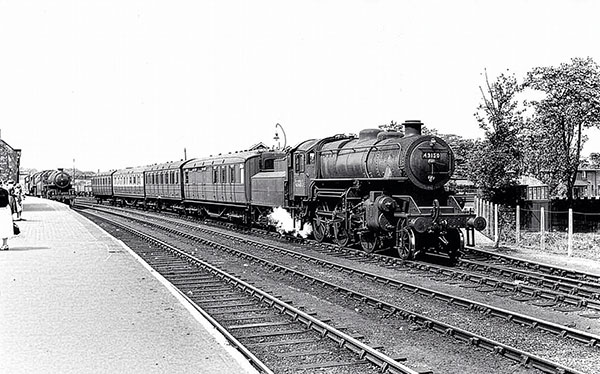
BR 4MT arriving from Kings Lynn - c.1957

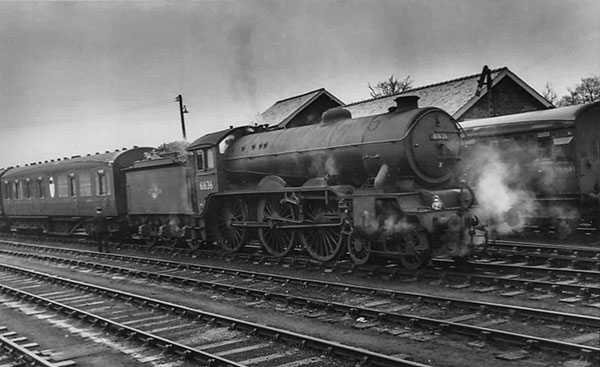
B17 4-6-0 Harlaxton Manor c.1962
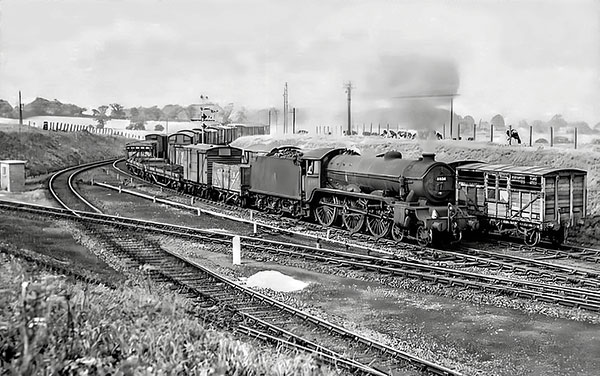
B17/6 4-6-0 Harlaxton Manor no. 61636 - 28th November 1958
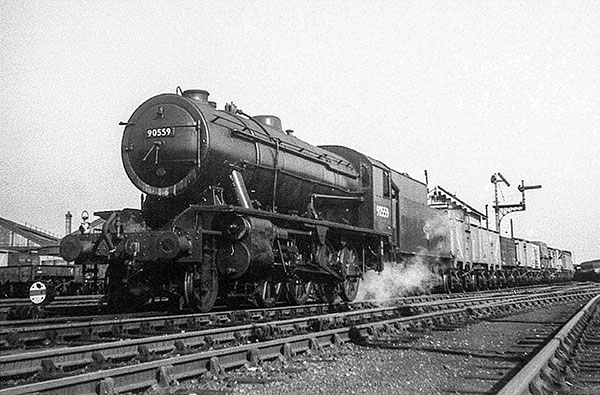
WD (War Department) Austerity no. 90559 leaving Melton East - 1959

Above left photo
B17/6 4-6-0 Harlaxton Manor shunting her carriage stock beside the Goods Shed, after bringing in the 1.37 pm from Cromer Beach.
Above right photo
WD (War Department) Austerity 8F 2-8-0 no. 90559 leaving with freight on the down line - 1959


June 1938 June 1938
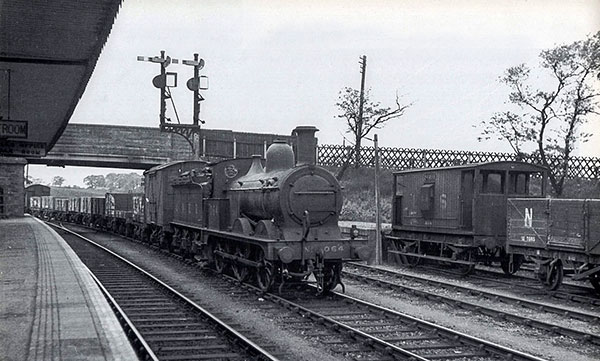
M&GN Class D no. 064 - LNER J40 0-6-0 arriving at Melton Constable - June 1938
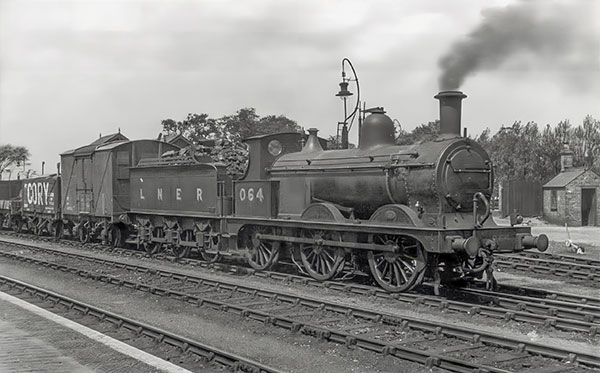
M&GN Class D no. 064 - LNER J40 0-6-0 standing in Melton Yard - June 1938

M&GN Class D no. 59 13th October 1954
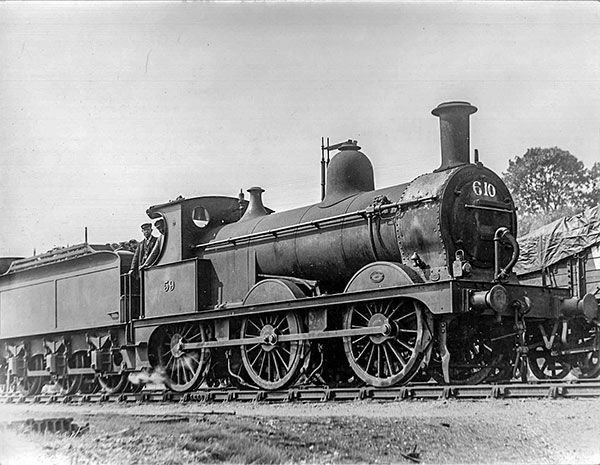
M&GN Class D no. 59 - LNER J40 0-6-0
Melton West with a B12 4-6-0 no.61520 from King's Lynn - 13th October 1954

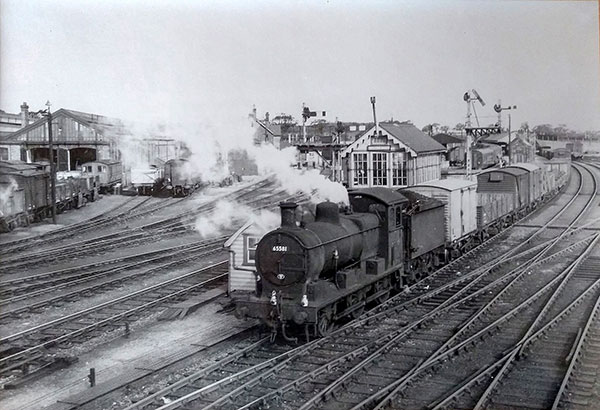
M&GN Class C freight train WD 2-8-0 September 1960
M&GN Class C in front of Melton Constable goods shed
(War Department) WD 2-8-0 with concrete freight from Lenwade - Sept 1960

The most important inward traffic was coal, both for the gasworks and for domestic use. There were several coal merchants in the yard over the years. The earliest merchant on the scene was J. O. Vinter of Cambridge, in 1883 noted as Vinter & Cooke but subsequently as Vinter alone. This tenancy was obviously seen as important as it was kept up until c.1930. Thomas Moy Ltd. of Colchester had arrived by 1896 and stayed until at least the end of the 1930s. By 1915, Melton Constable Co-operative Society had rented a coal ground and had acquired two wagons from Cox & West of Sheringham. This Co-op became part of the North Norfolk Co-operative in 1930 and a branch of the Norwich Co-operative Society in 1933. In the 1920s, Briston merchants Attoe & Twiddy and George C. Hewitt also rented allotment space, the latter having his own wagons, although there are no known photographs.
Nigel Digby


Melton Constable freight Melton Constable West c.1959
Melton Constable freight
Melton Constable West - c.1959

J17 freight 1959 c.1958
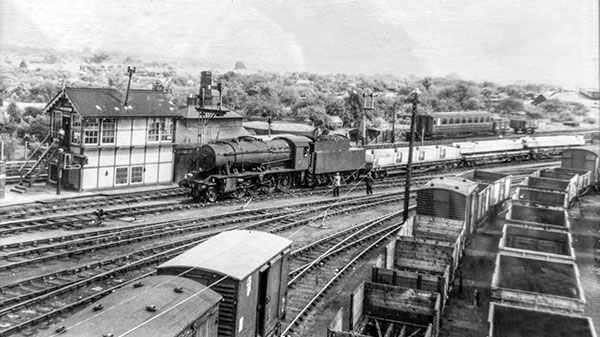
J17 0-6-0 hauling freight away from Melton East - 1959
4MT with freight, DMU waiting and filthy carriages behind - c.1958

The Yarmouth and Lynn lines were closed on 2nd March 1959 but the others remained in use, although the Norwich line was for goods only. Even this was closed to Guestwick when the new Themelthorpe cut-off was opened on 12th September 1960.Operation was concentrated on Melton East box and Melton West box was closed on 1st January 1961. The site remained open under the control of the East box until 6th April 1964. After closure, much of the infrastructure remained for several years.
Nigel Digby


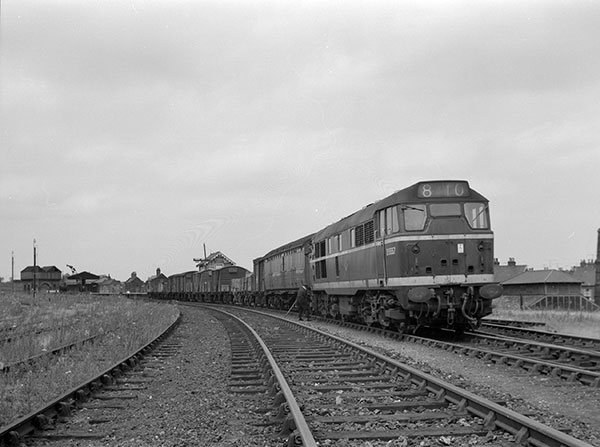
Type 31 c.1963 24th December 1963
Brush Type 31 at Melton East - c.1963
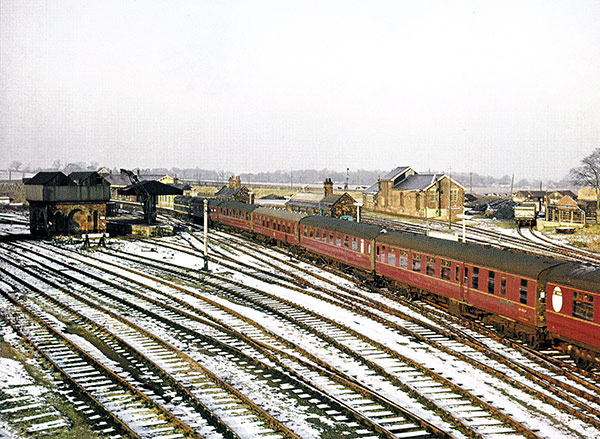
24th December 1963
Courtesy of M&GN Society

Above right photo
Brush type 2 diesel D5560 taking its train back to the platform for the 11.35 to Norwich Thorpe, having run around its coaches. The goods shed can be seen top right, with the coal yard to its right and the cattle loading pens on the extreme right. All steam traffic had ceased by that time.


If you have any memories, anecdotes or photos please let us know and we may be able to use them to update the site. By all means email or telephone 07836 675369.


Copyright © Jonathan Neville 2025
Top of Page