Melton Constable History

Home

Railway History

Engineering

Carriage &
Wagon Works

Carriage & wagon shop
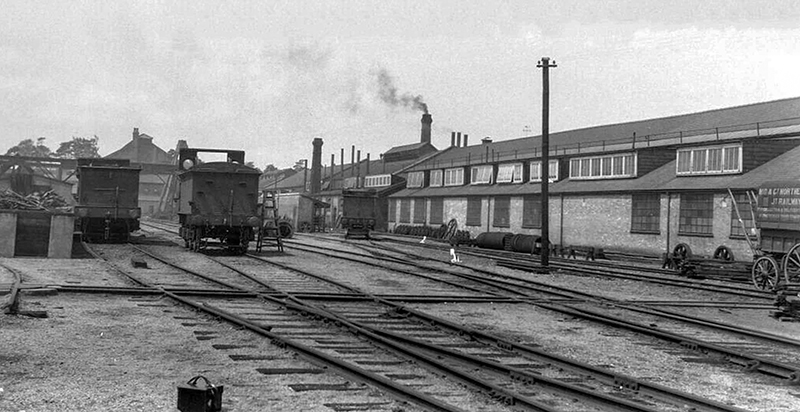
Above photo
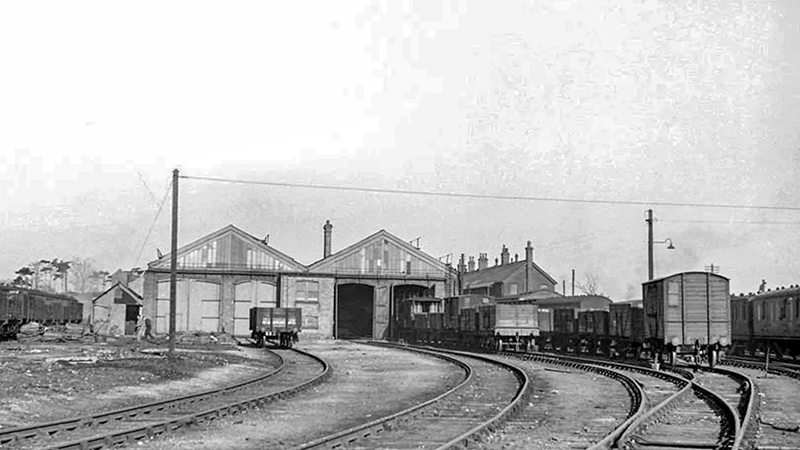
Tenders are parked on separate lines awaiting maintenance. A horse drawn delivery cart with raised shafts is on the right, also awaiting work. The narrow gauge parts delivery line can be clearly seen running horizontally at right angles to the main tracks, before moving through 90 degrees via a miniature turntable on the left border of the photo.

The dimensions of the works were:
Carriage and Wagon shop 80 ft. x 150 ft
Locomotive shop 120 ft. x 125 ft
Smith’s shop 40 ft. x 100 ft - with 30 forges and a 25 cwt. Massey steam hammer

The new works at Melton Constable were initially built and brought into operation by Mr J W Mann who had been appointed Locomotive Superintendent of the Lynn and Fakenham Railway in 1880. On 10th May 1881 the first track was laid, the foundations of the various shops were put in, part of the walls put up and the framework of many houses in Melton Street erected. Although commenced by the L&FR, completion was carried out by the Eastern & Midlands Railway. The works first operated in 1883.

At first a little trouble was experienced with the foundations in the mixture of sand, clay and marl but this was later overcome and the sheds of brick with iron window frames and iron and wood roofs safely erected. The ironwork was by Everitt, Adams & Co. of Great Ryburgh.

The works were compact and well equipped. The erecting shop had two roads and there was a machine shop, boiler shop, forge, smithy and other ancillary shops. Before the erecting shop was completed, lighter work, such as wheel removal, had been carried out in the open. The layout consisted of one island providing two 800 ft platforms enabling long trains to be divided as required. Lord Hastings had his private waiting room at the Lynn end of the up platform and on the opposite side. The provision of this amenity for the nobility was one of the original conditions of land transference. Most of the platforms were roofed. Internally the erecting shop was perhaps the most impressive in the whole of Norfolk. Water was obtained from a well 7 ft dia x 30 ft deep pumped by a 6NHP Tangye steam engine into a tank 20 ft high.

 The Works were brought into operation in 1883 by the Eastern & Midlands Railway when the local locomotive shops at Yarmouth and Fakenham were closed and all heavy repairs were transferred to Melton Constable. Mr J W Mann, who had overseen the construction of the works, resigned in 1884 and William_Marriott, who had become Civil Engineer of the Eastern & Midlands in 1883, was appointed Locomotive Superintendent.

During the next few years the works were occupied in heavy repairs to locomotives; the first rebuilding proper did not take place until 1890 when No.18, one of the Cornwall Mineral Railway engines, was converted to a 2-4-0 tender locomotive. Nos 13 and 3 were modified in the same way in 1891 and No. 14 in 1892. No. 29 (re-numbered 42) was rebuilt in 1891.

New engines received during the life of Eastern & Midlands Railway comprised three 4-4-0 express engines from Beyer, Peacock & Co, in November 1886, given numbers 29-31. In May 1888 Gorton Works despatched four more 4-4-0 Peacock engine locomotives to Melton Constable, allotted Nos. 32-35.

By the time the Midland and Great Northern Joint Railway was formed on 1st July 1893 the E&MR possessed thirty-six locomotives. This locomotive stock resolved itself into two main types that became the standard on the M&GNJR, viz. seven 4-4-0 side tanks and fifteen 4-4-0 tender express engines.

For some years after the M&GNJR was formed, Melton Constable was intensely occupied in general repair work to both locomotives and other rolling stock. Fifteen engines were rebuilt in the period 1895 - 1909. During this period Melton Constable also took delivery of thirty-three 4-4-0 inside cylinder passenger engines manufactured by Sharp, Stewart & Co. and in 1896 took receipt of eight 0-6-0 tender goods engines built by Neilson & Co. of Glasgow.

None of these later additions were suitable for shuttle passenger service and shunting duties. Consequently a new design of 0-6-0 side tank shunting engine was put in hand, mainly as “stock jobs”, to fill the demand for such a type in the extensive yards of Norwich, Yarmouth and South Lynn. Although classed for accountancy purposes as rebuilds these were in effect new engines utilising what parts were still serviceable from CMR engines purchased in 1880 and 1881. Altogether nine were constructed in the period 1897 - 1905; they were intended as replacements for six of the old Cornish Mineral engines, the old Black, Hawthorn saddle tank and engines purchased in 1880 and 1881. Altogether nine were constructed in the period 1897 - 1905; they were intended as replacements for six of the old Cornish Mineral engines, the old Black, Hawthorn saddle tank and two Fox, Walker engines. All nine of this class bore number-plates of E&MR design, i.e. red ground with golden gorse figures. The last of these nine engines was withdrawn from service in 1949.

These new 0-6-0Ts had two 16” x 20” diameter wheels, boiler with round top firebox with a total heating surface of 737 sq. ft. Those which had old boilers fitted operated at 140 lb/sq in and those with new boilers 150 lb/sq in. Their total weight in working order was 37 tons 13 cwt. Grate area was 11.3 sq ft. They had the Melton third pattern chimney, MR pattern boiler mountings and injectors below the tanks for flooding should they not start at once and get overheated. Other features were a fountain point just forward of the spectacle plate from which points to the whistle and other fittings were taken, steam brakes to the driving and trailing wheels although a hand operated brake with vertical spindle was also included. The connecting rods were outside the coupling rods and had open-ended big-ends with the small-ends adjustable by screw and wedge. Lubrication to the cylinders was by a sight-feed instrument not the old bubble type. Sanding was provided for running in either direction and all had vacuum brakes.
National Railway Museum


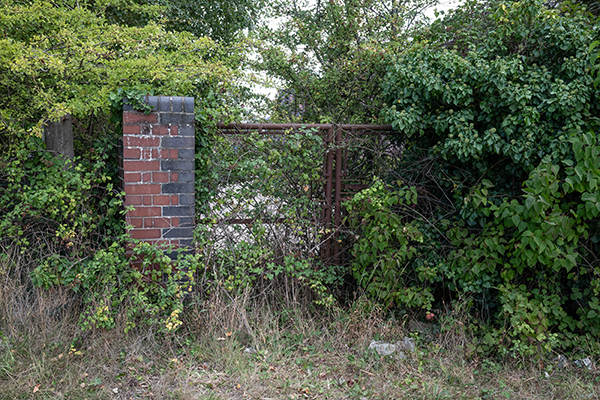
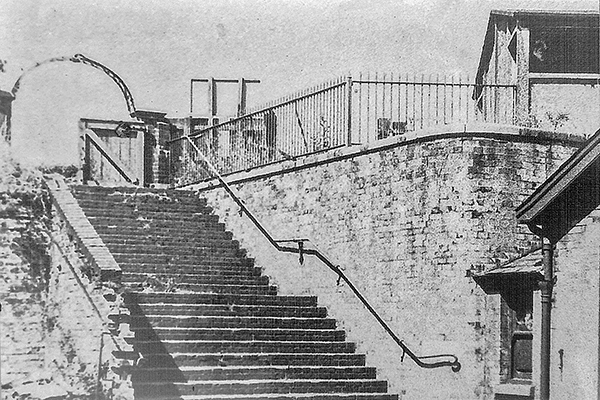
Workers entrance Workers entrance
Workers' entrance from the Hindolveston Road
Workers' entrance steps

Clocking in Office
Works clocking in Office

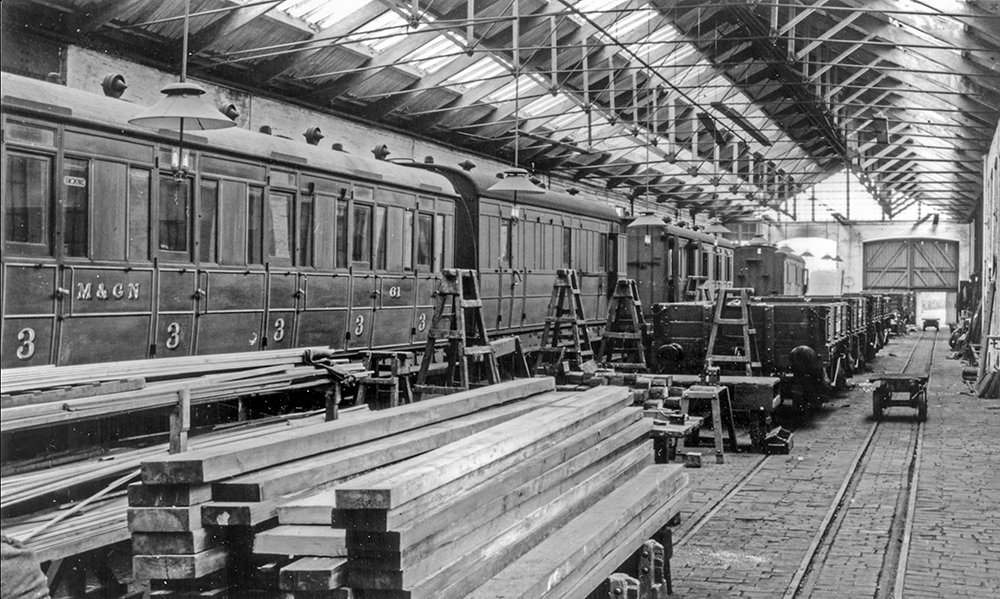
Carriage shop interior
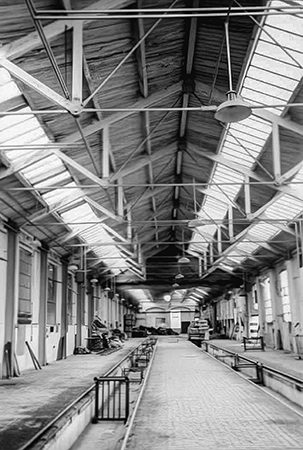
Carriage & wagon shop interior

 The steady increase in goods traffic demanded still more locomotives and Kitson & Co. Ltd supplied eight 0-6-0 goods tender engines in 1899 identical with those of the Midland Railway pattern. Again in 1900, twelve GNR 0-6-0 tender goods locomotives built by Dübs & Co., Glasgow were sent to Melton Constable.

A corresponding increase in passenger traffic called for further passenger engines and seven 4-4-0 inside cylinder locomotives were supplied by Beyer, Peacock & Co. Ltd. in 1899, similar to those of the MR, and also known as Class C.

In 1904 Melton Constable Works again undertook production of still more passenger locomotives, in this instance 4-4-2 tank engines. They were well-proportioned locomotives with sloping side tanks, two outside cylinders 17¼” x 24”, 3’-0” diameter bogie wheels, 6’-0” diameter drivers and 3’-6½” trailing wheels. The boiler had a round top firebox and a total heating surface of 1099 sq. ft. Boiler pressure was 160 lb/sq in and the total weight in working order was 68 tons 9 cwt. The boilers were similar to the MR Type 36 Class B and the fittings (the closed dome, the Ramsbottom safety valves with the elegant tail lever and combination injector mounted on the firebox backhead) followed Derby practice, except for the chimney which was of the Melton third pattern design. There was great similarity between the cylinders, wheels and motions of these engines and the original Peacocks supplied from 1882. The tank capacity was 1650 gallons of water and 2 tons of coal. Three 4-4-2T engines were built in 1904, 1909 and 1910 and saw service until 1944.

The nine 0-6-0T and three 4-4-2T locomotives built by the M & GNR all incorporated parts of those they replaced but the large amount of work entailed could justify them being termed “new”. After the 4-4-2T engines were built no further new locomotives were built at Melton but a great many modifications were always being made. At the time of Mr._Marriott’s retirement in 1924 his last locomotive list comprised ninety-five engines and there were four blank numbers available for any additions.

Melton Constable Works not only repaired existing stock supplied to the former companies but also built a number of new vehicles. In 1902, for example, the works turned out some trucks for travelling oil-gas holders, the trucks being made and erected in the carriage and wagon shop the twin 4 ft. 0 ins. diameter x 17 ft. 2 ins. long dish ended tanks being dealt with by the boiler shop and hydraulically tested to 10 psi. During the whole of this period maintenance work at Melton covered not only railway vehicles but the large fleet of horse-drawn delivery vans and trolleys as well.
National Railway Museum


Carriage & wagon shop

William Newman (Mr._Marriott’s first mechanical draughtsman and Chief Assistant to the Locomotive Superintendent since 1893) succeeded William Marriott as Resident Mechanical Engineer in 1924. He, like his predecessor, was faced with the ever-present demand for greater motive power to deal with the heavier trains, especially the summer excursions. No new engines were forthcoming and he tackled the problem by maintaining a rigidly high standard of maintenance of both locomotives and passenger stock. Mr. Newman retired in 1932.

He in turn was succeeded by Mr. A.H. Nash from Derby works. Apart from blast nozzle and chimney modifications, no fundamental changes were made to the engines in general during his period in charge and no new type of locomotive or new design was undertaken at Melton up to its closure. Mr. Nash left Melton in 1937 after the L&NER took charge.
National Railway Museum


c.1914
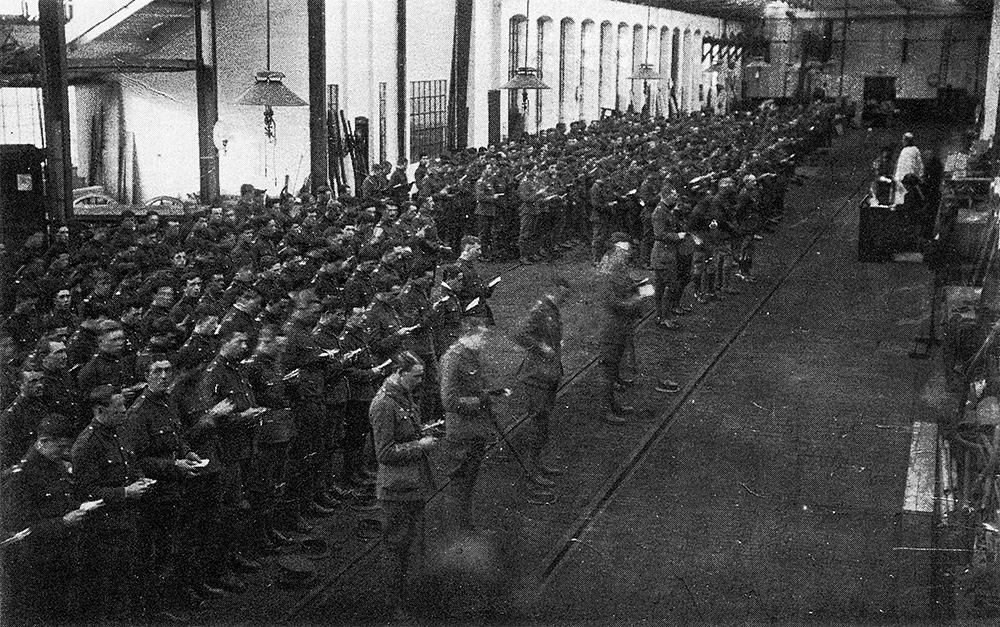
M&GN carriage shop service - Sunday 13th December 1914
Many troops were stationed close to Melton Constable at the beginning of WW1 and St Mary's tin church at Burgh Parva was far too small to accomodate a battalion of men. Thus Melton Constable's carriage shop was utilised for some services. The above photo shows the 5th Battalion of the Essex Regiment taking part in their Sunday service. Music for the hymns was played on the harmonium seen just to the left of the minister conducting the service.

c.1930
M&GN carriage shop clearly showing two trucks on the narrow gauge line used for moving materials around the works complex - c.1930

The Narrow Gauge Trolley Track by Frank Morgan

The track started under the water tanks at the engineer's department and was laid to give access to any part of the works and shops at Melton. If a heavy piece of equipment or heavy load of material was needed to be moved from one shop or department to another it could be loaded onto a trolley and pushed to anywhere in the works. Turntables were situated at all convenient points to allow passage into any shop. I think the track was twenty-four inches and the turntables were approximately three feet six inches to four feet in diameter; points were fitted at junctions other than the right angle turns. It was apparent that all the loco dept. i.e. boiler shop, fitting shop, clerk of works' shops and stores were all on level ground, whereas the engineer's dept. was on sloping ground, hence the reason for all engineer's dept. trolleys to be fitted with a brake while all the loco trolleys were not so fitted.
This brings to my mind an occasion when I had to go with the loco carpenter to take a load of timber to the saw mill. Imagine a man and a boy pushing a load of nine inch by two inch deals up the hill - you might be lucky enough to catch somebody to give you a push! We had to leave the timber to be machined and off we go with the empty trolley, with our trolley having no brakes I took a short piece of two by two and pushed it under the top of the trolley and onto the wheel to act as a brake (may I point out here that riding on trollies was strictly forbidden). We had just started going down the hill and old Fred knelt in the trolley knowing that I had it under control, and the temptation was far too much for me so I took out the two by two and jumped on. The trolley immediately picked up speed, the old man jumped off and went sprawling in the track and try as I might I could not get the temporary brake stuck in again and by now I dare not jump off so I hung on like grim death and it went right down to the power house and off the end of the track! I never dared to try that again, fortunately for us the matter passed without a report . . .
There was also a trolley track serving the concrete shop up Windgate Sidings. This was used for transporting the concrete blocks from the concrete shop to the stacking place and also to the loading sidings where the blocks were loaded into trucks for transport to various places; the points on this track consisted of one piece of rail on a central pivot which would connect either rail.
M&GN Circle


War Memories
War Memories

The Carriage & Wagon Department Personnel

To commence I must say that they were a happy lot in this department. I really can't remember any serious rows during my time there, plenty of leg pulling etc. but that was taken as it was meant.
Starting with the coachbuilders, they were Dick Shingler, Harry Holbrook, Billy Daniels, Len Dunthorne and Billy Le Grys, with apprentices Frank Morgan, Alec Holbrook, Barney Taberham and John Dack.

The Paint Shop consisted of Jimmy Platten, Herbert Rayner, Billy Edwards, Charlie Beckett and Jack Twiddy, with apprentices Charlie Porter, my brother Walter Lewis, Billy Shaw and Arthur Rayner. Billy Holbrook operated the woodwork machinery and Bob Brownsell the metalwork machines.

In the first of the workshops running down the side of the carriage shop were the pattern makers, Dick Groves with apprentice Reggie Slegg, followed by Fred Thompson.

Next in line came Billy Harrod in the paint finishing shop, then were the leather workers Harry Cook and his mate Jack Watts.

The coach trimmers next door were Albert Grint and Charlie Fox, and apprentices Albert Adams and myself. Basil Dix came in when Albert finished his time and went to join another ex-apprentice Ronnie Dack at Vauxhall Motors.

The subsidiary stores came next with Jimmy Bangay in charge. Following on we come to the wheelwrights Billy Broughton and Ernie Payne. I used to be fascinated when watching them repairing a wheel on a parcel van or dray.

Another two very skilled workers nearing the bottom of the carriage shop were Harry Frary and his mate Billy Eke, they were the vacuum fitters and last in the line was Jimmy Allison the blacksmith.

Completing the team were Dick Allison and Bert Neale the "heavy gang".

The wagon builder was Stanley Fields, Jesse Taberham assisted him when required and Jesse also made engine firelighters from old sleepers.

I mustn't forget our foreman Mr. Oliver Monks, we lads shewed him great respect, he was very strict but, I must add, very fair too. I remember having to ask him for time off to play football (cup replays and early evening kickoffs) and I was never refused. Ralph Groves worked in Mr. Monks' office.

I often had my leg pulled about football and I remember Harry Holbrook telling me that he would come and watch me play when I played at Wembley. I have played at Wembley but not the stadium I hasten to add.

Well I hope I haven't forgotten anyone, but it is, of course, over fifty years ago and our memories do sometimes play tricks; they were however happy days and a wonderful community to be brought up amongst.
Harry Lewis - 20th February 1989
M&GN Circle


c.1950
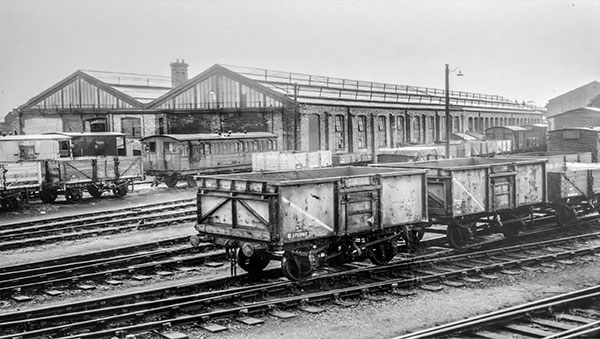
Rolling stock ready for scrapping - c.1950

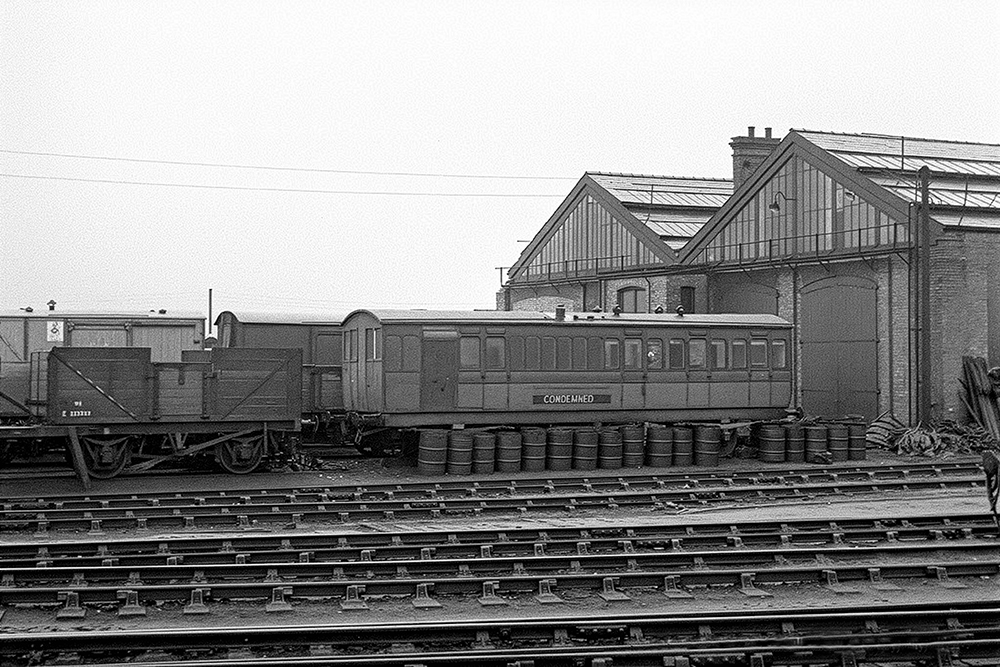
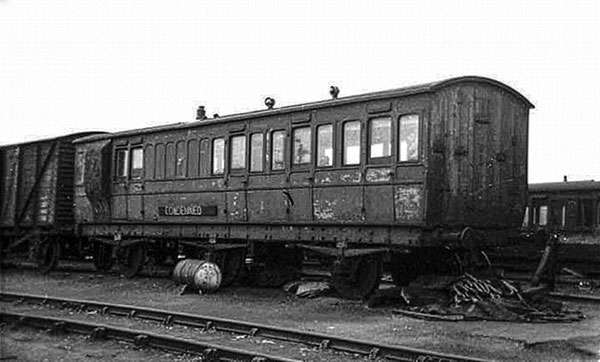
4th May 1961 Condemned carriage
Condemned rolling stock in front of the works shed - 4th May 1961
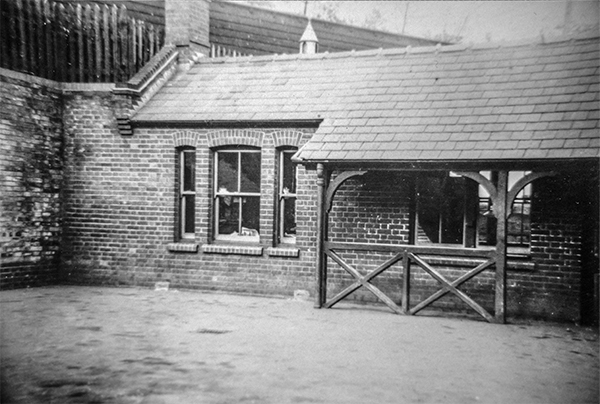
Condemned carriage, possibly of GER origin

Following on from the L&NER "take-over" in October, this month marks the 50th anniversary of the closure of Melton works and transfer of the locomotive department to Stratford. Small locomotive repairs were carried on for a time and the gas_works remained fully operational. Most M&GN men affected by the closure were apparently found other jobs but the effect on Melton Constable was clearly quite devastating. Eventually part of the works were turned over to the manufacture of wagon sheets, as Ralph Kimber explains :-

SHEET FACTORIES ON THE JOINT
"Did we have wagon sheets on the Joint? Of course we did! I was told a factory was near the loco department at Yarmouth Beach. I would like to put on record the sheet factory at Melton Constable. After the 1936 closure the works were slowly cleared and I understand most of the machinery which was of no use was scrapped and sold to Germany - who returned it ??
At the onset of WWII the works were slowly filled with WD and Air Ministry items also Food Ministry goods, from uniforms gauges and, I believe, tea. Day and night watchmen were employed, but little is known of what precisely was stored there.
However, in mid 1940 and early 1941 the stores were slowly moved out and officials were seen measuring the different buildings. As usual in a village rumours were rife in the Club and pub. "The works are to be re-opened" - partly true. It was remarkable how some folk found out details. Then at last it happened, a wagon sheet factory was to be opened as a result of the bombing of many railway works and factories.
New faces came and the first manager was a Mr. Easton from Gidea Park. His assistant was a Mr. Albert Milor from Newcastle. Shop foremen were Mr. Reg Scotney from Peterborough and Mr. Eric_Wiffen from Romford.
Mr. Lawrence Porter, who had been in an official position during the Food Ministry days was employed as a clerk, the Misses Jean Ward and Silvia Costessy worked in the offices, later joined by Mr. Roland Meek. Many local people were employed repairing old sheets and a machine shop was opened to make new sheets. Examination sheds were set up and a workforce of seventy plus was in project.
Heating was by an old boiler from the M&GN days and us young passed cleaners were employed to look after it. When it finally broke down an old 0-6-0 ex-GER goods engine was fitted to heat the factory until another boiler was installed. Fitting work was done by Stan Williamson, Jack Leamon, Fred Holmes and G. May.
Mr. Easton became active in the village and was Lieutenant in charge of the local Home Guard. Mr. Milor was a keen footballer and also kept the old Black Boys at Thornage. Reg Scotney became NUR secretary on the death of William H. Dalton and Eric Wiffen became secretary of a local sick and insurance club. Mr. L. Porter later retired and was replaced by Roland Meek.
Later, of course, a carriage and wagon works was opened, but I just felt that a record of the use the old M&GN works were finally put to should be recorded..
Ralph Kimber - 1986
M&GN Circle


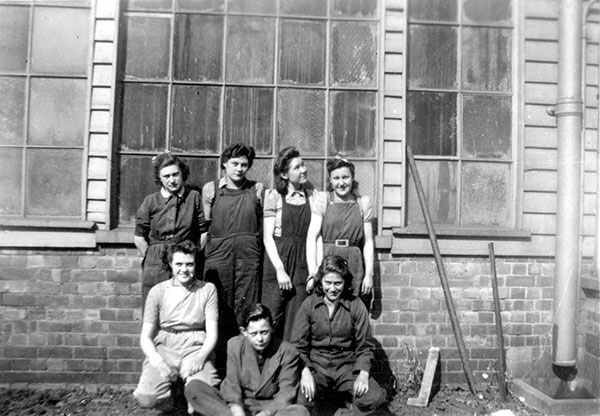
Sheet factory workers c.1942
Sheet factory workers - c.1942
Dot Colman
Dot Colman
Above left photo l-r
Back Row: Vera Dent, Gwen Morgan, Margaret Miller, Dulcie Mann
Front Row: Betty Jones, Derek Dann, Margaret Dent

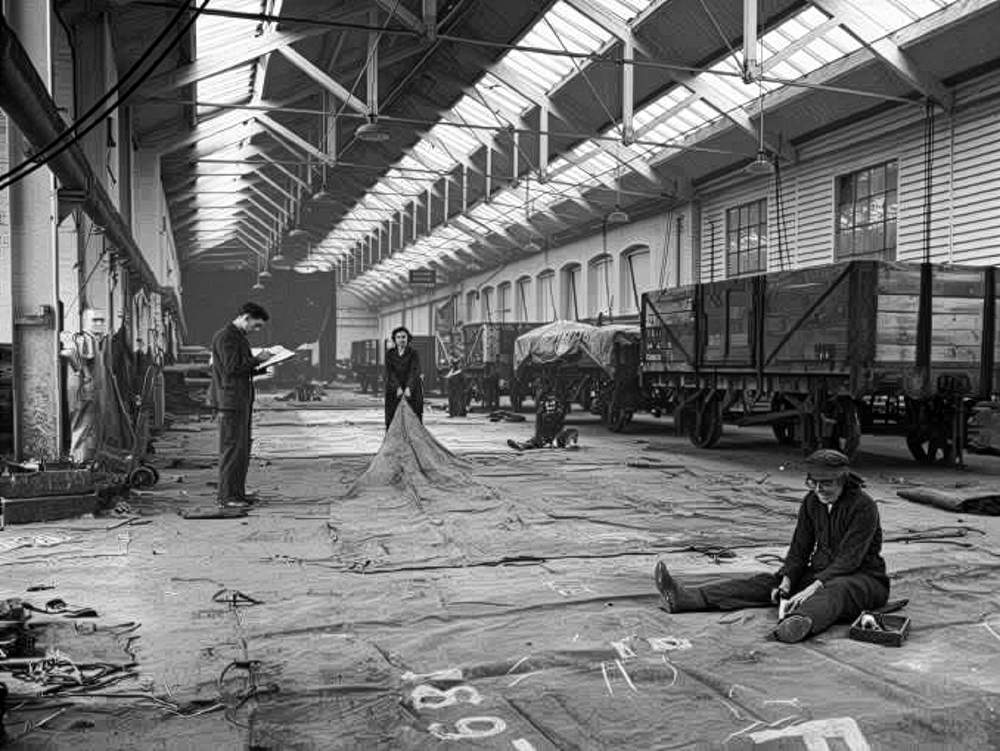
Sheet repairing 1955
Wagon sheet repairing - 1955
The sheet factory closed c.1964

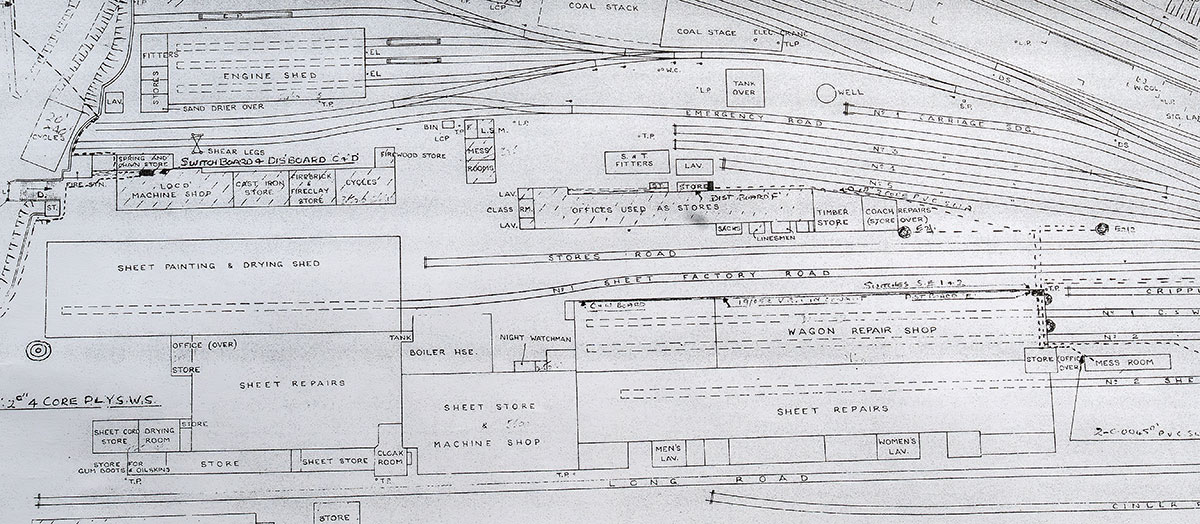
M&GN Works Map 29th May 1959
M&GN Closure Map - 29th May 1959

Operation of the M&GN was taken over by the London and North Eastern Railway on 1 October 1936 which transferred all locomotive operations to its Stratford Works as part of a move to rationalise functions of the Joint system. Melton Constable Works ceased to repair locomotives after this date, but the facilities continued to be used for wagon repairs and the scrapping of redundant rolling stock. Further rationalisation in 1945 left Melton Constable as a wagon sheet works, whilst declining traffic served to highlight the duplication of facilities between the M&GN and other Great Eastern lines. Most of the M&GN closed on 28 February 1959, leaving Melton Constable as the terminus of a branch from Sheringham until 4 April 1964 when it was closed to passengers.
Wikipedia


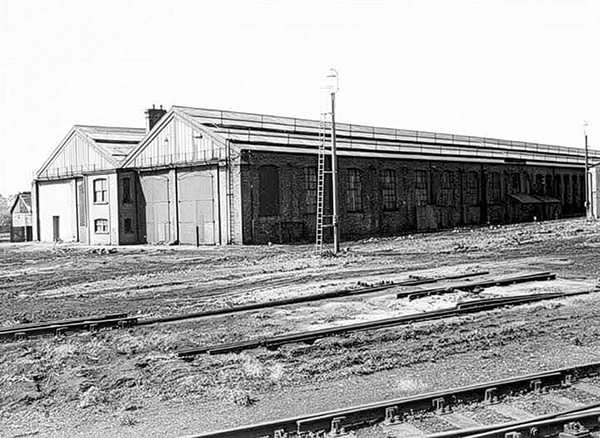
c.1962 c.1962
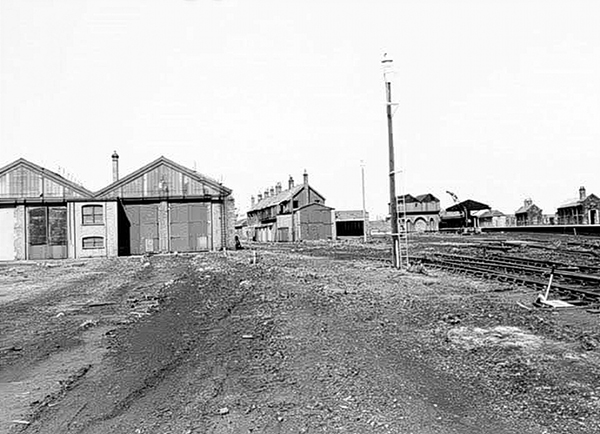
Carriage sheds after closure and the lines removed - c.1962


If you have any memories, anecdotes or photos please let us know and we may be able to use them to update the site. By all means email or telephone 07836 675369.


Copyright © Jonathan Neville 2025