Melton Constable History

Home

Railway History

Engineering &
Locomotive Works

Carriage & Wagon Works

The Midland and Great Northern Joint Railway comprised three units. The first consisted of four small contractors lines crossing the district between Peterborough, Bourne, Spalding and Kings Lynn opened in 1858-66 and worked by the Great Northern and Midland Companies both wanting to extend into north Norfolk. The second was an independent line from Yarmouth to North Walsham opened in 1879-81. The Lynn and Fakenham Railway merged with this company in 1882 to form the Eastern & Midlands Company. The Midland and Great Northern Joint Railway built its works at Melton Constable, the central junction on its system. The first track was laid in May 1881 and the works were brought into operation in 1883 and closed in October 1936.

The site of the works was original chosen by the Lynn and Fakenham Railway who undertook the initial building. A map of Norfolk shows a ridge of high land running roughly from a little northeast of Fakenham to that part of the coast between Cromer and Mundesley, the highest altitude being as much as 327 feet above Ordnance Datum in what is a generally very flat area. It follows that any railway to serve North Norfolk from the west must negotiate this Cromer Ridge. This requires the line either to run along the ridge or to cross it. In the other proposals, i.e. those of the Great Eastern Railway and the CNLR, these lines were to cross the ridge through the Briston Gap where the Glaven valley could have been reached without exceeding 160 feet above O.D. But the route of the Lynn & Fakenham Extension had first to ascend the ridge by the Thursford Bank to the summit of Pigg’s Grave 312 feet above O.D., run comparatively level to just west of Briston, where a station was proposed and gradually downhill south-east to Aylsham and beyond. One part of the western boundary of Melton Constable is 323 feet above O.D. and the site of the works about 280 feet and sloping slightly eastward.

In choosing the site the ruling factor was the availability of the necessary land. The major landowner was Lord Hastings and he made land available in the two adjoining parishes of Melton Constable and Burgh Parva so that the works and station became situated not in the existing settlement of Briston, but in an almost new village. Thus Melton Constable grew because of the Briston Gap (geological) and the position of the land made available (private enterprise). Any disadvantages were minor ones such as scarcity of labour, a slightly sloping site and variable soils – sand, chalk, marl and clay for foundations. The advantages were few but major, in that all reservoirs could be sited as high as possible on top of the slopes, the drainage was natural towards Burgh Beck in the north-west and River Bure in the east and 25 acres of land were available.
National Railway Museum


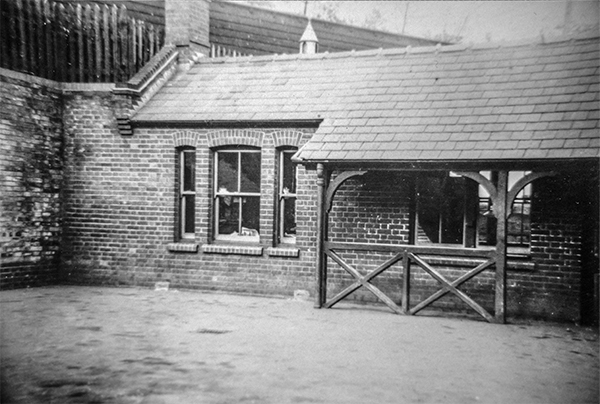
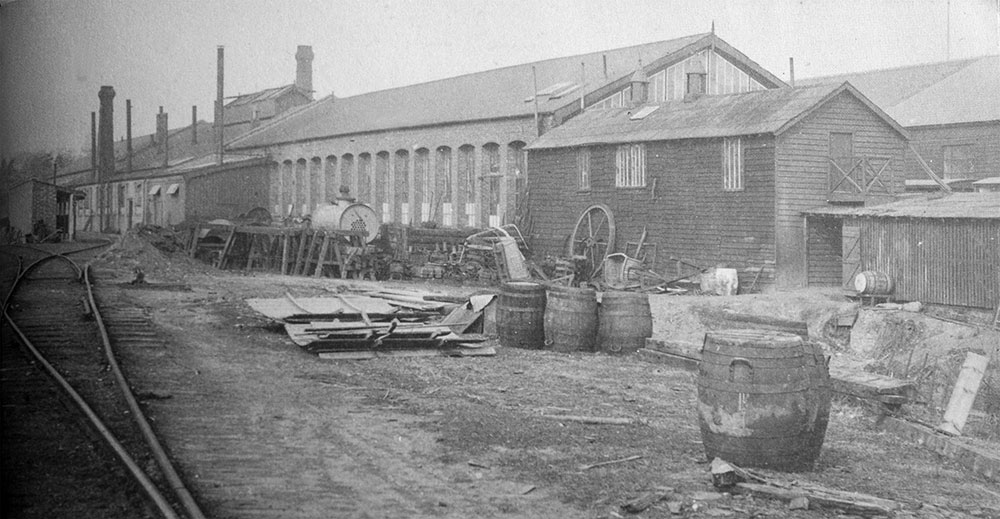
Rear of the works June 1929
Rear of the works on the east side - June 1929

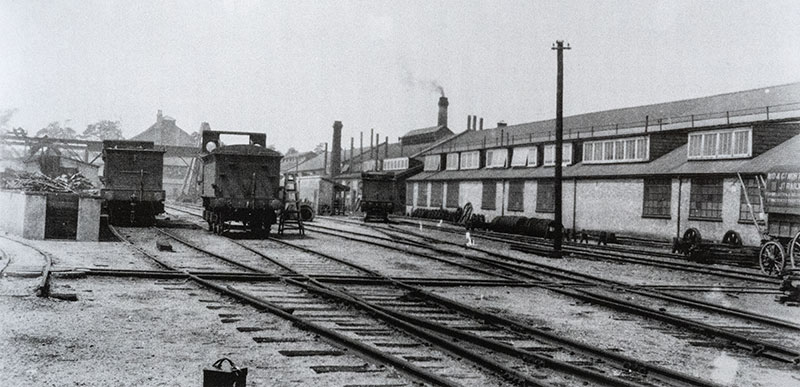
Above photo
The eastern side rear of the carriage and wagon shops housed the smaller workshops for trades that included upholstery trimmers and leather workers. The concrete works is off to the rear left. The horse drawn parcels van no. 72 is awaiting maintenance, as are three tenders. The tall smoking chimney is that of the foundry. The 2 foot gauge parts delivery line that ran through the works can be seen traversing left to right and its small turntable that turned trucks through 90 degrees, can be seen, lower centre and extreme left.
When the concrete shop was renewed in 1909, the tramway was enlarged to accommodate the increased working area.


The site of the works was original chosen by the Lynn and Fakenham Railway who undertook the initial building. The new works at Melton Constable were initially built and brought into operation by Mr J W Mann who had been appointed Locomotive Superintendent of the Lynn and Fakenham Railway in 1880. On 10th May 1881 the first track was laid, the foundations of the various shops were put in, part of the walls put up and the framework of many houses in Melton Street erected. Although commenced by the L&FR, completion was carried out by the Eastern & Midlands Railway.
The Works were brought into operation in 1883 by the Eastern & Midlands Railway when the local locomotive shops at Yarmouth and Fakenham were closed and all heavy repairs were transferred to Melton Constable. Mr J. W. Mann, who had overseen the construction of the works, resigned in 1884 and William Marriott, who had become Civil Engineer of the Eastern & Midlands in 1883, was appointed Locomotive Superintendent.
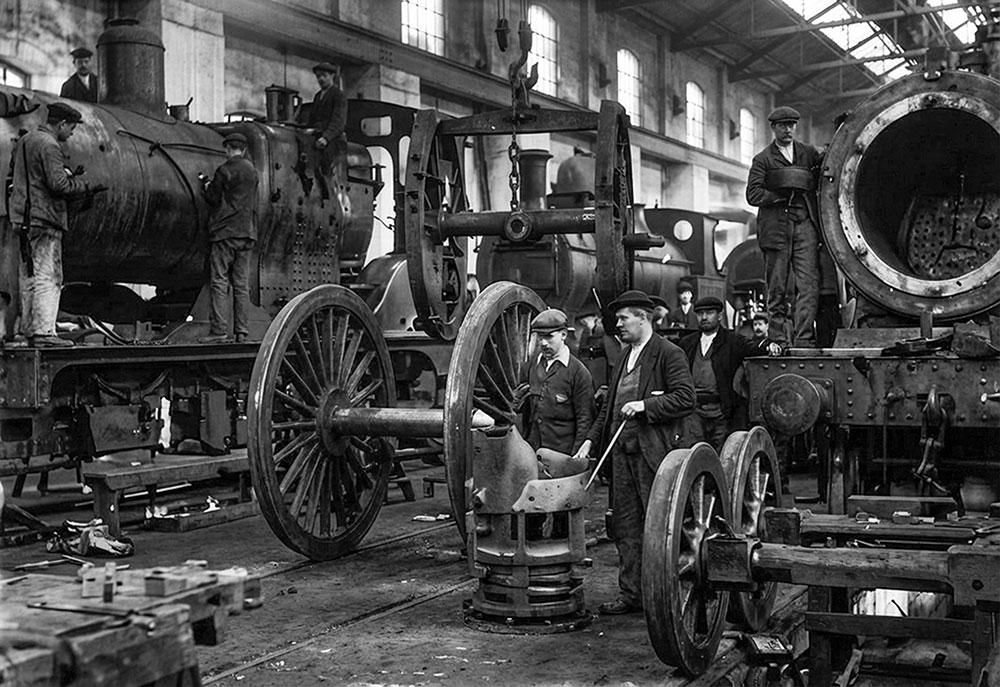
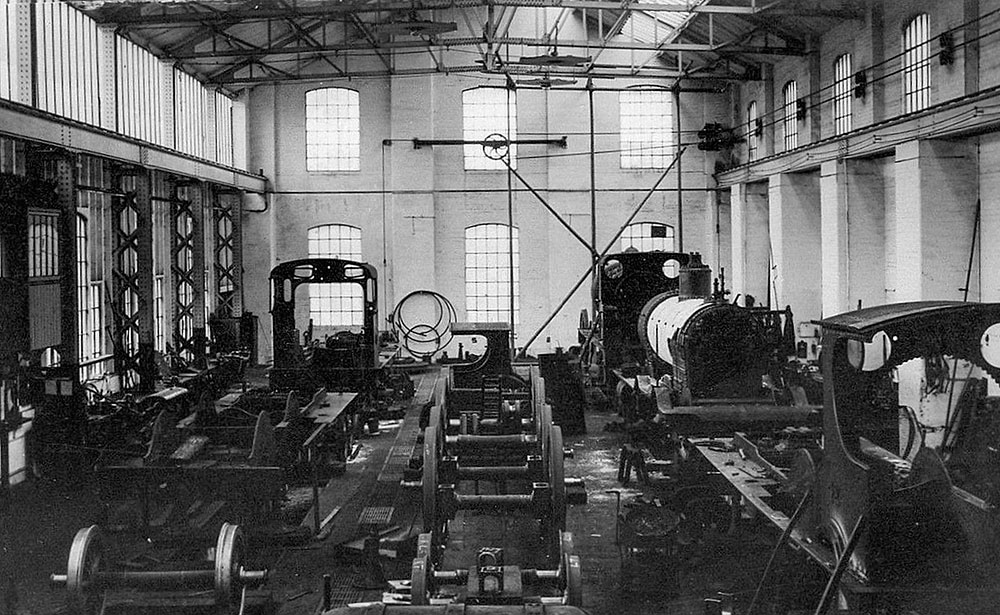
The works were compact and well equipped. The erecting shop had two roads and there was a machine shop, boiler shop, forge, smithy and other ancillary shops. Before the erecting shop was completed, lighter work, such as wheel removal, had been carried out in the open. The layout consisted of one island providing two 800 ft platforms enabling long trains to be divided as required. Most of the platforms were roofed.
Melton Constable Works not only repaired existing stock supplied to the former companies but also built a number of new vehicles. In 1902, for example, the works turned out some trucks for travelling oil-gas holders, the trucks being made and erected in the carriage and wagon shop the twin 4 ft. 0 ins. diameter x 17 ft. 2 ins. long dish ended tanks being dealt with by the boiler shop and hydraulically tested to 10 psi. During the whole of this period maintenance work at Melton covered not only railway vehicles but the large fleet of horse-drawn delivery vans and trolleys as well.
William Newman (Mr. Marriott’s first mechanical draughtsman and Chief Assistant to the Locomotive Superintendent since 1893) succeeded William Marriott as Resident Mechanical Engineer. He, like his predecessor, was faced with the ever-present demand for greater motive power to deal with the heavier trains, especially the summer excursions. No new engines were forthcoming and he tackled the problem by maintaining a rigidly high standard of maintenance of both locomotives and passenger stock. Mr. Newman retired in 1932.
He in turn was succeeded by Mr. A.H. Nash from Derby works. Apart from blast nozzle and chimney modifications, no fundamental changes were made to the engines in general during his period in charge and no new type of locomotive or new design was undertaken at Melton up to its closure. Mr. Nash left Melton in 1937 after the L&NER took charge.
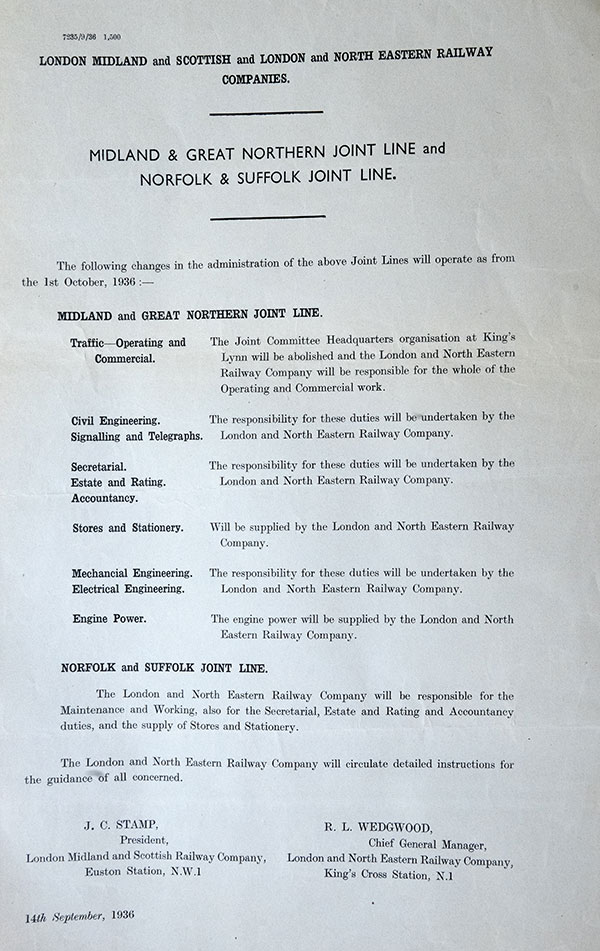
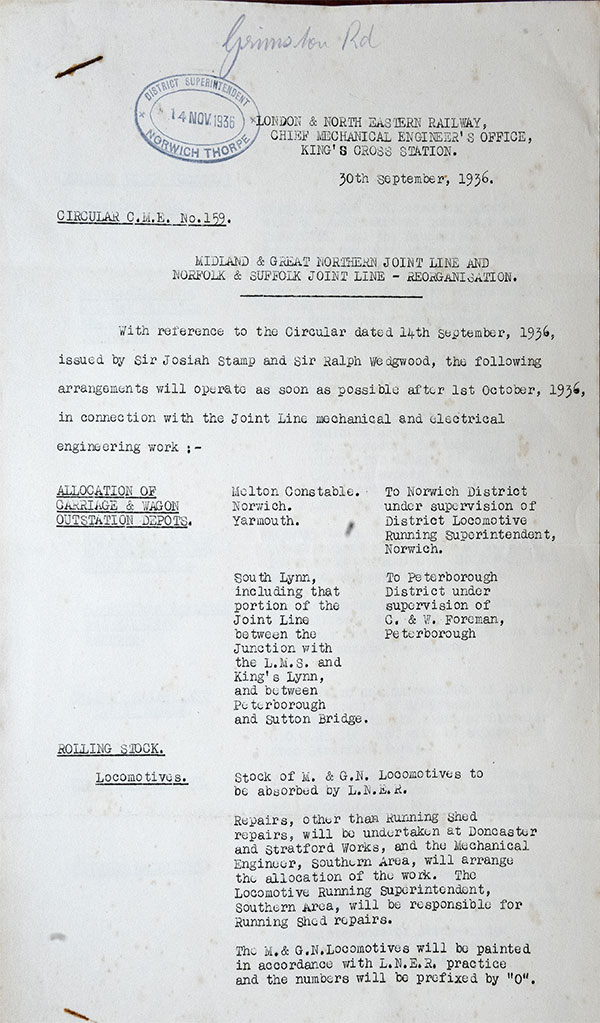
From 1921 and onwards the Melton shops were on short time and were closed on Saturdays from 25th October 1930. On 1st October 1936 the Joint locomotive stock was transferred to the L&NER. Steadily between 1936 and 1945 the old engines were gradually withdrawn and broken up. However two of the sturdy shunting tanks lasted long enough to be taken in to British Railways stock in 1948.
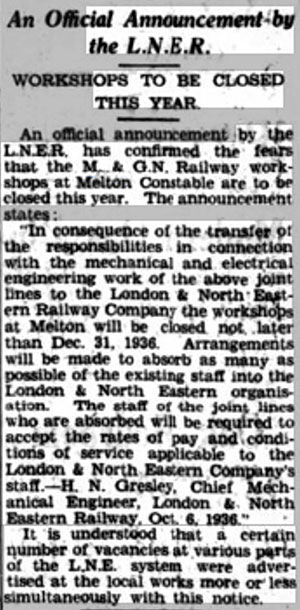
The Works closed in October 1936 and the Melton Gasworks finally closed on 3rd March 1962.
Science Museum Group


The story of Melton Constable over the years up to 1916 is one of almost constant development. Originally, the buildings only took up half the available land but from 1895, new signalling and telegraph buildings were erected along the southern boundary, along with sheds for stores. A new boiler shop was finished in November 1897 and the erecting shop was renewed in 1899. The large water tank (100,000 gallons) at the rear of the site was added in 1898 and also supplied the village. The paint shop was extended in 1902, its outer wall being of timber. In 1912 the carriage & wagon shop next to the paint shop was extended to the same size, but the wooden wall was retained as a partition.
Nigel Digby


A Stroll Around the Works at Melton - Frank Morgan

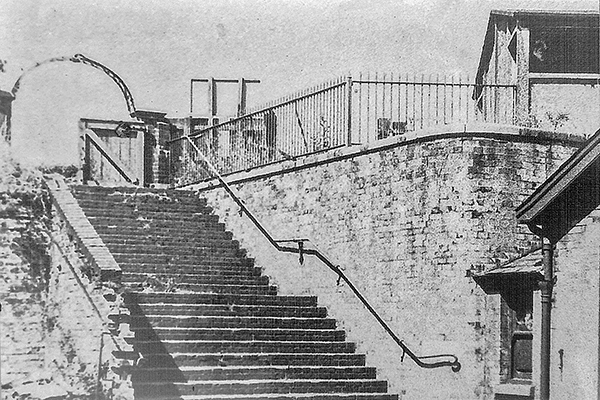
We start from the main entrance by the flight of about thirty well built brick steps (still in existence). At the bottom of these steps on the right hand side was the watchman's office where the officer on duty would stand and watch everyone go off duty; three of these men worked an eight hour shift. On the left of the steps was the time office employing four men, and on Friday when the "buzz" blew every man filed past by the wicket window in numerical order to draw their pay. May I add if you missed your turn you had to wait till last. Directly in front of you was the mess room which could easily seat all the men who had to stay there for dinner; one man and a boy did all the cleaning etc. in here.
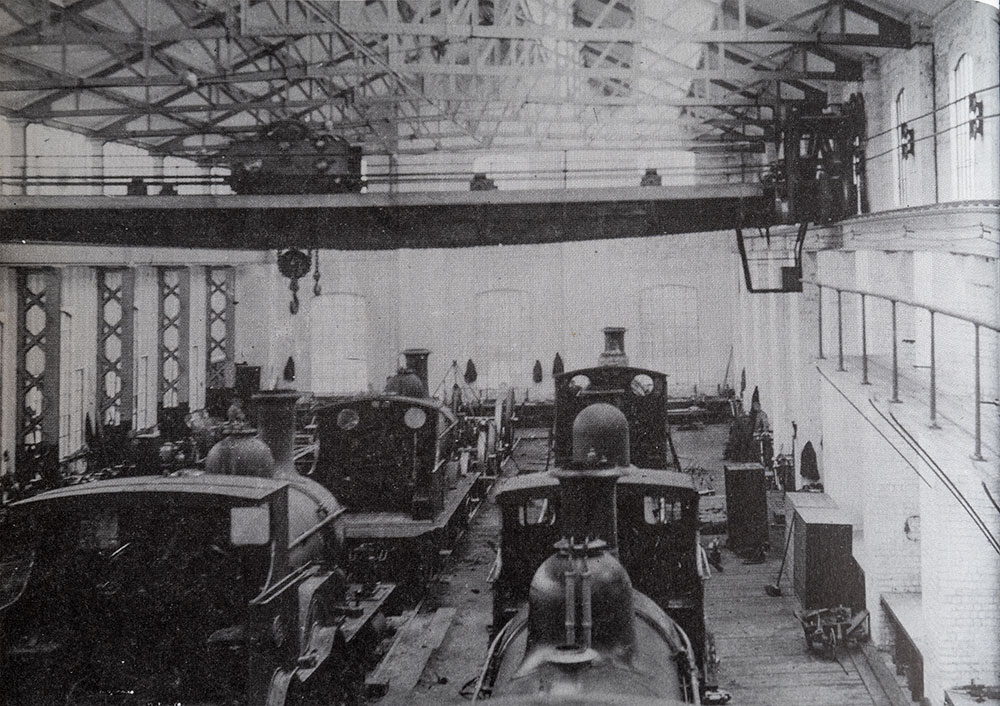
Next we come to the fitting and erecting shop - where all the engines were repaired and quite a few built. Engines would be stripped down to the frames and all parts repaired or replaced as required; the overhead crane could operate the whole length of the shop so no matter where the engine stood even the boiler could be lifted out and transferred to the boiler shop, (more on the boiler transfer later). There were three gangs of men in the erecting shop and there were benches all along the wall and the far end where fitters did the individual jobs.
On then to the machine shop where anything and everything could be turned from a bolt to a pair of engine wheels. Just outside the machine shop door was the "bosh" which consisted of two tanks about two feet six inches high and six feet square filled with caustic soda and was heated by a steam pipe, this would clean anything no matter how greasy it was, axle boxes, springs, the lot! The man who worked there was supplied with protective clothing and clogs, and well he might be!
Next to this was the coppersmith's shop - here all copper pipes were prepared, also the bearings were "metalled up". At times in there during operations the fumes would make a casual visitor gasp for breath. Adjoining this was the loco carpenter's shop, whose job was to lag the engine boilers, fit the engine footboards, fit hammer shafts and anything that might crop up (see later).
We must retrace our steps a little, back through the machine shop, past the grindery where some very professional men could grind with precision. In the corner of the machine shop was the engine room, here was a wonderfully kept engine with a fly-wheel of about twelve feet in diameter and was about twelve inches thick. This engine was polished and kept in tip-top condition and it supplied the power for all machinery in the loco dept. It amazed me to stand and watch the attendant stop that machine with the piston in the exact position so as to get a good start the next day. Also in the engine room was the chain hanging down by the clock for releasing steam to blow the "buzz". This buzz, by the way, on a clear day could be heard almost five miles away.
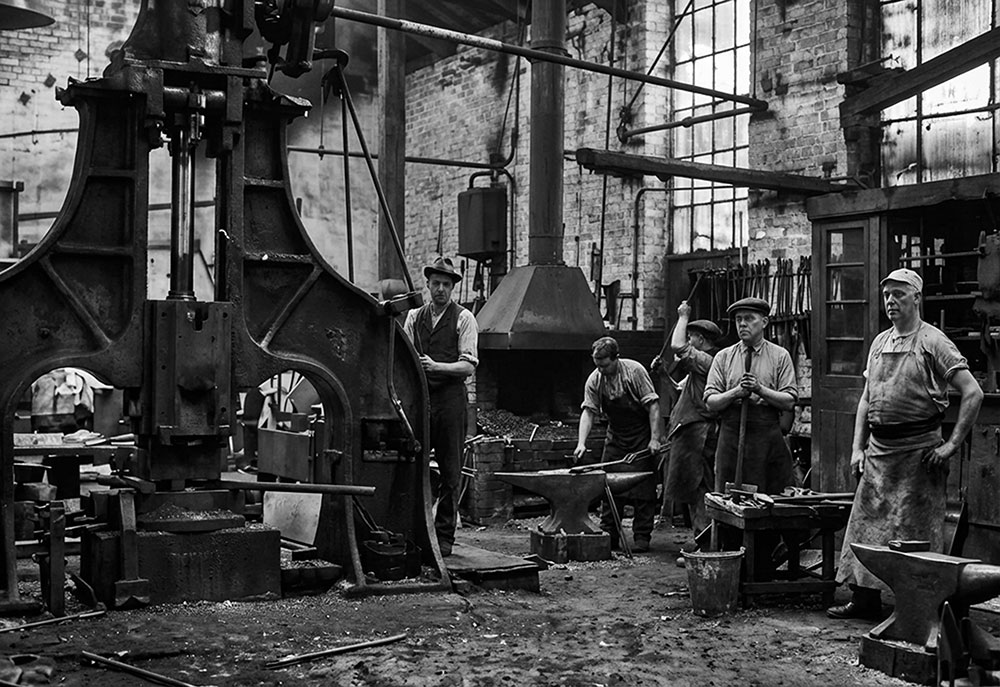
On then to the blacksmith's shop, five forges down each side and three steam hammers down the middle of the shop, the first one was quite small, the next one about twice the size and the third one was quite a bruiser. When this one was in operation it shook the floor right through the carriage shop. In the corner was a funny little contraption in the form of a power hammer and operated by two men standing one behind the other with one foot on a long board and they both applied their weight and this brought the hammer down in the form of a miniature steam hammer; this was used for making bolts of all sizes.
Through into the carriage shop, first, in the corner section all the machines, circular saw, planes, band saw, drilling machines, grindstone, lathes; the carriage and wagon shop where naturally all carriages and wagons were overhauled, repaired, painted and so on. Along the side of the wagon shop were lean-to shops consisting of pattern makers, varnishers, leather worker, coach trimmer, stores, wheelwright, (who is also repaired all road vehicles), coach fitter, blacksmith and bosh.
The boiler shop stood on its own as did the tender shop. To drive the machinery in the boiler shop a shaft ran underground from the machine shop under a set of rails and into the boiler shop. Here again was another strange machine, long and cylindrical, a whole set of boiler tubes could be put in and revolved and the process straightened the tubes out and and at the same time cleaned all the verdigris off and shewed up any weak spots. Now you might wonder how the boilers were transferred from the erecting shop to the boiler shop. This was an operation which had to be seen to be believed! First the boiler was lifted out of the frame by the overhead crane, traversed to the end of the shop and placed on two bogies, a chain slung around it and secured, then "Black Bess" was somehow coupled on and so the tow began, bearing in mind the boiler shop and erecting shop stood parallel with each other and about fifty yards between them, this load had got to travel about half a mile to get to the boiler shop. It was towed down the yard over several sets of points and then propelled back to the boiler shop, having completed a tour of half the yard. On arrival the boiler was lifted off the bogies, this time with a manual operated crane and placed in position for repaint.
Across the yard was the compound, all metal sheets, rods of all description were kept here. Adjoining this was a building known as the "white city" which was the store shed for all the patterns which were made for all the various fittings appertaining to the smooth running of the Joint. Also, this shed housed the spare boat for Breydon Bridge, this boat was always kept in good repair in case of emergency with the regular boat. Along the outside of this shed was a row of scrap bins each one labelled so that mild steel did not get mixed with spring steel, etc. The steam for driving the machinery was supplied by (I think) six boilers in the boiler house, and next door was the compression house, providing compressed air which was piped all over the depot. The foundry was situated at the end of the mess room and provided all castings of any description.

Last, but not least, was a huge block of office buildings. All around the works was a trolley track providing access to any part of the works.
M&GN Circle


Like most Meltonians I was born into a railway family, my father Sydney, was a chargehand boilersmith, my grandfather, Walter, a signal inspector; my uncle Horace, after serving his apprenticeship left Melton Constable to go to London Kings Cross depot; and my uncle Mathew, after serving his apprenticeship left to enter the Royal Navy.
As I approached school-leaving age I sat the entrance examination to enter the M&GN works and having been informed I had passed went for an interview and was accepted for as fitter and turner apprenticeship. As my birthday was on Boxing Day I was to start in January 1934. When the big day came I was kitted out in a boiler suit and work boots, at this stage I do not know who was worried the most, my mother or I. So after a "cheerio" off I went up the hill at Melton with my father.
Having been shewn where and how to clock-on, I was taken into the machine shop and taken to a centre lathe and over the next week was shewn how to operate it. The overhead shafting and drive belts were so noisy compared with the classrooms at school that I began to wonder if I could stand it, but after a few weeks it became natural and very little notice was taken of it. In the machine shop was an outstanding machine, a fairly new capstan lathe operated by Jack Anderson and we as new boys would look and marvel at his operating of such a magnificent piece of machinery.
At the end of the year, I was transferred into the fitting shop into a gang headed by Fred Bell, the two senior fitters being Bert Frosdick and Wilf Rayner with the odd job man being Joe Horne of Salvation Army fame. My teacher was Wilf Rayner who taught me very well and I shall always remember stripping all the things like injectors, gauges, etc. from the cab end of the boiler, then as was usual, some studs were broken, so we got out the drill post and the pneumatic drill to put a hole through the centre of the studs and then with a hammer and chisel very carefully break out the stud shell leaving the hole ready for re-tapping. A great sense of achievement was felt after bedding in my first regulator valve and first axle box.
When the boilers were finished and all of the gauges, etc. were fitted they were put outside the boiler shop for steam testing. My biggest day was due as a boiler to which I had fitted the various parts on to the cab end, as usual lots of eyes were on every boiler under test to see if any steam leaks shewed. The night before the test I did not sleep too good as I wanted everything to go well so that my father would not be disappointed in me. Came the day and I am pleased to say no steam leaks and the "Well done son" from my father made me feel on top of the world.
The fitting shop foreman was Charlie Dyer. In the summer time when weather permitted the windows near the roof over the overhead crane rails were opened and birds used to fly in and out. One day a pigeon came in and sat on the crane rail and several people tried scaring it off and I remember picking up an old nut and shying at it, missing of course, and the nut sailed through one of the panes, this was just before the lunch break. After lunch Mr Dyer came and tapped me on the shoulder saying "See that broken pane up there laddie?", I replied "Yes, Sir", then he said "Do you know how it happened?". I was so scared I am afraid I lied and said, "No, Sir", whereupon he said "Well if you do laddie make sure you come and tell me", and as he walked off a grin came on his face, and I realised that he knew I had done it.
Len Bussey MBE - M&GN Circle


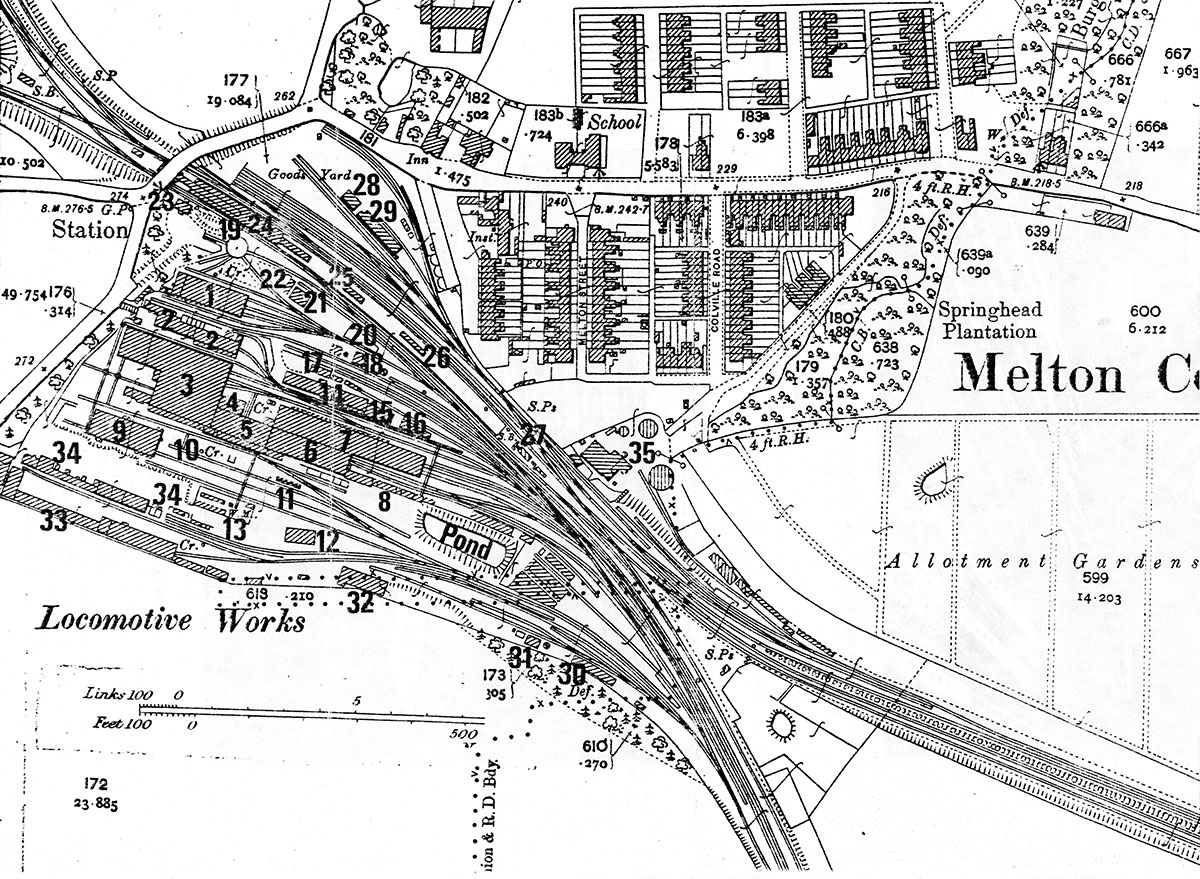
Works map 1905
O.S. map 1904

1. Loco Shop
2. Time Office, Mess Room, Foundry
3. Fitting Shop, Machine Shop, Gas Fitters, Brass Finishers
4. Boiler House
5. Blacksmiths' Shop
6. Wagon Shop
7. Carriage Shop
8. Pattern Shop, Varnish, Leather,Trimmers, Fitters, Blacksmiths
9. Boiler Shop
10. Tender Shop
11. Toilets
12. Pattern Stores,Spare Boats Breydon Bridge (White City)
13. Compound
14. General Offices, General Stores
15. Paper Stores
16. Timber Shed
17. Ambulance Room, Clerks Toilets
18. Water Tanks for Locomotives

19. Turntable
20. Coal Stage
21. Oil Stores
22. Loco Mess Room
23. Lord Hasting's Waiting Room
24. Porters Room, Station Entrance Steps, Booking Office, Parcels Office, Refreshment Rooms, W. H. Smith Bookstall
25. Waiting Room, Ladies Toilets
26. Telegraph Office, Station Master's Office, Inspector's Office
27. Melton East Signal Box, Toilets, Shunters' Hut, C&W Hut, S&T Hut
28. Goods Office
29. Goods Shed
30. Key Stores for Permanant Way
31. Pump House, Power House
32. Timber Drying Shed
33. Permanent Way Shops
34. Concrete Shop
35. Gas Works

There had been a pond in the south eastern area of the site, as marked on the above map. It gradually reduced in size as it was used to dump waste. It was said that it was eventually filled with old locomotive wheels when the carriage & wagon shed was extended, before additional sidings were laid over it.

Workers entrance Workers entrance
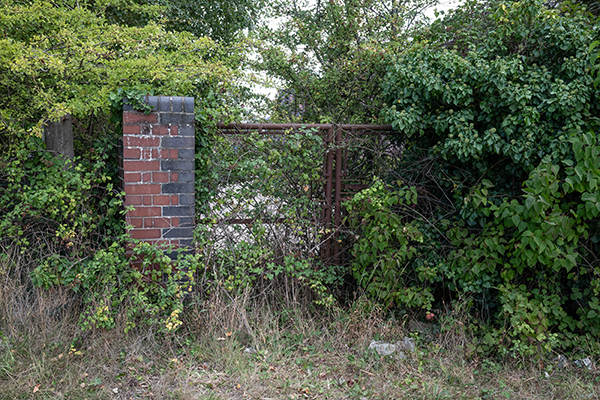
Workers' entrance from the Hindolveston Road
Workers' entrance steps

Clocking in Office Works Leaving Off time - c.1914
Works clocking in Office
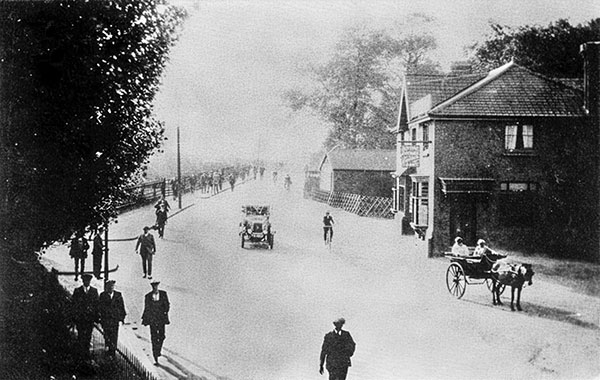
Leaving Off time 5.30 p.m., Briston Road - c.1914

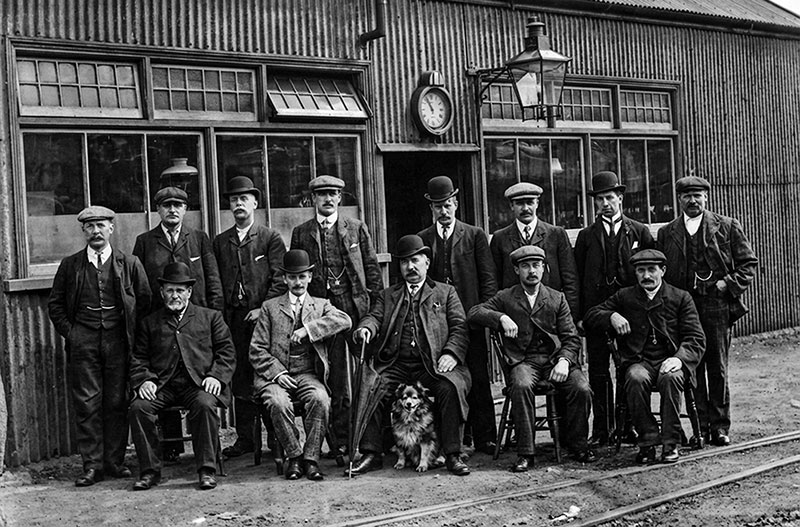
578 Running Shed Footplate Staff
Above photo taken in front of the Signing On Office and the Night Foreman's Office
Back row:-

Arthur Mallett, John Loynes, George Vince, Albert Hall, George Leverick, David Long, Albert Walpole, William English
Front row:-
Thomas Long, Walter Stangroom, A. Stewart Turbett (Running Shed Foreman), Walter Pilch, Fred Morgan

Melton Works - The Erecting Shop by L. C. Porter

A Seven Year Apprenticeship At The Works - I was an apprentice at Melton Works from 1917 to 1924. In May 917, at 6.00am. I reported to Mr. C. Dyer, the fitting shop foreman. He handed me over to Mr. Tom Green who was motion fitter dealing with slide bars, pistons, cross-heads, and slipper blocks. I was then kitted out with one hammer, four chisels, six files, and stayed with this section for six months.
Then I moved on to J. Holmes, known as "Derby" Jack, working on big and little ends, and connecting rods, for a further six months. Transferring to the machine shop, foreman Mr. J. Williamson, I tackled lathe work for two and a half years.
The remainder of my seven years was made up of a year at the drawing office, where the head draughtsman was Mr.G. Clarke. Subsequently I went to the erecting section under Mr. J. Watson for two years and completed my time with Mr. Walter Newson, boiler maintenance, for six months.

Foundry Shop
J Blaxter                   cast iron
T Buckenham
F Johnson
Worship                  brass
Fisher
R Groves                pattern maker

Erecting sections
J Watson                        chargehand              
R Pigott                           fitter
J Graveling                     fitter’s mate
S Fisher                          chargehand
G Woolard                     fitter
W Breaze                       fitter’s mate    
W Newson                     chargehand
J Leamon                       fitter
J Horne                          fitter’s mate
R Fuller                          metallic packing
G Wheatley                    toolmaker
R Dennis                        millwright
H Philpott                       fitter

All these sections had floating numbers of ApprenticesC Stone                           coppersmith
F Holmes                     metalling axle boxed
H Worship                   gas fitter
C Parlett                      gauges, vacuum, pressure, safety & lock

The Machine ShopJ Williamson                  foreman           
J Anderson                     turner
T Dack                             turner
R Ashman                      turner
A Arnold                         turner
A Barrett                         turner
J Milburn                        turner
G Buckingham              turner
Waldron                         wheel turner
W Lincoln                       wheel turner
T Dack                             boring machine
G Phillips                        milling machine
F Graveling                     combination lathe
E Sexton                         planning machine
S Neal                              planning machine
A Brett                            drills
J Hook                             drills
J Hancy                           radial drill
E Fuller                           slotting machine
J Lee                                shaping machine
C Loose                           shaping machine
C Dack                             shaping machine
E Fox                                bolt screwing
E Wright                         boiler stays
C Hammond                  beltman

Smith Shop
J Moore                          leading smith
R Wakefield                   leading smith
R Leader                         smith
S Fosdick                        smith
J Thompson                   smith
T Ives                               smith
W Pryke                          tool smith
G Page                            spring smith
W Licence                      bolts & rivets

War Work
Apart from keeping our own locos running a number of Midland Railway locomotives were overhauled after which, it was said, they went to France.
The armoured train which was stationed at North Walsham was serviced in the shops. While this was carried out one of our 4-4-0 "C" class G.7 locos was the power unit. At one stage new ammunition racks were made and fitted. A section was also formed for the making of light railway sections, crossings, switches, points etc. for the war effort.
Three steam hammers were there, one was used for stamping shell ends.
Work was also carried out for Brookes of Lowestoft and other engineering firms from time to time.
M&GN Circle


The Melton buzzer (steam hooter) summoned men to work and was a familiar sound for miles around. There were no paid holidays, the works would simply close for the second full week of August. Outside the confines of the station, housing had been built on Melton_Street in 1881. Astley_Terrace followed in 1886, then the remaining company land north of the station was filled more dwellings between 1886 and 1889. There was also a school,a Railway Institute and a recreation ground.
Nigel Digby

The Locomotive & Carriage_Works were founded in 1881, there being the Engineer's office, foundry, the erecting shop, carriage shop, machine shop and smithy, also signal shops and and telegraph stores. These buildings were approached by tracks from the east, joining a headshunt running beside the Norwich line and Up sidings. A 2 foot tramway crossed the site, trolleys being used to convey heavy articles from one part of the Works to another.
Nigel Digby

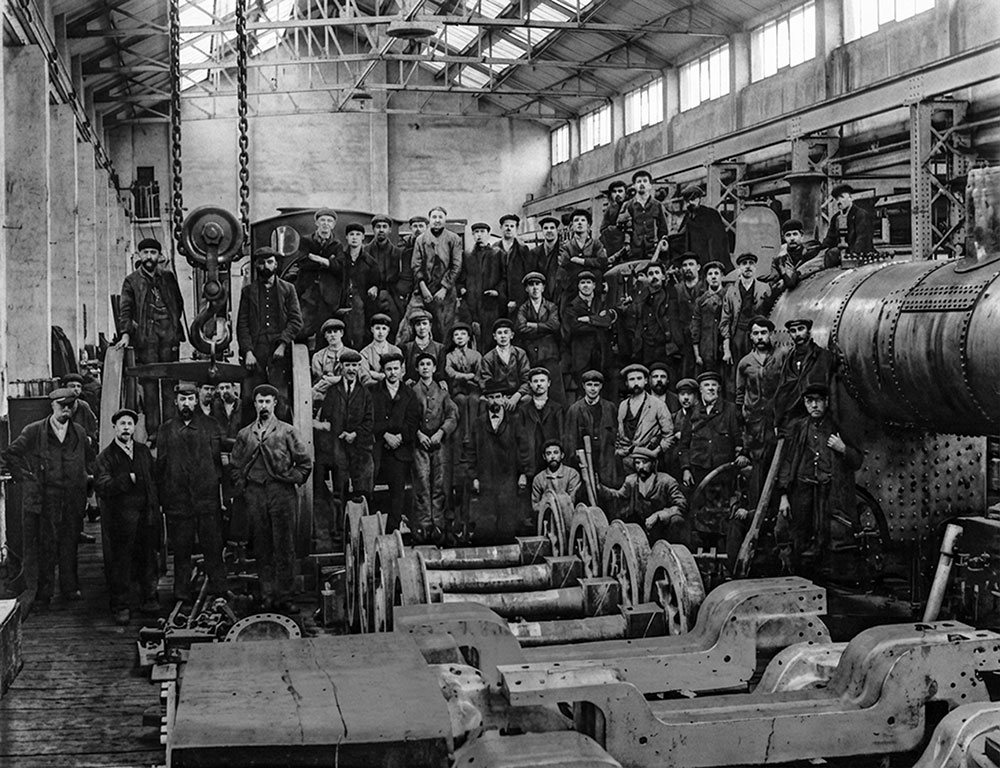
Engineering saff in front of the loco shed
Carriage, wagon and paintshop staff posing for a group photograph in front of the shed

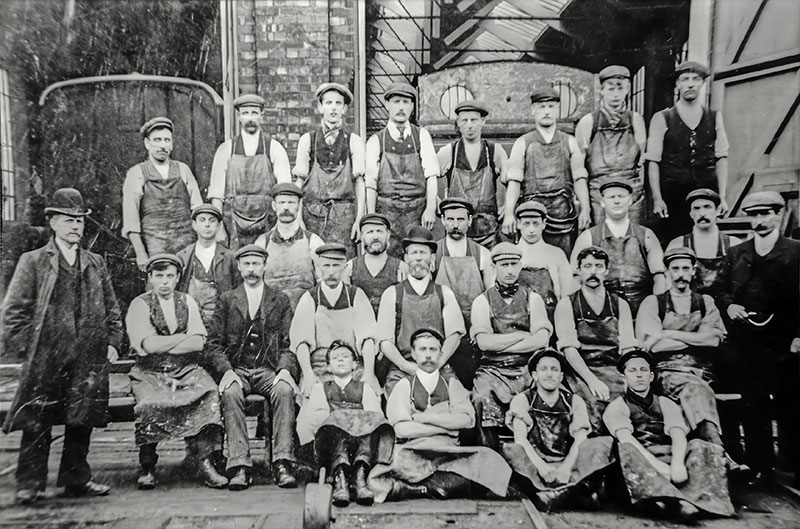
Boiler Shop Staff in 1920 - L. C. Porter

A. E. Waters                     Foreman
A. Monks                         Assistant Foreman
W. Slocombe                  Boiler Maker
G. Butters                        Boiler Smith
L. Massingham               Boiler Smith
A. Ives                              Boiler Smith
G. Clarke                         Tuber
B. Raynor                        Tuber
W. Miller                         Tuber
F. Butters                         Plater
R. Simmonds                  Plater
G. Twiddy                        Rivetter
J.L.eader                         Rivetter
G. Morgan                       Holder-Up
S. Wilmot                        Holder-Up
S. Earl                             Holder-Up
S. Eke                             Brazer
S. Bass                           Store-Keeper

M&GN Circle

The Develpoment of Melton Works
Ronald Clark confirms the Works first operated early in 1883. The first railway buildings were, apart from the station, the Running Shed, (40' x 120' for 12 locomotives), coaling plant and large turntable. A. J. Wrottesley records that Mr. J. W. Mann from the North Eastern was appointed Locomotive Superintendent of the L&F in 1880 and built the Locomotive Shops and housing for the men, the original shops at Fakenham becoming sheds for the Goods Department.
Mr. Marriott recorded in his reminiscences 'Forty Years of a Norfolk Railway' that he went to live at Melton in 1885 and he relates how he set out to improve facilities there, to attract more men to the village - more houses were built and :-
"the directors kindly gave us the old Holt station for a reading and small billiard room" - interesting, as this was in the 1890's were there in fact 3 different station buildings at Holt through the years? - the original terminus, the one which was destroyed by fire in the 1920's, and its replacement? Does this building still exist at Melton?

Reminiscences of the Works

PAY DAY!
In the eyes of many, the most important event at the Works!
Harry Lewis writes :-
"Passing through Melton the other week, naturally brought back memories of the old days and I pictured the branch of Barclay's Bank opposite Colville Road. This was situated in the front room of a private house. There was a brown blind halfway across the window with "Barclays Bank" on it. I believe they only opened on Fridays and that mainly to issue the cash for the railway wages. However, I'm not really sure about that, memories can play tricks!
My thoughts automatically turned to my father, who was loaned with another clerk from the Goods Office to deal with the wages. They would walk down the hill to the Bank accompanied by the railway policeman and another man pushing a sack- barrow to which a Gladstone bag was padlocked. After collecting the money they would proceed up the street to the Works. This was the ritual week in and week out, without incident. Can you imagine that happening today? Just another example of how times have changed.
When the wages were packeted up they were placed in trays in numerical order and of course issued in the same way. I well recall how we would race down to the Time Office on Fridays, after clocking out, to make sure of getting in the queue in the right order, we then had to call out our clock number at the window and was handed our wage packet. If you missed your turn, then your packet would be put on one side until everyone else had been paid, which could be quite a wait, hence the rush on pay nights to join the queue.
I often think of my old work mates and wonder where they are and what they are doing, some of course you forget and no doubt they have forgotten me, though since joining the M&GN Circle I have met people that I haven't seen for over forty years.
Excerpt from M&GN Circle Newsletter


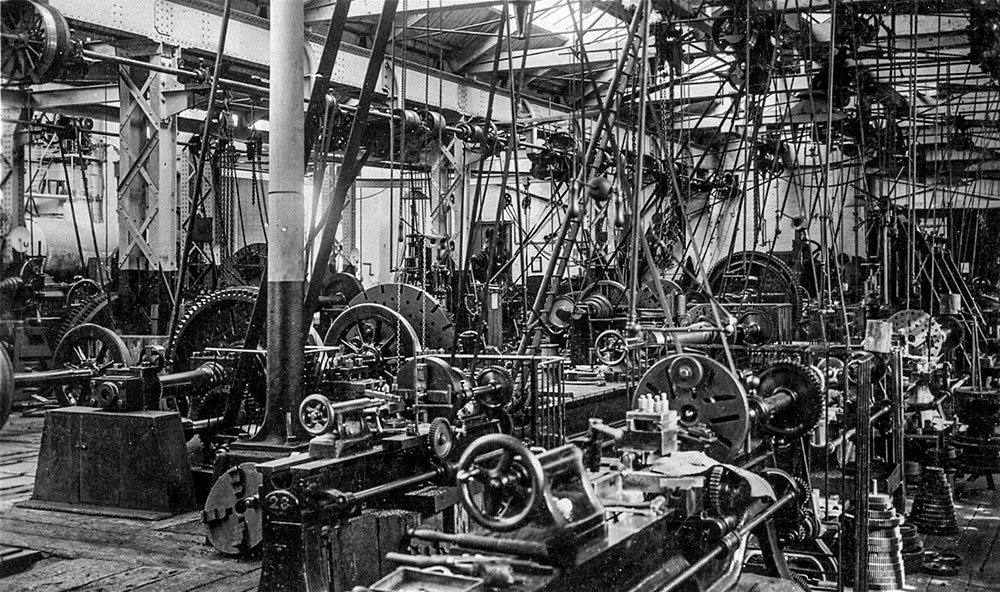
Machine shop 1909
M&GN machine shop - 1909

M&GN Machine Shop
M&GN machine shop

c.1885
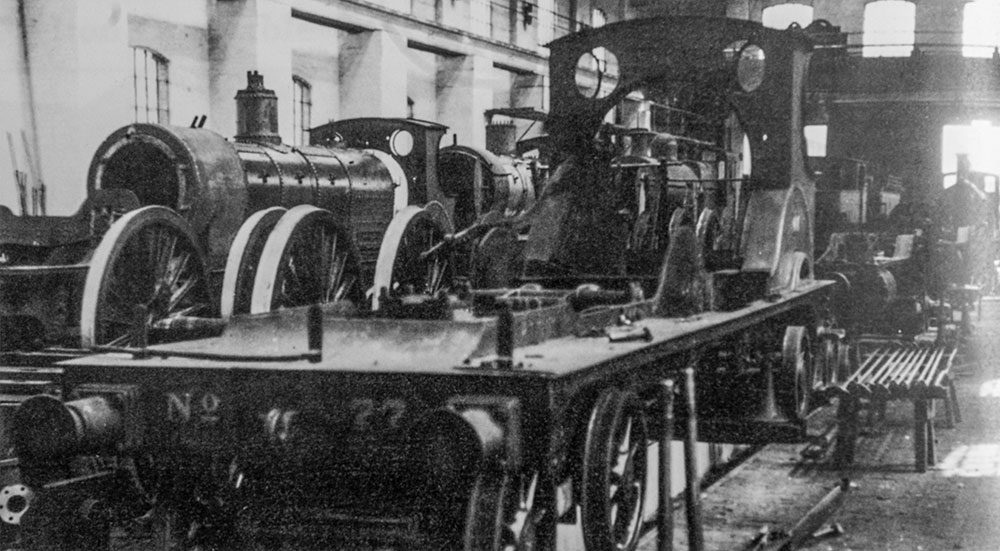
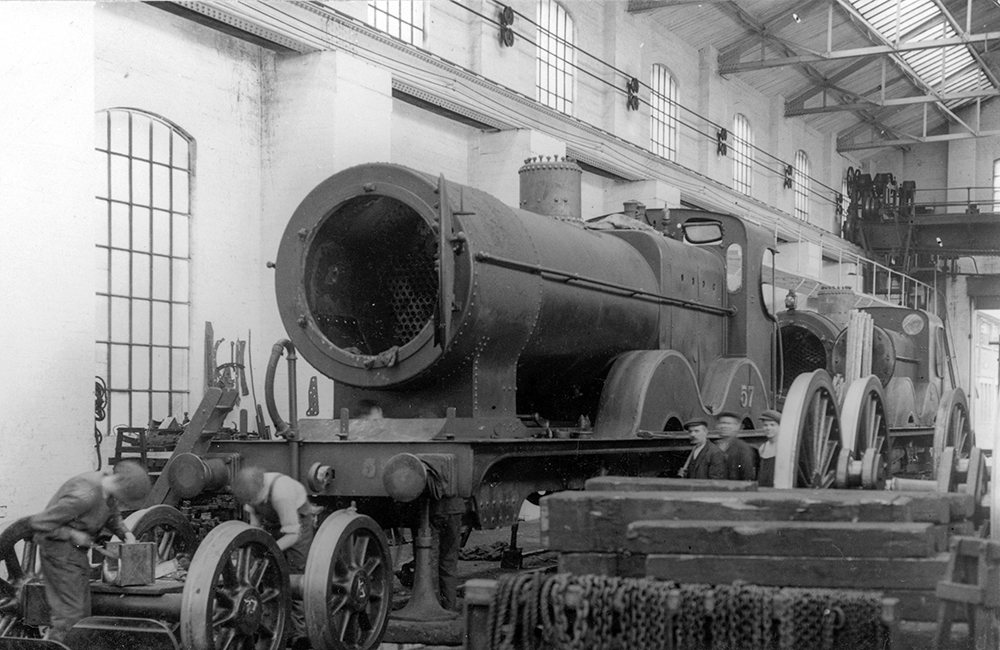
Outside cylinder Beyer Peacock locos in the M&GN Erecting Shop - c.1885

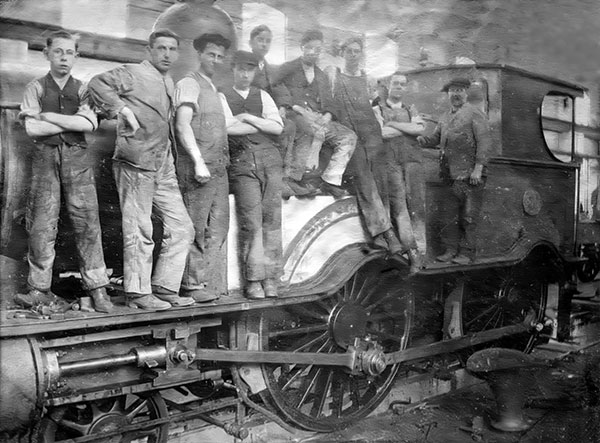
Engineering staff
Enginering staff
Engineering staff Engineering staff
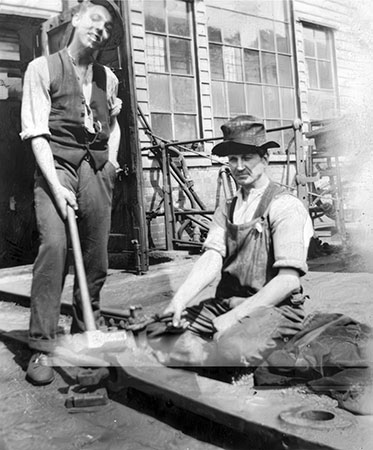
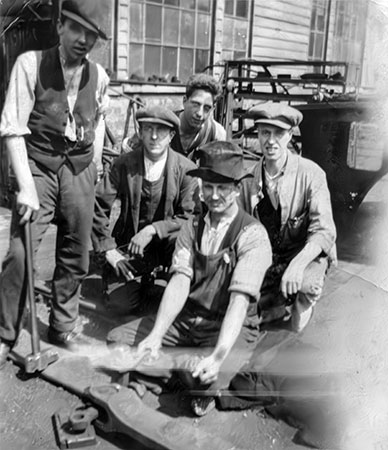
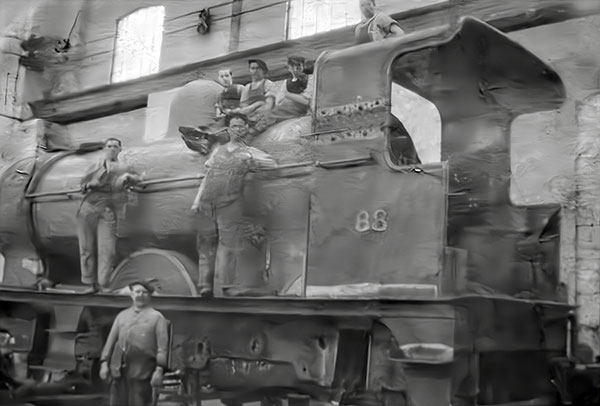
Early photos of Engineering Works staff

Erecting Shop staff 1902
Erecting Shop staff - 1902

Nineteen locomotives were built at Melton Constable; nine were J93 0-6-0Ts, three were 4-4-2Ts. Some were William_Marriott's design. The biggest work was locomotive repair. Overhauls, reboilering and modifications were carried out in the erecting shop on site, components being made at the iron works and machine shops. None of the locomotives built there survive into preservation although an M&GN C class (Belpaire firebox) boiler survives.
Wikipedia


M&GN no.41
M&GN 4-4-2T no. 41

Three M&GN Class A (C17) Atlantic tank engines were built at the Works - No. 41 was built in 1904 and withdrawn in January 1944, No. 20 was built in 1909 and withdrawn in April 1942, No. 9 was built in 1910 and withdrawn in July 1944. These new builds were officially described as rebuilds of older locomotives to avoid declaring them as new builds, although they were essentially new engines.   


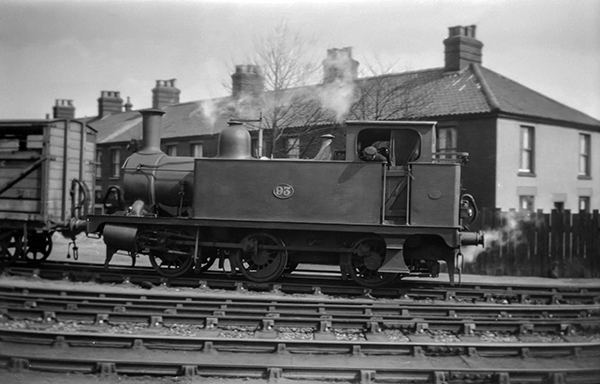
J93 0-6-0 no. 93
J93 0-6-0T no. 99
M&GN J93 0-6-0T no. 93 with a wooden door at work outside Astley Terrace
J93 0-6-0T at work beside the platform's Marriott concrete sign - 28th May 1937

Nine J93 0-6-0T shunting engines were built in the Works between 1897-1905. Their numbers were - 93, 94, 95, 96, 97, 98, 99, 100 and 101.


Most of the J93s were built carrying the 'Rebuilt Melton Constable' plates, and six of the class (Nos. 93-8) were reputed to have been rebuilt from locomotives that had started out on the Cornwall Minerals Railway (CMR). These were built by Sharp, Stewart & Co. in 1874, and acquired by the Lynn & Fakenham Railway in 1880-1. These were then inherited by the Eastern & Midlands Railway - predecessor of the M&GN. The stock register describes the J93s as new locomotives, and Mr G.B. Clarke (draughtsman to Marriott) is on record as emphatically stating that the J93s were new locomotives. Therefore, J93s Nos. 93-8 should really be considered replacements for the ex-CMR engines.
The J93s were used for shunting and station pilot work at South Lynn, Melton Constable, Norwich City, and Yarmouth Beach. The South Lynn locomotives were also used for trip works to King's Lynn station and harbour. Early in their lives, they also operated some passenger trains between South Lynn and King's Lynn.
The 1937 allocation was: South Lynn (4), Melton Constable (3), and Yarmouth Beach (2). The Melton Constable figure includes the Norwich sub-shed. During LNER ownership, No. 098 was the only J93 to be allocated off the M&GN network, when it was allocated to nearby King's Lynn between September 1939 and June 1940.
Withdrawals started in 1943. Three survived to enter British Railway ownership (1948). They were withdrawn by the end of 1949, still in their wartime 'NE' lettering.
LNER


Loco fitting shop 1909
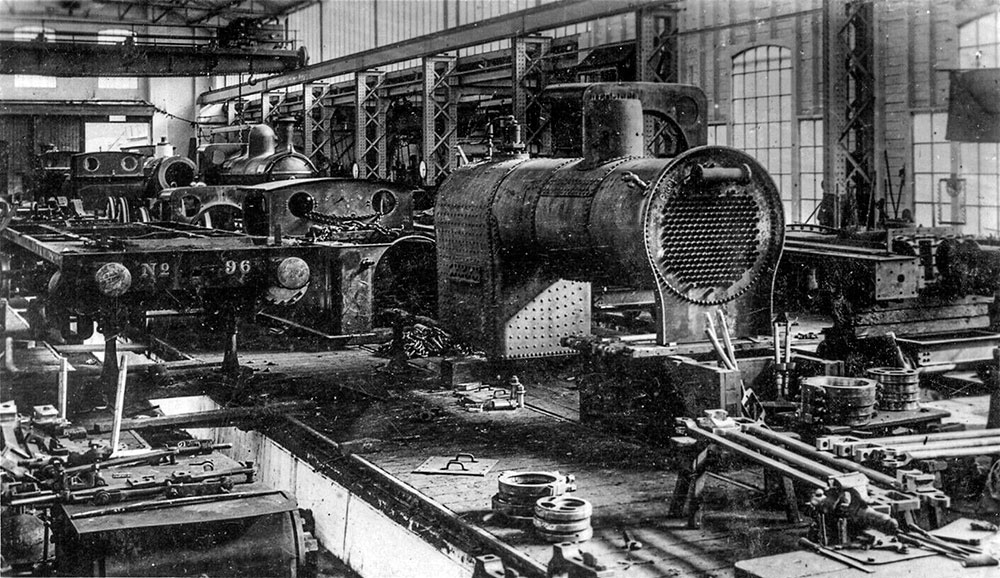
M&GN locomotive fitting shop with 0-6-0T no. 96 under repair in the left foreground and Class A 4-4-2T no. 41 under construction - 1904

1904
M&GN locomotive fitting shop with Class A 4-4-2T no. 41 under construction - 1904

Lagging an Engine Boiler

I have previously mentioned that it was the duty of the youngest boy in the carriage shed to go and assist the loco carpenter when he had an engine boiler to lag; this job usually took one and a half days. The materials required were six wooden bands and numerous lengths of three inch by three eighths of an inch tongued and grooved boards. By virtue of the boiler barrel consisting of three panels and each panel being about half an inch thicker than the previous pair, these timber bands were of elm and were two and a half inches by two inches, two by two and one and a half by two (I think I have got the sizes right). They were about fourteen or sixteen feet long and were cut on the bandsaw approximately every half inch to about one quarter of an inch from the edge, this allowed you to bend it to the shape of the boiler. You can imagine what a job it was to get them in place without breaking them. However, when I reported to the carpenter, Fred Tuck (Wilfred's father), we would get a trolley and off to the "white city" where the materials were stored. The old man had an uncanny knack of knowing how many lengths were required for each type of boiler, so, loaded up we push the lot right round the works to the fitting shop.
We always started at the smokebox end, the two biggest bands in the first panel, imagine getting them round the boiler without a mishap; we would pull them round as tight as possible and Fred would decide on where to cut off for length, then a metal band with a long three eighths of an inch bolt for adjustment was put round it and the bolt tightened up which pulled the timber band tight to the boiler, then a strip of zinc was nailed on to make the joint. This procedure was carried out till all six bands were in place. Fred now cuts the boards in lengths to suit each panel and the boy nails them on. Starting at the bottom you fix six boards then leave three unnailed, repeating this to the top, the reason for this was when you had finished two fitter's apprentices came along, took out the loose boards and filled the aperture with asbestos before nailing the boards on, then when the metal lagging is put on the boiler has the appearance of being the same diameter all along.
In later years I saw an engine stripped out in Kings Cross shed and all this was replaced with asbestos palliasses under the metal lagging, what a saving in time and material! For this job we got some "divi", for six boilers my share was four shillings (20p), at that time we thought it was great. ON several occasions when we were doing this job the boilersmiths would be rivetting the smokebox on. I can assure you that wasn't very pleasant as the flakes off the rivets kept dropping on the back of your neck or on your hands."
Frank Morgan
M&GN Circle


Class A Beyer Peacock under repair

Erecting Shop
Ongoing overhauls

Melton Works Smiths' Shop
The Works Smiths' Shop with a large steam hammer to the left

iron Foundry
The Iron Foundry along with its sidings and temporary buildings

Wheel Store
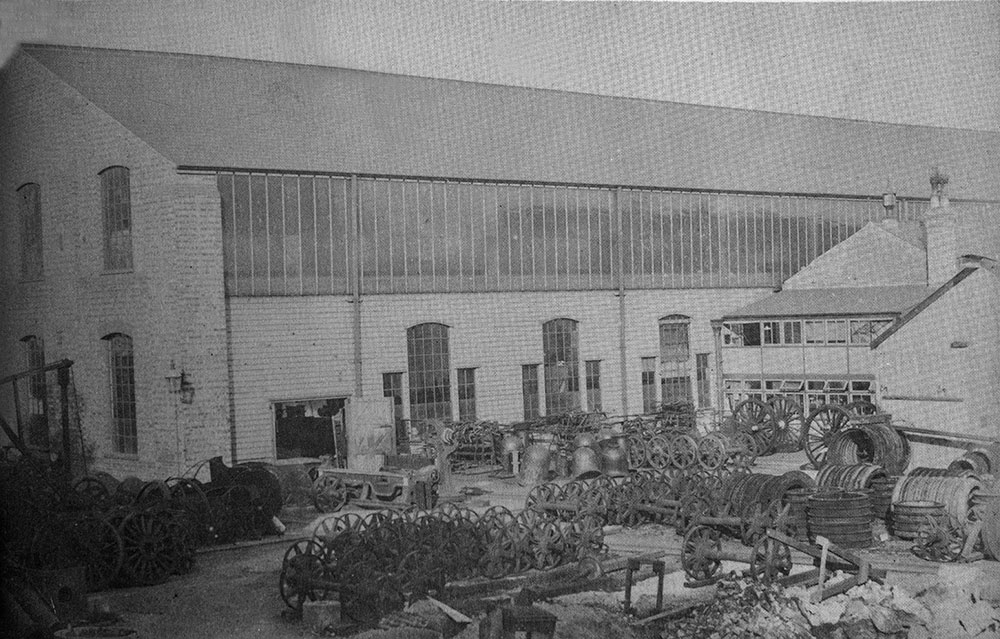
The outside Wheel Store including driving wheels for Hudswell Clarke tank engines and Beyer Peacock locos.

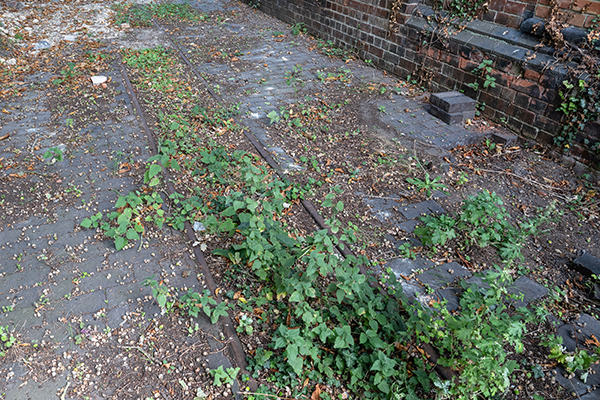
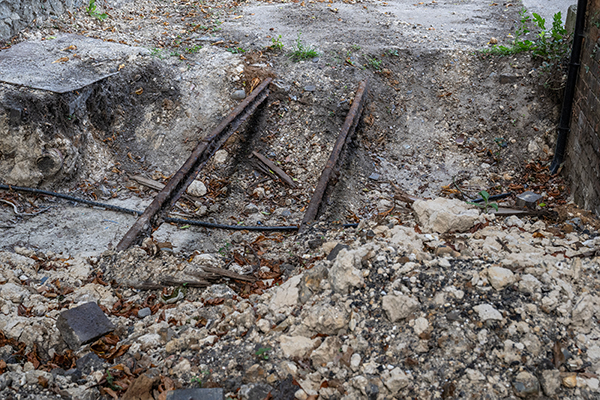
Narrow gauge track 24th August 2025
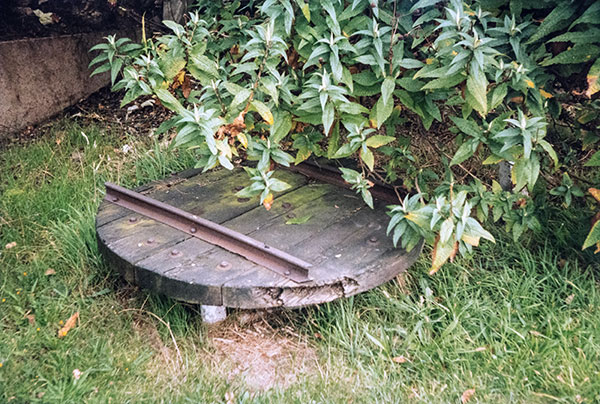
Narrow gauge track remains at the back of the erecting shop - 24th August 2025

A narrow gauge track was built to ferry materials around the site and it appears that the trucks were human propelled. Two of the trucks on the line can be seen in a photo on the Carriage & Wagon Works page.


Narrow gauge turntable
Courtesy of M&GN Circle

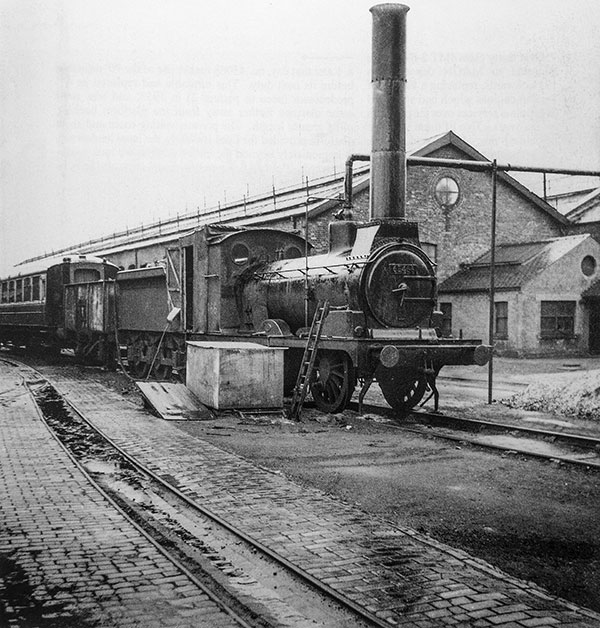
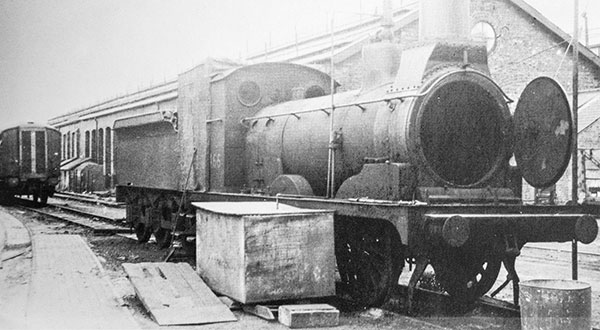
J15 65466 stationary boiler J15 65466 stationary boiler
Ex J15 0-6-0 no. 65466 in use as a stationary boiler - 21st February 1959
The narrow gauge track is in the foreground, with the former paint shop behind.
Ex J15 0-6-0 no. 65466 in use as a stationary boiler - May 1959

M&GN Erecting Shop
M&GN erecting shop - c.1925

Harry Lubbock c.1925

The Mechanical Engineering department at Melton was put on short time (four days a week) from 21st May as the Shops were unable to obtain the necessary supplies of steel. In order to make good the arrears on repairs to the locomotive fleet. The department returned to full time from 1st January 1927. The Civil Engineering Shops were also put on short time from 12th June 1926 to 1st January 1927.
M&GN Circle


1Jul1936
M&GN erecting shop - 1st July 1936

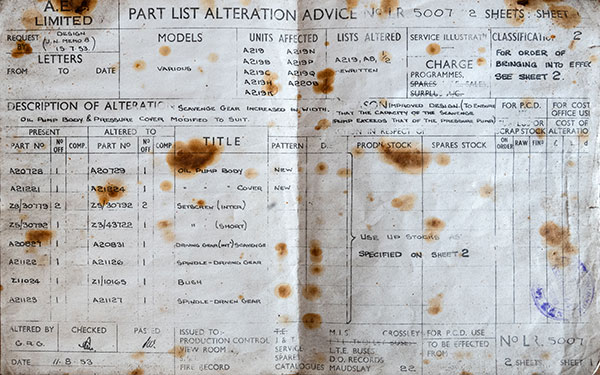
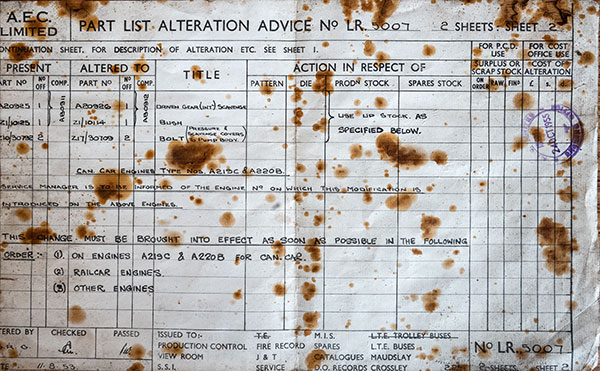
Part List Alteration Advice Note
Part List Alteration Advice Notes 1 & 2 - 11th August 1953

LNER takeover 1936 LNER takeover 1936

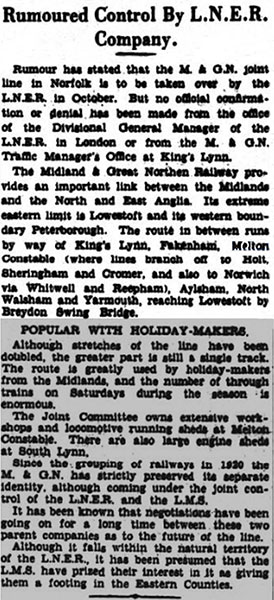
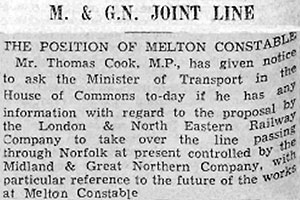
LNER Control Rumour 584 LNER takeover info request 15Jul1936 M&GN Closure 9th October 1936
Yarmouth Independant - 27th June 1936
EDP - 15th July 1936
Lynn Advertiser - 9th October 1936

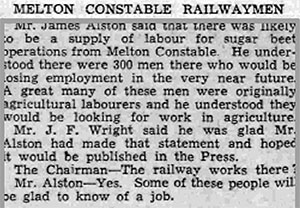
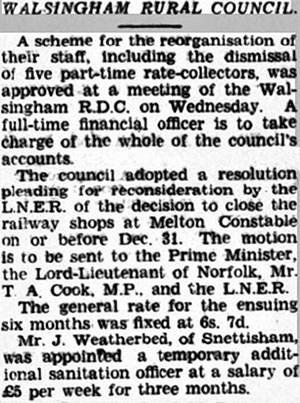
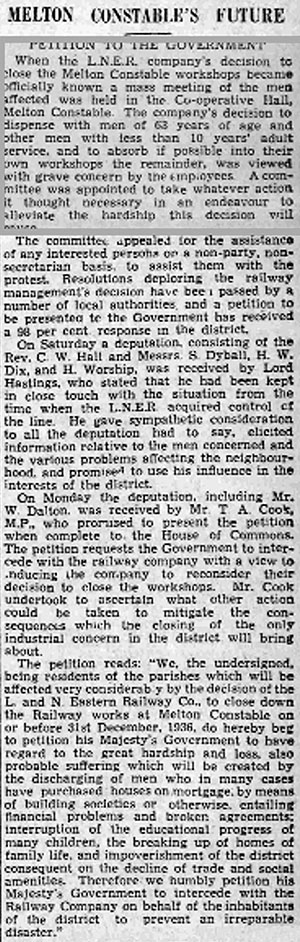
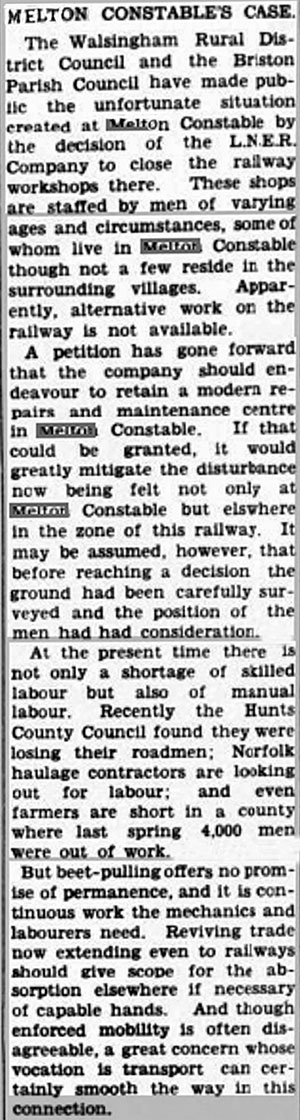
586 M&GN Agricultural Labourers notice 19Oct1936 587 Walsingham Council resolution 19th October 1936 M&GN Petition 30th October 1936
EDP - 19th October 1936
Lynn Advertiser - 23rd October 1936
EDP - 30th October 1936


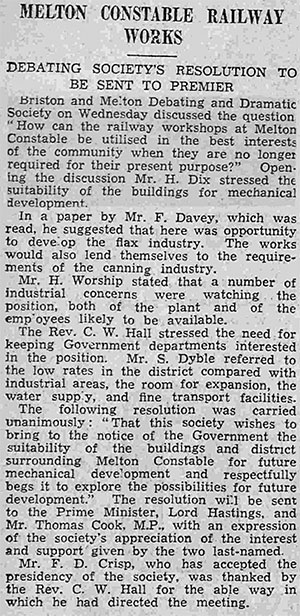
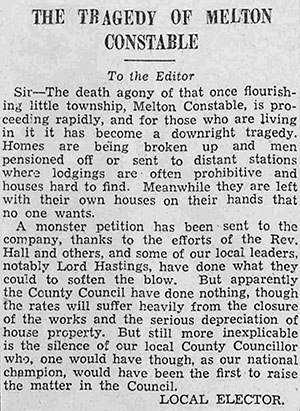
Melton Constable Case 30th October 1936 Melton Resolution 6th November 1936 Melton Tragedy 20Nov1936
Lynn Advertiser - 30th October 1936
EDP - 6th November 1936
EDP - 20th November 1936

The Works at Melton were closed in December 1936, a sad blow to the whole district. Henceforth only small repairs were undertaken. The buildings were used for a time around 1939 for storage of War Department materials and from 1942, a wagon sheet factory; later a wagon and carriage repair works, were established but the village suffered a decline in its fortunes from which it has never fully recovered.
Nigel Digby


1881: Building started by Lynn and Fakenham Railway and continued by Eastern & Midlands Railway

1881: Locomotive & Carriage Works founded

10th May 1881: First track laid

1st January 1882: Railway Station opened

1882:
Running shed, 40 ft. x 120 ft. for 12 locomotives, coaling plant, large turntable erected and 28 dwellings built for railway officers and men

1883: Works brought into operation by E&MR when local locomotive shops at Yarmouth and Fakenham closed and heavy repairs transferred to Melton Constable

1883: William Marriott appointed Civil Engineer for the Eastern & Midlands Railway

1884: J. W. Mann resigned as Locomotive Superintendant

1884: William Marriott appointed as Locomotive Superintendant

1886: Further dwellings completed

 1888: New bore hole sunk

1889:
Tenders invited for installing an extra single lift gas holder and 2 purifiers. R Dempster & Sons Ltd won the contract

1893: Midland & Great Northern Joint Railway formed

1894: Land leased for grocer’s shop and a batch of 19 dwellings completed

1895: New signalling and telegraph buildings erected along southern boundary

1896: Institute erected. Further 24 dwellings including 2 shops and house for a doctor

November 1897: New boiler shop commenced working

1898: Large water tank (100,000 gallons) installed to supply the works and the village

1899: New gas holder added

1899: Erecting shop renewed

1901: Tower scrubber called up

1902: Paint shop extended

1910: Railway Institute extended

1912: Carriage & wagon shop extended

1924: William Marriott retired

May 1926: M&GN staff on strike in support of the miners

1st October 1936: Administration of the M&GN taken over by the LNER

December 1936: Engineering Works closed


If you have any memories, anecdotes or photos please let us know and we may be able to use them to update the site. By all means email or telephone 07836 675369.


Copyright © Jonathan Neville 2025
Top of Page